Here at the frontier, the leaves fall like rain. Although my neighbors are all barbarians, and you, you are a thousand miles away, there are still two cups at my table.


Ten thousand flowers in spring, the moon in autumn, a cool breeze in summer, snow in winter. If your mind isn't clouded by unnecessary things, this is the best season of your life.

~ Wu-men ~


Monday, March 20, 2006

Japanese Language Study


I've been learning kanji, Chinese characters, lately. I can recognize the meaning of about 100 of them, even if I can't always remember how they are pronounced. To put 100 kanji in perspective, a Japanese high school student will know just under 2000. However, the proverbial journey of 1000 miles ...

Since the kanji I've learned are very basic ones, they turn up all of the time. Also, since this is something I've been working on recently, I tend to notice kanji when I run across them more now than I ever did before. Do I know a given kanji, do I recognize any of the elements, and so on.

Right now I'm reading a book entitled Hiding the World in the World. It's a collection of essays about the Zhuang Zi. Throughout the book, the authors have included some chinese characters when they are making specific points.

The character for 'zi' (master, sage, something like that) stood out when I came across it. It was a character I knew. I looked up the Chinese for Laozi, Sunzi, Mozi, and many others. The 'zi' character was a constant.

The meaning I learned for it was ... child. Can it be a coincidence that the character for child and for master are one and the same?

Saturday, March 18, 2006

Top Ten Beasts and Dragons: How Reality Made Myth


The following is the lead page of an article at www.livescience.com about how real animals served as the prototypes for the legends of dragons. If you click on the title of this post, you'll be directed there.


Top 10 Beasts and Dragons: How Reality Made Myth
by Ker Than

Dragons are awe-inspiring patchwork creatures found in the myths and legends of cultures all around the world. In Europe, they are nightmarish fire-spewing reptiles, large and lizard-like, with the forked tongue of a snake and wings like a bat. In the legends, they are reviled and feared because they liked to imprison maidens, destroy villages and hoard over mountains of gold.

In the ancient cultures of Mexico and South America, a divine feathered serpent known by various names was believed to renew the world after each cycle of destruction.

In China, dragons are amphibious creatures that dwell in oceans, lakes, rivers and even raindrops. They are revered as life-giving symbols of fortune and fertility, capable of unleashing rain in times of drought. They are animal mosaics, possessing the body of a snake, the scales of a fish, the talons of an eagle, the antlers of a stag, and the face of a gilin—another mythical creature that resembles a deer but whose body is wreathed in flames.

Despite their differences, many of the mythical dragons found throughout the world all began as vague serpentine ideas modeled after real creatures, beginning with a snake or some other fearsome reptile. Over time, they acquired more definite and exotic shapes as they absorbed the hopes and superstitions of the local people and borrowed the traits of local animals.

Our short list of creatures and natural phenomenon reveal what may have inspired the look of dragons as well as creatures that are truly dragon-like.

-- Ker Than

Friday, March 17, 2006

The Fox Borrows the Tiger's Terror


What follows is the story behind a Chinese idiom. If you click on the title of this story, you'll be directed to a whole page of links to stories.

About this one; perhaps it is another application of 'borrow a sword to kill another'?

The Fox Borrows the Tiger's Terror

In the Warring States period, the Chu State had a very capable minister called Zhao Xixu. He was well respected and held in awe by the people of other countries as well as his own. One day, the king asked his ministers "I hear every state in the north is afraid of our minister Zhao Xixu, is that so?" At the question, almost all the ministers kept silent except one called Jiangyi, who liked to curry the king's favor very much. He lost no time to seize the opportunity and said, "Your Majesty, you know, it's you who people awe and respect, not him! Have you ever heard the story The Fox Borrows the Tiger's Terror?" Well, here is the story.

One day a tiger was hunting around in a forest. An unlucky fox was met and caught by the tiger. For the fox, the inescapable fate was very clear -- death. Despite the danger, the fox thought hard to find a way out. Promptly, the fox declared to the tiger, "How dare you kill me!" On hearing the words the tiger was surprised and asked for the reason" The fox raised his voice a bit higher and declared arrogantly: "To tell you the truth, it's I who was accredited by God to the forest as the king of all the animals! If you kill me, that will be against the God's will, you know?" Seeing that the tiger became suspicions, the fox added: "Let's have a test. Let's go through the forest. Follow me and you will see HOW THE ANIMALS ARE FRIGHTENED OF ME." The tiger agreed. So the fox walked ahead of the tiger proudly through the forest. As you can imagine, the animals, seeing the tiger behind, were all terribly frightened and ran away. Then the fox said proudly: "There is no doubt that what I said is true, isn't it?" The tiger had nothing to say but to acknowledge the result. So the tiger nodded and said: "You are right. You are the king."

When Minister Jiangyi finished the story above, he added to the king: "It seems as if the northern neighbors were afraid of Minister Zhao xixu. In fact, they are afraid of Your Majesty just as the animals were afraid of the tiger not of the fox." The king was very pleased at Minister Jiangyi's words. And never doubted its truth.

The idiom is often used to analogize with those who take advantage of one's or somebody else's power to bully people.

Sunday, March 12, 2006

What is Zen?


Click on the title of this post to be directed to "A Touch of Zen" website, from which the excerpt came...

Let us start with the question: “who is the founder of Zen?”

Bodhidharma came to China in the 6th century and it was he that was generally credited as the founder of Zen. Some say that this was not the case. They say that Huineng was the real founder of Zen in the 8th century. Huineng’s enunciation that prajna and jhana should go together and that one should not practice jhana first until proficient was a startling reversal to the previous Patriarchs. One cannot have jhana without prajna and vice versa. Prajna is intuitive wisdom, which is equivalent to enlightenment.

The Noble Eightfold Path is composed of three disciplines: 1) moral precepts, 2) meditation (jhana), and 3) prajna (transcendental wisdom). So with Huineng’s teachimg, prajna (enlightenment) is synonymous with jhana (meditation). This is Zen Buddhism. Whereas before Huineng, meditation comes first, and when meditation succeeds wisdom and enlightenment arise. But prajna cannot be attained with discursive knowledge. It is intuitive knowledge. In other words, while we are thinking, talking and feeling, Zen and prajna are present at the same time. Zen and prajna are not two different items: they are one and the same thing. When one sees a flower, the flower must see one as well. This is then the real seeing. Also knowing alone is not enough. Seeing must come with knowing: seeing is direct experience and knowing is philosophical, knowing about. So in Zen context, the seeing and knowing must move up to a higher plane, and this intuitive seeing becomes prajna, which is jhana. When Zen talks about feeling and desire it should be reminded that these feelings should not refer to the selfish relative self. It should refer to something higher, so that it becomes intuition---enlightenment. It must also be collective or total intuition, which becomes real understanding of reality i.e. enlightenment. This is what Zen tries to achieve. In practice, Zen means doing anything perfectly: making mistakes perfectly etc. In other words, there is no egoism in what we are doing. The whole activity is harmonious. The perfect pain that we suffer is universal pain. The joy is universal joy.

Zen has no dogmas, no ritual, no mythology, no church, and no holy book. In all its varied and deep experiences of life and culture, there is usually a similar taste of depth of oneness. But there is also separation. Egolessness and ego are also absorbed in this depth of voidness. Zen is interesting and has good taste. Its mountains are more mountainous. Actually nobody understands Zen. Nobody can explain it. Zen arises spontaneously out of the human heart: not a special revelation to anyone. When goodness, truth and beauty are all present, as one, there is Zen. To grasp movement in stillness, and stillness in movement, this is Zen.

Tuesday, March 07, 2006

Kung Fu, the Original Series


When I was a teenager, in the 70's, a radically different tv show came on the air. It's name was Kung Fu, and I was hooked immediately. The story is well known. Looking back, the fight scenes are hokey by todays standards, but what hooked me was the attempts at philosophy (and what the show had to offer was a mishmash from many different sources). The exchanges between young Caine and Master Po (Master Kan as well) were priceless.

Still, that show was the number one thing that got me hooked on martial arts and other asian things.

"Listen for the color of the sky. Look for the sound of the hummingbird's wings. Search the air for the perfume of ice on a hot day. If you have found these things, you will know."

-Master Po

Monday, March 06, 2006

Today felt like spring was just around the corner.


Today felt like spring was just around the corner. Perhaps it was because I hear a mourning dove for the first time since before winter.

Of green
dreams in winter,
thawed brooks purl anew.
Phantom sunflowers touch the sky
Waking.

Dao De Jing: Chapter 11


The Dao De Ching (aka Tao De Ching) is not only one of the world's classics, it's the foundation of philosophic daoism. If you click on the title of this post, you'll be directed to a complete online version.

Chapter 11: Tools

Thirty spokes meet at a nave;
Because of the hole we may use the wheel.
Clay is moulded into a vessel;
Because of the hollow we may use the cup.
Walls are built around a hearth;
Because of the doors we may use the house.
Thus tools come from what exists,
But use from what does not.

Thursday, March 02, 2006

Itsukushima Shinto Shrine


The Itsukushima Shinto Shrine has been designated by the UN as a World Heritage Site. It dates from the 6th century, and has been in it's present form since the 12th century.

The most recognisable feature of the shine is the seemingly floating torii (a stylized gate).

If you click on the title of this post, you'll be directed to a wikipedia article on the shrine, which contains more pictures of it.

Sizzling rain


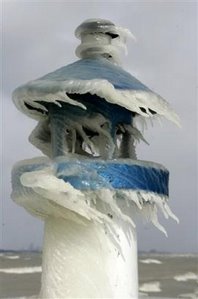
We have freezing rain today in the Detroit area. When I pulled up into the parking lot at work this morning, and got out of my car, I could hear the icy rain coming through the branches of the woods which borders the lot.

It sounded like something sizzling.