Here at the frontier, the leaves fall like rain. Although my neighbors are all barbarians, and you, you are a thousand miles away, there are still two cups at my table.


Ten thousand flowers in spring, the moon in autumn, a cool breeze in summer, snow in winter. If your mind isn't clouded by unnecessary things, this is the best season of your life.

~ Wu-men ~


Showing posts with label Dragons. Show all posts

Thursday, February 22, 2024

Thursday, January 11, 2024

Musashi the Artist


Besides being a famous swordsman, Musashi was an artist. At Ichigoji, there is an article about his famous dragon painting. An excerpt is below. The full post, with accompanying photographs, may be read here.


Another year draws to a close and the Year of the Dragon begins here in Japan (yes – it is a somewhat odd combination of the Chinese lunar New Year that begins a couple of months later, and the western New Year).


The imperial connections of the dragon in China are well-known; in Japan there was a strong connection with esoteric arts and Zen Buddhism in particular (at least in art) where they are seen as protectors of the Buddhist law. In this respect, they are still to be seen on the ceilings of many temples in Kyoto – some of them dating back to the late Muromachi  period (late 1500s). Some of these are on public display, some in areas only open to the public during the special openings in the spring and autumn, and some are rarely to be seen at all - perhaps only when peering through the wooden slats into the gloom. Some of these are very evocative, some less so, but they certainly have a power in situation that is difficult to reproduce in photographs.


The same may be said for the many dragons depicted on sliding doors and screens, some of them very powerful, others quite strange (or even both in the case of some of Kaiho Yusho’s paintings, where the dragons loom out of the darkness as presences quite different from the scaled creatures of Chinese lore. I wrote about some of the great dragon paintings (Master Dragon Painters), and strongly recommend seeing them in the flesh if possible. The reality of a painting is more than the image itself - the setting, the lighting, the size, the texture, the sense of antiquity, - all these add something to the experience that make it more than visual alone. With ink, the age of the paper, the way the ink has sunk in, faded or worn off – the patina of age, I suppose you could say – is part of the work. 


For whatever reason, I have always found the works of Miyamoto Musashi particularly powerful in the flesh (not something I’ve had the chance of doing very often, mind you), but I have not had the chance to see his dragon painting. Of course, he is better known for the more modest creatures he depicted, things he had seen with his own eyes, but at least one dragon painting survives (and there is supposed to be another, even more elusive one, too).


The dragon faces left into space, but his eyes look elsewhere. The look on his face is mild, even sheepish, recalling some of Kaiho Yusho’s dragons. (It is quite likely that Musashi had seen and perhaps made copies of Yusho’s work). What is he looking at? 


As I’ve written before, there is recognition now in art circles that the pairing of dragon and tiger had strong associations with military divination, and these connotations would have been familiar to many warriors. It is possible that this painting was one of a pair – I have seen it suggested there could have been a tiger, or as in the case of Kaiho Yusho’s works, another dragon. Perhaps the eyes are a clue. 


Saturday, April 06, 2013

... And From The Dragon, We Learn To Ride The Wind

This is a clip from the original Kung Fu TV series pilot: The Way of the Tiger, the Sign of the Dragon. This is what started me off with my interest in martial arts.

The Shaolin master who demonstrates the Dragon form is actually Grand Master Ark Yuey Wong.


Thursday, March 28, 2013

Nine Dragons

The Chinese believe nine is a lucky number and the number nine is often associated with dragons. Indeed Kowloon, an area of Hong Kong means "nine dragons." There are nine forms of the dragon and the dragon has nine offspring. Only the Emperor could wear nine dragons on his clothes. Click here to see the Nine Dragon Trident form from Choy Lay Fut kung fu.

Also, when practicing internal martial arts, one of the key characteristics is moving the body from the core. The foundation of moving from the core is the pelvis area.

Michael Buhr, the author of the Internal Gong Fu blog has written an eBook on working the pelvis to improve one's martial arts practice.  There is a huge amount of information available for a very low price. It is available for the Kindle. Please check it out.

Monday, September 03, 2012

The Mind of the Dragon


“The heart of the study of boxing is to have natural instinct resemble the dragon.”          Wang Xiang Zhai


Thursday, August 30, 2012

The Dragon of Echigo

In Chinese mythology, the Dragon and Tiger are forever in contention. So it would be appropriate that the Tiger of Kai, of whom I've posted about before would have a long time adversary known and the Dragon of Echigo.


Below is an excerpt from the Wikipedia article on Uesugi Kenshin, thd Daimyo of Echigo province and a legendary general. The full article may be read here.

Uesugi Kenshin (上杉 謙信?, February 18, 1530 – April 19, 1578) was a daimyo who ruled Echigo province in the Sengoku period of Japan.

He was one of the most powerful lords of the Sengoku period. While chiefly remembered for his prowess on the battlefield, Kenshin is also regarded as an extremely skillful administrator who fostered the growth of local industries and trade; his rule saw a marked rise in the standard of living of Echigo. Kenshin is famed for his honourable conduct, his military expertise, a long-standing rivalry with Takeda Shingen, his numerous campaigns to restore order in the Kanto region as the Kanto Kanrei, and his belief in the Buddhist god of war — Bishamonten. In fact, many of his followers and others believed him to be the Avatar of Bishamonten, and called Kenshin god of war.

Monday, December 12, 2011

Chinese Folk Tales: The Sons of the Dragon

I received this link from a friend. It's now it the "Links" Section.

It's a website of Chinese Folk Tales. Below is one of them. Enjoy.

From Taiwanese Folk Beliefs: The Sons of the Dragon.

3. Sons of the Dragon
A dragon has nine sons.
The first son loves loud noises, so bells are adorned with the images of dragons.
The second son loves music, so musical instruments are adorned with images of dragons.
The third son loves to drink, so drinking vessels are adorned with images of dragons.
The fourth son loves mountain peaks, so the tops of tall buildings or other structures or places are adorned with images of dragons.
The fifth son loves weaponry, so weapons are adorned with images of dragons.
The sixth son loves literature, so images of dragons are found on movable type.
The seventh son loves litigation, so images of dragons are found in courtrooms.
The eighth son loves sitting, so chairs are decorated with the images of dragons.
The ninth son loves heavy objects, so the images of dragons may be found on plinths.

Tuesday, September 13, 2011

The Dragon Motif

Previously, I had posted an excerpt of a review of The Propensity of Things by Francois Jullien. Below is an excerpt from the book which particularly caught my eye.

Conclusion II: The Dragon Motif

The body of the dragon concentrates energy in its sinuous curves, and coils and uncoils to move along more quickly. It is a symbol of all the potential with which form can be charged, a potential that never ceases to be actualized The dragon now lurks in watery depths, now streaks aloft to the highest heavens, and its very gait is a continuous undulation. It presents an image of energy constantly recharged through oscillation from one pole to the other.

The dragon is a constantly evolving creature with no fixed form; it can never be immobilized or penned in, never grasped. It symbolizes a dynamism never visible in concrete form and thus unfathomable. Finally, merging with the clouds and mists, the dragon's impetus makes the surrounding world vibrate: it is the very image of an energy that diffuses itself through space, intensifying its environment and enriching itself by that aura.

--


Shortly after reading The Propensity of Things, I read Lectures on the I Ching by Dr. Richard Wilhelm.

How to go about studying the I Ching has always been somewhat of a puzzle to me. From his lectures, I got some idea of the underlying structure of how the I Ching is put together and how hexagrams are evaluated.

Throwing some coins then looking up one’s fortune, like breaking open a fortune cookie it is not.

Thursday, September 01, 2011

To Ride the Wind

A couple of years ago, I posted an article about Chinese Dragons. Both the Tiger and Dragon are elemental figures, but while the Tiger is born a Tiger, the Dragon becomes one by dint of his own effort. 


Among the fearsome powers of the Dragon is the ability to ride the wind.


Below is an excerpt from an article about a modern self made Dragon, Ram Charan. I don't know if I would want to adopt his life style, but I can't help but admire him for his expertise, erudition and focus. 


The full article may be read here.

...Having uploaded himself into the global
economy, Charan circulates, continuously, with something like the speed and efficiency
of capital. Consider the itinerary he sketched at dinner one night a few months ago in New York. He had just agreed - for the first time in his career -to let a journalist travel with him and watch him work. "I should tell you where I've been the last few weeks," he began in heavily accented English. "I go to India on the Friday of the week before
Thanksgiving. I am Sunday morning in Bombay. Monday morning I am in Delhi.
Wednesday I'm in Bombay. Thursday I'm in Bangalore. Saturday I'm in Trivandrum.
Wednesday I'm in Johannesburg. Friday morning, at seven, I am in New York. I have a
two-hour meeting with a CEO who has flown in to see me. I have two more meetings and I
fly out that night to Dubai. I am in Dubai on Sunday and Monday, then I come back here.
On Thursday night I fly out to Jubail, Saudi Arabia. Then I come back here. Tuesday
morning I have a whole-day schedule in New York. Tuesday night I go to Milwaukee. I
came from Milwaukee last night. They diverted my plane so I had to stay in Pittsburgh. I
had a meeting this morning in Philadelphia. I had three meetings here in the afternoon.
And I'm here tomorrow, with GE. Then an hour-and-a-half phone call. Then I'm going out
tomorrow night to West Palm Beach. Monday morning I have a breakfast meeting in New
York. And then I'm flying out to Perth, Australia." At least he flies first-class.


Have I mentioned that Charan has never married? That he has no children? And still I
haven't come to possibly the most peculiar aspect of his personality. I mean that which
sets him apart from virtually every person he comes in contact with, none more so than
his overachieving CEO clients: Charan has no goals. He never set out to become a
globetrotting consultant, any more than he dreamed of attending Harvard Business
School, or becoming a professor, or even so much as one day earning a living beyond the
small city in India where he was born.

Charan's weird and wonderful life is an unintended byproduct of dedication, he insists.
Dedication to learning and teaching and service, to the whole set of Hindu virtues
embodied by one of Charan's favorite phrases, "Purpose before self." "People used to
ask me, What is your ambition?" says Charan, who turned 67 this past Christmas. "I say
I have none. My dedication is going to take me where I'm going to be."

Tuesday, May 10, 2011

Dragon Whips Tail

Dragon Whips Tail: the Continued Destruction in the Aftermath of the Golden Dragon Massacre.


If you follow the link above, you'll find a post about the famous Golden Dragon Massacre which occurred in San Francisco in 1977. That's a long time ago, but the story isn't over. A friend sent me an article about the aftermath which continues to this day. An excerpt is below. The whole article may be read here.

SAN FRANCISCO / Workers want pay from Dragon / Back wages claimed as restaurant reopens under new name

May 11, 2006|By Vanessa Hua, Chronicle Staff Writer
 The Golden Dragon may have roared its last, but the death of this notorious Chinatown restaurant -- the scene of a gang massacre in 1977 -- has left behind trail of lawsuits, and workers are complaining it stiffed them out of a year's worth of unpaid wages. 
Former Golden Dragon employees held a press conference Wednesday demanding that San Francisco's Office of Labor order the restaurant's owners to pay the workers $1.5 million in penalties on top of the $195,897 in wages and the city another $1.5 million in fines.

The workers already recouped $150,000 in March 2005 from the owners, said Alex Tom, a coordinator for the Chinese Progressive Association, a Chinatown advocacy group. Now, the owners "are trying to change the name" to avoid paying the rest, he said.

"They are trying to find ways not to have to pay people back," Tom said. "And the workers want to hold the employers accountable."

The employees kept working, he said, because the financially shaky restaurant kept promising to pay them.

Even before the wage claim reignited this week, the restaurant and its owners had returned to the spotlight.
Co-owner Jack Lee is a longtime elder in the Hop Sing tong, an influential brotherhood that owns the restaurant's Washington Street building, and he was seen dining with the brotherhood's former president, Allen Leung, just before Leung was shot to death in February.

Lee, a Chinatown leader, and Big Hong Ng, a former Chinese opera star, former lovers and co-owners of the Golden Dragon, opened the restaurant together in 1964 and lived together for 30 years, court filings allege, even though Lee was married to a woman in Los Angeles and maintained a relationship with a third woman in Hong Kong.

As a community leader, Lee marketed the restaurant and helped bring in a steady stream of customers. But the business began to falter after he moved out of the home he shared with Ng in 1998, court filings allege.
In December, he sued her to recoup a roughly $450,000 loan his company made to the restaurant business. Ng countersued, alleging Lee embezzled and took "money directly out of the cash registers."

And in January, the city shut down the Golden Dragon for health code violations. On Friday, Winnie Ng -- sister of the Golden Dragon co-owner Big Hong Ng -- will re-open the renovated restaurant as the Imperial Palace.

Wednesday, June 03, 2009

Who Needs Fiction: Komodo Dragon Attacks Escalate


This is an excerpt from an AP story. The full store can be read here.

Komodo dragon attacks terrorize Indonesia villages


KOMODO ISLAND, Indonesia – Komodo dragons have shark-like teeth and poisonous venom that can kill a person within hours of a bite. Yet villagers who have lived for generations alongside the world's largest lizard were not afraid — until the dragons started to attack.

The stories spread quickly across this smattering of tropical islands in southeastern Indonesia, the only place the endangered reptiles can still be found in the wild: Two people were killed since 2007 — a young boy and a fisherman — and others were badly wounded after being charged unprovoked.

Komodo dragon attacks are still rare, experts note. But fear is swirling through the fishing villages, along with questions on how best to live with the dragons in the future.

Main, a 46-year-old park ranger, was doing paperwork when a dragon slithered up the stairs of his wooden hut in Komodo National Park and went for his ankles dangling beneath the desk. When the ranger tried to pry open the beast's powerful jaws, it locked its teeth into his hand.

"I thought I wouldn't survive... I've spent half my life working with Komodos and have never seen anything like it," said Main, pointing to his jagged gashes, sewn up with 55 stitches and still swollen three months later. "Luckily, my friends heard my screams and got me to hospital in time."

Komodos, which are popular at zoos in the United States to Europe, grow to be 10 feet (3 meters) long and 150 pounds (70 kilograms). All of the estimated 2,500 left in the wild can be found within the 700-square-mile (1,810-square-kilometer) Komodo National Park, mostly on its two largest islands, Komodo and Rinca. The lizards on neighboring Padar were wiped out in the 1980s when hunters killed their main prey, deer.

Friday, February 15, 2008

Dragons


If you click on the title of this post, you'll be directed to a page on Chinese Dragons. Below are some excerpts.

Chinese Dragons

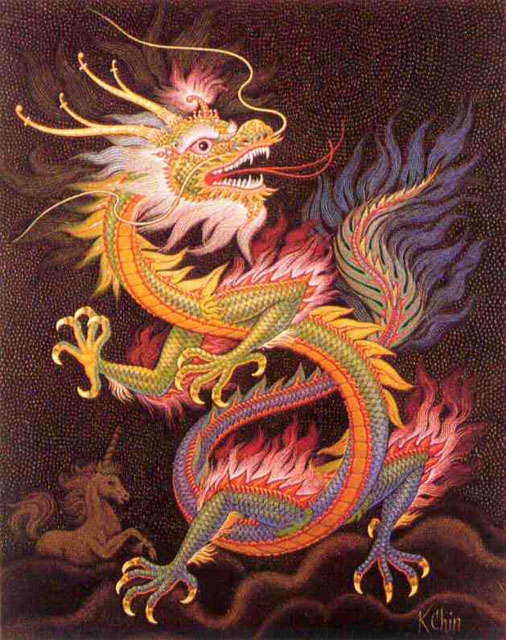
The Chinese dragon is a symbol of wisdom, power, and luck in Chinese culture. Unlike Western dragons, oriental dragons are usually seen as benevolent and kind. Dragons have long been a symbol in Chinese folklore and art. Temples and shrines have been built to honor them.

Through the symbol of the dragon, many Chinese see divine attributes which they aspire to themselves. In fact, the Chinese are sometimes referred to as "descendents of the dragon." The dragon is held in reverence and respect in Chinese culture. It is unseemly to defile a depiction of a dragon. Dragons are referenced by several Chinese proverbs.

Chinese dragons control the rain, rivers, lakes, and sea. They can ward off wandering evil spirits, protect the innocent, and bestow safety unto all. They are called lung or long in the Chinese language.

They fly in the sky among clouds. Most pictures of Chinese dragons show them playing with a flaming pearl. Legend has it that the pearl gives them their power and allows them to ascend into heaven.

The Legend of the Carp says that a carp able to leap over the mythical Dragon Gate will become a dragon. Many have sought out the true location of this Gate, but none have found it. Several waterfalls and cataracts in China are believed to be the location of the Dragon Gate. This legend is an allegory for the drive and effort needed to overcome obstacles.

Chinese dragons have serpentine bodies, four legs, and are usually without wings. They are said to be a composite of various other animals-the body of a snake, the antlers of a deer, the talons of an eagle, the soles of a tiger, the scales of a carp, and the eyes of a demon. It is said that Chinese dragons have 117 scales.

They are usually depicted with four toes. In the traditional symbol of the emperor, the dragon is depicted with five. In Japan, dragons are depicted with three toes.

There are nine types of classical Chinese dragons. They are as follows:

  1. Tianlong, the Celestial Dragons, are the celestial dragons who pull the chariots of the gods and guard their palaces.
  2. Shenlong, the Spiritual Dragons, control the wind and the rain.
  3. Fucanglong, the Dragons of Hidden Treasures, are underworld dragons which guard buried treasures, both natural and man-made. Volcanoes are said to be created when they burst out of the ground to report to heaven.
  4. Dilong, the Underground Dragons, are earth dragons whose task it is to preside over rivers and streams. According to some accounts, they are the female counterpart of the Shenlong and they fly only in order to mate.
  5. Yinglong, the Winged Dragons, are the oldest of all eastern dragons and the only kind with wings.
  6. Qiulong, the Horned Dragons, are considered to be the mightiest dragons.
  7. Panlong, the Coiling Dragons, are water dragons believed to mostly inhabit the lakes of the Orient.
  8. Huanglong, the Yellow Dragons, once emerged from the River Luo and presented the legendary Emperor Fu Hsi with the elements of writing. They are known for their scholarly knowledge.
  9. Lóng Wáng, the Dragon Kings, are rulers over each of the four seas, those of the east, south, west, and north. Although their true form is that of a dragon, they have the ability to shapeshift into human form. They live in crystal palaces guarded by shrimp soldiers and crab generals.

Thursday, August 17, 2006

Nine Dragon Wall


A very popular tourist site in Beijing is this Nine-Dragon Wall in BaiHai Park. After hundreds of years, the colors of the ceramic tiles are just as brilliant.

The wall was built in 1756. It is 21m long, about 15m high and 1.2m thick. It is faced with 424 7-color ceramic tiles. At the center of the wall, there is a giant dragon, flanged by four dragons on each side. In addition to these nine large dragons, the wall is covered from edge to edge with many smaller dragons. In all, there are 635 dragons.

Friday, June 02, 2006

Dragon Boat Festival


The Dragon Boat Festival was celebrated by Chinese around the world recently. Below is an excerpt from an article on the origins of the festival. If you click on the title of this post, you'll be directed to the full article.

The other main legend concerns the poignant saga of a famous Chinese patriot poet named Qu Yuan a.k.a. Ch'u Yuen. It is said that he lived in the pre-imperial Warring States period (475-221 BC). During this time the area today known as central China was divided into seven main states or kingdoms battling among themselves for supremacy with unprecedented heights of military intrigue. This was at the conclusion of the Zhou (Chou) Dynasty period, which is regarded as China's classical age during which Kongzi (Confucius) lived. Also, the author Sunzi (Sun Tzu) is said to have written his famous classic on military strategy The Art of War during this era.

Qu Yuan is popularly regarded as a minister in one of the Warring State governments, the southern state of Chu (present day Hunan and Hubei provinces), a champion of political loyalty and integrity, and eager to maintain the Chu state's autonomy and hegenomy. The Chu king, however, fell under the influence of other corrupt, jealous ministers who slandered Qu Yuan as 'a sting in flesh'. So the fooled king banished QU, his most loyal counselor.

In Qu's exile, so goes the legend, he supposedly produced some of the greatest early poetry in Chinese literature expressing his fervent love for his state and his deepest concern for its future.

The collection of odes are known as the Chuci or "Songs of the South (Chu)". His most well known verses are the rhapsodic Li Sao or "Lament" and the fantastic Tien Wen or "Heavenly Questions".

In the year 278 B.C., upon learning of the upcoming devastation of his state from invasion by a neighbouring Warring State (Qin in particular), Qu is said to have waded into the Miluo river in today's Hunan Province holding a great rock in order to commit ritual suicide as a form of protest against the corruption of the era. The Qin or Chin kingdom eventually conquered all of the other states and unified them into the first Chinese empire. The word China derives from Chin.

The common people, upon learning of his suicide, rushed out on the water in their fishing boats to the middle of the river and tried desperatedly to save Qu Yuan. They beat drums and splashed the water with their paddles in order to keep the fish and evil spirits from his body. Later on, they scattered rice into the water to prevent him from suffering hunger. Another belief is that the people scattered rice to feed the fish, in order to prevent the fishes from devouring the poet's body.

However, late one night, the spirit of Qu Yuan appeared before his friends and told them that the rice meant for him was being intercepted by a huge river dragon. He asked his friends to wrap their rice into three-cornered silk packages to ward off the dragon. This has been a traditional food ever since known as zongzi or sticky rice wrapped in leaves, although they are wrapped in leaves instead of silk. In commemoration of Qu Yuan it is said, people hold dragon boat races annually on the day of his death.

Today, dragon boat festivals continue to be celebrated around the world with dragon boat racing, although such events are still culturally associated with the traditional Chinese Tuen Ng Festival in Hong Kong (Cantonese Chinese dialect) or Duan Wu festival in south central mainland China (Mandarin Chinese dialect).

Tuesday, April 11, 2006

Cutting off the head of the dragon


Click on the title of this post to view the original newspaper article, together with the accompanying pictures. It includes a fascinating description of the underworld in Chinatown.

Saturday, April 8, 2006
(SF Chronicle)
A KILLING IN CHINATOWN

Allen Leung, a power in the community and named to a city task force by 2 S.F. mayors, was slain 2 months ago -- and no one is talking to police

Jaxon Van Derbeken, Vanessa Hua, Chronicle Staff Writers

Allen Leung's life was one of seeming contradictions. He was known as the "dragon head" -- a leader in the closed, sometimes illicit world of Chinese brotherhoods known as tongs -- but he also played a very public role in San Francisco as a commissioner of the Taiwanese government and a member of a local economic task force.

He once shot and killed an intruder in his home, but he was considered a peacemaker and resolver of disputes within San Francisco's Chinese community.

He had great power and influence among the city's Chinese Americans but at times feared for his life because of an extortion plot.

In February, the 56-year-old native of China was shot to death in his import-export business on Jackson Street. A gunman wearing a mask demanded cash. Leung agreed but was shot anyway as his wife looked on.

Investigators are struggling to unravel Leung's intricate web of relationships, a life that spanned boundaries of East and West, legal andillicit, public and private. They say they have come up against a wall o fsilence, even from Leung's closest associates.

"There are people out there," homicide Inspector Dennis Maffei said, "who know a lot more than they're saying."

Allen Ngai Leung, like many immigrants before him, joined tongs to help him make his way in Chinatown.

The youngest of five children, born in southern China, Leung was raised by his sisters after the Communists jailed his mother and forced his fatherto flee to Hong Kong. Leung went to Hong Kong as a teen and came to the Bay Area in 1971 when he was 20.

Leung honed his English and attended San Francisco State University, where he studied business and philosophy and met his future wife, Jenny. After graduating, he earned a real estate license and became a bilingualcounselor at John O'Connell High School.He helped establish the White Crane martial arts studio with his two brothers, and in 1979 he founded Wonkow International Enterprises Inc., a travel agency on Jackson Street that later became an import-export company.

During these years, he joined the Hop Sing tong and the Chinese Freemasons, two influential brotherhoods in Chinatown.

The tongs grew out of secret societies founded by revolutionaries in 17th century imperial China. In America, they started during California's Gold Rush, helping immigrants endure the hardships of discrimination, and eventually spread to other parts of the country.

Some began offering "protection" to defend interests in gambling, drugs and prostitution. Today, federal authorities still label several tongs,including Hop Sing, as "criminally influenced," meaning some members might engage in illegal activity.

"With any organization, you have a certain percentage of people who may go sideways on you and become organized into criminal activity," said NelsonLowe, a senior FBI agent and expert in Asian organized crime.

"Although they are associated with a tong, they are not representative of what a tong stands for."

By the 1970s, most San Francisco tongs had become social clubs for aging immigrants. But Hop Sing was torn by violence as younger members struggled for power with older leaders.

One of the upstarts was shot to death on a Chinatown street in August1973. Four years later, three teenage gunmen opened fire inside the GoldenDragon restaurant, which is in a Hop Sing-owned building. Five patrons were killed and 11 wounded; the apparent target, a Hop Sing enforcer, was unharmed.

Leung's business was just a couple of blocks from Hop Sing headquarters on Waverly Place.

Leung built his business by trading in shark fin, a Chinese delicacy. On his company Web site, he credited himself with successfully urging theU.S. government to back shark fishing. Eventually, limits were imposed to prevent overfishing.

He opened a Hong Kong office in 1985 and expanded into real estate. He bought homes for himself in the Marina district, Las Vegas and Florida.

At the recommendation of Pius Lee, one of Chinatown's best-known figures, Mayor Willie Brown appointed Leung to the board of the Chinatown Economic Development Group in 1999. Mayor Gavin Newsom would reappoint him.

Taipei made him a volunteer commissioner for the government, the highest honorary position for overseas pro-Taiwan leaders. Even though he never lived in Taiwan, his anti-communist sentiments and those of Hop Sing were well known.

"It's the combination together that made him popular," Lee said, naming organizations Leung was involved in. "People knew about him. He liked to negotiate. For any problem, he said: 'Let's sit down with a cup of coffee.'

"Olivia Leung, one of Leung's three children, said in an interview that her father relished being his own boss because it freed him to be involved in the community.

She said her father encouraged his children to network. "Not only to help people," she said, "but to get to know people in the community and to benefit you."

As Leung's businesses grew, he took a larger role in Hop Sing. In 1990, he became the English secretary, able to conduct tong business and translate Chinese documents into English.

After a period of relative quiet, however, the tong was again in turmoil.

According to federal authorities, Chinese organized crime had taken over Hop Sing and other tongs. Two of the reputed leaders were Peter Chong and Raymond "Shrimp Boy" Chow.

Chong came to the United States in 1982 ostensibly to promote Chinese opera. Chow, who claimed to have joined Hop Sing soon after arriving in1976 at age 16, would later boast that he controlled all Asian gangs in San Francisco.

"If you are asking me which gang did I join, I did not join any gang,"Chow told a federal prosecutor in 2002. "I owned the gang. ... All those people who were walking the streets of the Bay Area, all of them were controlled by me."

In 1992, authorities indicted Chong, Chow and 25 others for racketeering, saying Hop Sing was involved in everything from underage prostitution to the international heroin trade.

Chong left for Hong Kong before he could be arrested. Caught in Macao, hewas released by Chinese officials skeptical of the U.S. case.

Chow was convicted of gun charges and sent to prison for 25 years to life.

According to the prosecutor in that case, Leung had a minimal role in tong business at the time the two men were in control. With Chow in prison and Chong out of the country, he became a leader. In 1994 he began the first of four stints as Hop Sing president.

He was a "perfect leader" and negotiator who treated even those with whom he disagreed with respect, said the current tong president, Bill Wong.

"Some people don't like him, but he treats them nicely," Wong said in an interview after Leung's death. "He sometimes has a different opinion, but he always tries to compromise. You never hear about him trying to do something in his own interests. He always thinks about the association and the Chinese community.

"Leung was an elder in the tong when, in 2003, Raymond Chow was released from prison. His sentence had been cut in half in 2001 when he agreed to testify against Peter Chong. The government used his testimony to secure Chong's extradition and his conviction for racketeering.

Chow got what many in law enforcement said later was an extraordinary deal: Instead of deporting him, the government supported his applicationfor a resident visa.

The San Francisco police soon concluded that Chow was associating with members of Asian gangs, including those in Hop Sing, in violation of his deal.

"The deal shouldn't have been cut with him," said Oakland police Lt. Harry Hu, who took part in the federal investigation. "He's out, and there's practically no leash on him -- they did a disservice to the community."

Former Assistant U.S. Attorney William Schaefer, who helped arrange Chow's deal, said it was made in part because Chow's testimony cemented Chong as the leader of the group.

"He and Mr. Chong were clearly very, very close," Schaefer said.

Not long after Chow got out of prison, one of his associates approached a longtime friend of Leung and said several young members of Hop Sing wanted money "to do business."

The friend was Jack Lee, now 86, a Hop Sing elder who had fended off achallenge to his leadership during the bloody days of the 1970s. He also co-owned the Golden Dragon.

According to the police, Lee solicited other elders from Hop Sing chapters in Los Angeles, Seattle, Denver and Portland, Ore., to contribute a tota lof $120,000 for what was described as money to start a youth group.

"The elders were skeptical about how the money was to be used," Inspector Jameson Pon, a member of the department's gang task force, said in asubsequent affidavit for search warrants.

As he solicited support for the youth group, Lee was having financialproblems involving his restaurant, which paid rent to the tong.

His business partner was having trouble making the payroll, and Lee was embroiled in a court battle over $450,000 he said his restaurant partner owed him.

Nothing had been decided on the youth group request when, on Feb. 25,2005, someone splattered the headquarters of several Chinatown tongs with red paint. Hop Sing was not hit.

On March 11, Hop Sing unanimously voted down the money proposal. The next day, someone fired rounds into the door of Hop Sing.

Leung became a key source for investigators probing the paint attacks and the shooting. He told FBI Special Agent William Wu about the decision to turn down the request for money. He also told him Chow had shown up at Hop Sing's headquarters in late 2004, demanding $100,000.

Chow -- still on supervised release -- told Wu a very different story. He said Hop Sing board members had approached him and "waanted him to loan-shark the money," according to Inspector Pon's affidavit.

On the same day as the shooting, the police learned from the FBI that immigration authorities had picked up Chow "as a result of the escalating events leading up to the shooting at the Hop Sing tong," Pon said.

Within days, a letter postmarked from San Francisco arrived at Hop Sing, addressed to Leung, Lee and the tong president at the time, Johnny Chiu.

"Someone open fire at your front door, but you're just chicken s -- , no response to it, just keeping your mouth quiet," the letter read. "Having this kind of a leader makes all the tongs lose face. I have a poem to dedicate to you. It says you should be embarrassed for a thousand years and your reputation stink for ten thousand years."

On March 31, Leung approached Pon's partner in the gang task force as the investigator ate lunch in Chinatown. He worried that Chow's emissaries"will try to get him and the board members," Pon said. A week later, Leung told the FBI the same thing.

Federal agents wanted Leung to wear a hidden listening device to further the investigation, but Leung refused. Without direct evidence, police and FBI officials said later, the case died.

Leung's family said he had resumed his normal life. "He wasn't afraid,"said Olivia Leung, 23.

"He said we have to take precautions. But I wouldn't say he was paranoid. There is no point in living in fear."

Leung had already proved that he was no one to be trifled with. One night in April 1997, he opened fire on a burglar who had broken into the family home in the Marina. The man was hit in the chest and died at the scene; the police ruled the shooting justified.

At 4 p.m. on Feb. 27, a man came out of a driving rainstorm into the office on Jackson Street where Leung and his wife were working. He demanded cash and opened fire. The police say it clearly was an execution slaying.

Investigators have not ruled out Chow, who is free as he challenges efforts to deport him, or any of his emissaries as suspects. But it's become clear that others didn't like Leung. Even some of his friends have been reluctant to open up.

Jack Lee was seen eating with Leung at a cafe about an hour before Leung was shot, and the police wanted to talk to him about what he knew.

Before Lee would talk, however, he hired a criminal defense lawyer. Homicide Inspector Dennis Maffei wouldn't say whether Lee has been interviewed.

Lee's lawyer, Garrick Lew, would not comment.

Investigators are looking at Leung's other connections, particularly a brotherhood called the Chee Kung Tong, or Chinese Freemasons.

The tong, one of the oldest in the country, was once powerful, helping to raise money to support Chinese Nationalist Sun Yat-Sen's overthrow of imperial rule. Its headquarters in Chinatown still has a black metal safe that was used to store the money.

Over the years, the tong had evolved into a social organization. "It is no longer a viable group anymore because of its dying and dwindling membership," said Marlon Hom, professor of Asian American Studies at San Francisco State University.

Leung assumed a leadership role after two elders of the tong died. He inherited a squabble with members in East Coast chapters.

The dispute began in 2002 when a member of the New York tong, Pang Woon Ng, proclaimed himself a leader in the Chinese Freemasons. Leaders in San Francisco objected and accused Ng of usurping authority. In a civil suit,Ng charged the San Francisco leaders with defamation.

Leung tried to settle the dispute while at the same time paying to fight the lawsuit.

The ill will lingered. The New York tong now is blocking a plan to divideup $1.1 million the Freemason chapters received from the mainland Chinese government as compensation for a temple the government demolished in Shanghai.

Major figures from both Hop Sing and the Chinese Freemasons joined hundreds of mourners at Leung's funeral on March 18 in Chinatown. Fu-MeiChang, a Taiwan cabinet minister, presented a posthumous medal honoring Leung's government service.

Raymond "Shrimp Boy" Chow was there, stocky with a shaved head, dressed in a white suit, a distinctive figure in a mass of black mourning attire. Hewas one of the few people called by name to bow before Leung's casket, a sign of honor.

Chow also filed up with the Chinese Freemasons. Before the group bowed, he bellowed exhortations in Chinese about heroes and heroism, a traditional Freemason salute. Then, the group bowed in unison.

He was there to pay respects to "Big Brother," he told Chinese reporters. He said he was saddened by Leung's death but declined to comment on the killing.

The police say they're making progress in what they concede is a complex case.

On March 24, investigators searched the offices of both Hop Sing and the Chinese Freemasons in Chinatown. Investigators expect to go to New York incoming weeks. This week they released a composite sketch of the gunman and said the Hop Sing tong is offering a $250,000 reward for help.

"We are looking at every possibility," Inspector Maffei said.

E-mail the writers at jvanderbeken@sfchronicle.com andvahua@sfchronicle.com.
-----------------------------------------------------------Copyright 2006 SF Chronicle

Saturday, March 18, 2006

Top Ten Beasts and Dragons: How Reality Made Myth


The following is the lead page of an article at www.livescience.com about how real animals served as the prototypes for the legends of dragons. If you click on the title of this post, you'll be directed there.


Top 10 Beasts and Dragons: How Reality Made Myth
by Ker Than

Dragons are awe-inspiring patchwork creatures found in the myths and legends of cultures all around the world. In Europe, they are nightmarish fire-spewing reptiles, large and lizard-like, with the forked tongue of a snake and wings like a bat. In the legends, they are reviled and feared because they liked to imprison maidens, destroy villages and hoard over mountains of gold.

In the ancient cultures of Mexico and South America, a divine feathered serpent known by various names was believed to renew the world after each cycle of destruction.

In China, dragons are amphibious creatures that dwell in oceans, lakes, rivers and even raindrops. They are revered as life-giving symbols of fortune and fertility, capable of unleashing rain in times of drought. They are animal mosaics, possessing the body of a snake, the scales of a fish, the talons of an eagle, the antlers of a stag, and the face of a gilin—another mythical creature that resembles a deer but whose body is wreathed in flames.

Despite their differences, many of the mythical dragons found throughout the world all began as vague serpentine ideas modeled after real creatures, beginning with a snake or some other fearsome reptile. Over time, they acquired more definite and exotic shapes as they absorbed the hopes and superstitions of the local people and borrowed the traits of local animals.

Our short list of creatures and natural phenomenon reveal what may have inspired the look of dragons as well as creatures that are truly dragon-like.

-- Ker Than

Friday, December 30, 2005

Two Dragons


This news story is from Yahoo. If you click on the title of this post, you'll be directed there.

Nationalism drives China, Japan apart

By Robert Marquand,
Staff writer of The Christian Science Monitor
Thu Dec 29, 3:00 AM ET

The growing trade between Japan and China in 2005 has been matched by rising symbolic and verbal provocations and a steady decline in public opinion and diplomatic ties - marking a new nadir in relations between the most important competitors for Asia's future.

And the year is ending on a sour note. Last week, China formally declared a policy of "peaceful development" as it rises economically in Asia. But within 24 hours, Japan's new foreign minister, Taro Aso, warned that China's nuclear program and secretive military development "pose a considerable threat," the first time a Japanese foreign minister has made such a bald statement of concern.

"This could possibly be the worst period of Sino-Japanese relations since World War II," says James Mulvenon, Asia specialist at the Center for Intelligence Research and Analysis in Washington.

Few analysts predict violent conflict between Japan and China. Both nations are regarded as practical and pragmatic. Yet the negative dynamics of rising nationalism, fear, historical animosity - and China's rapid economic expansion in Asia - are at work with no mediating structures or nations. Diplomats and even some Chinese and Japanese officials say privately that Washington has yet to show it is paying much attention, apparently preoccupied with other priorities such as Iraq.

Relations between the historic Pacific rivals immediately plummeted at the start of this calendar year. Japan surprised China in February, on the first day of its biggest national holiday, Spring Festival, by saying it claimed formal control of the disputed Senkaku (or Diaoyu) islands in the oil-rich East China Sea. The year has now ended with rhetorical salvos, with Beijing describing the Japanese foreign minister's comments about China's military last week as "highly irresponsible."

Two days after Mr. Aso's warning, Tokyo announced it would jointly develop a naval SM-3 missile interceptor with the US, part of a "nuclear missile shield," for use on Japan's advanced Aegis-system destroyers that are expected to be launched in 2008. The US and Japan have been developing closer formal military ties since early this year.

In between the 2005 bookends has been a quiet, intense game of diplomatic snubs, protests, and cat-and-mouse maneuvers in the East China Sea over drilling rights and borders. China has systematically worked to keep Japan off the UN Security Council in proposed reforms of that body. This spring, carefully controlled Chinese "mobs" threw bottles and rocks at the Japanese Embassy here, and smashed up some Japanese businesses in brief rampages in Shanghai, frightening Japanese expatriates.

Japan's UN bid
After a Dec. 26 meeting with Japan on UN reform, China stated it would support greater participation by African countries in the UN rather than an expansion of the Security Council, and reiterated its concern that until Japan is properly repentant for its war-time past, China will block Japan's effort.

No plans now exist for leaders or even foreign ministers of the two most powerful states in Asia to meet. At the first "East Asian summit" this month in Kuala Lumpur, designed to enhance intra-Asian ties (and exclude the US), no "sideline" talks took place. Summit host Malaysian Prime Minister Abdullah Badawi publicly stated, "We are concerned about the developing dichotomy in Japan-China relations ... one of the main pillars of East Asia cooperation."

Meanwhile, the general public opinion in both China and Japan about each other continues to slide, despite many instances of good business and professional working relationships. In fact, China is now Japan's No. 1 trade and export partner, replacing the US. But only 32 percent of Japanese have a friendly feeling toward China, a new government-sponsored poll shows. The figure has been dropping since 1995, when nearly 50 percent of Japanese said they felt positively toward their huge neighbor.

"Such a major drop in friendly feelings, or ... a rise in feelings of dislike, is not good for both countries," said former foreign minister Nobutaka Machimura in Tokyo Friday, after the poll was released.

Since visiting the Yasukuni shrine in October, Prime Minister Junichiro Koizumi has come under pressure from the Japanese business community to curb his provocations with such an important business partner. On Tuesday Aso the foreign minister stated that Japan should not view China as an "economic threat" but that "competition is a good thing in nature."

Both China and Japan have strong domestic reasons for allowing, and even carefully feeding and managing, the chill between the two.

Cohesion through a new nationalism
China is a communist state whose ideology no longer inspires most of its people, experts point out, but whose communist structures of control still are relied on for authority and legitimacy.

Within that system, hatred for the Japanese occupation in World War II is one substitute for ideology, and building a proud China capable of becoming the No. 1 power in Asia is one way of creating national cohesion. When Japanese Prime Minister Koizumi visits the Yasukuni Shrine, a place where more than a dozen top Japanese war criminals were secretly placed for burial in the early 1970s, it gives China plenty of fuel to stoke the flames of nationalism.

"Try to imagine [German] Chancellor Angela Merkel going repeatedly to pay her public respects at a cemetery where a dozen high ranking Nazis and members of Hitler's inner circle were buried," Mr. Mulvenon points out. "Do you think that might be upsetting?"

In Japan, China's rise has become a major political topic. Japanese politicians, even the head of the liberal Democratic Party of Japan, now are shifting to the right, looking for votes in a prouder "stand tall" rhetoric. Japan has sought to become a "normal nation" not so reliant on the US. Japanese used to point to dictator Kim Jong Il in North Korea as an example of dangers in their neighborhood.

But today the talk is of the enormity of the Chinese threat, a country of 1.3 billion people that Japanese say is controlled by a government whose workings are secret and is less than forthcoming about the size and intentions of its military, and could one day shut down Japan's oil supply.

Just $25.6 billion for defense?After Aso's comment about China's hefty military spending increases, Beijing vehemently and publicly repeated the official Chinese annual defense spending figure of $25.6 billion. Yet few China experts believe that figure. The London-based International Institute for Strategic Studies this fall argued that China now spends nearly $25 billion purchasing Russian armaments alone.

"If you are sitting in Japan, an island nation, and you are watching a huge neighboring country many times larger than you, start to develop a modern military, you are going to get worried," notes one European scholar in Beijing. "It is a fairly basic thing."

What many analysts worry about in the developing chill between China and Japan is the potential for a miscalculation. Japan's inability to offer a convincing apology for its wartime past, and the use of the Yasukuni shrine to score subtle ethnic put-downs in Asia (and get domestic applause) is one possible miscalculation.

Another is Beijing's apparent inability to apprehend how its growing muscularity looks in Asia, and its apparent inability to believably reassure other nations about its peaceful intentions. As Mulvenon points out, "When my Chinese friends ask me why Japan is so worried, I tell them the Chinese have no one to blame but themselves. They created this schism with their military modernization program.... [and] lack of transparency in their strategic intentions."

So far, the US has not actively engaged in trying to reduce the chill. "The US is better positioned than any of the regional powers to take the lead in changing the geopolitical context in Northeast Asia," notes James Goodby, a former US ambassador, speaking of a range of animosities and schisms in the Pacific.

"Until very recently the Bush administration has not seen fit to exercise this unique role...," he says. But Mr. Goodby adds that in recent weeks the White House may have gained a greater "awareness" of its potential for helping with stability.

Thursday, August 04, 2005

Tiger and Dragon Contending


Click on the title of this post to find the website I found this on.


The monastic students of the Long-hu Ch'an Monastery were in the middle of copying a painting of a dragon fighting with a tiger on the wall. The dragon in the painting was hovering under the clouds; the tiger was crouched on a mountain summit, poised as if about to pounce. Although it had been revised numerous times, there invariably seemed to be something missing in the flow of action in the painting. Quite by chance, at this time Ch'an master Wu-te returned from outside. The students requested the Ch'an master to make a quick assessment of what they had done.

After looking at it, Ch'an master Wu-te said: "The outlook of the dragon and the tiger hasn't been painted too badly, but how much do you know about the nature of the dragon and the tiger? What you should know is that before the dragon attacks its head must shrink backwards, just as when the tiger is pouncing upwards its head is bound to press downwards. The more the dragon's neck is bent backwards, and the closer the tiger's head is to the ground, the faster they will be able to rush forward and the higher they'll be able to jump."

The students were overjoyed to receive such an instruction, exclaimed: "The teacher really hit the nail on the head! Not only did we paint the dragon's head too far forward, but the tiger's head is also too high. No wonder we felt there was something lacking in the depiction of the action."

Ch'an master Wu-te seized this opportunity to teach by saying: "In personal conduct, as well as in taking care of affairs, while learning Ch'an and cultivating oneself religiously, one must prepare by taking a step back in order to rush ahead even farther, reflecting humbly so that one can climb even higher."

Apparently not completely following what was being told, the students asked: "Teacher, how is one who steps back able to move forward? How is one who humbles himself able to reach higher?"

In response, Ch'an master Wu-te then solemnly said: "Listen to my Ch'an poem :

By hand, plant the entire field with green seedlings;
Bowing my head, I see heaven appear in the water.
One's body and spirit must be clean and pure before one can practice the way.
Taking a backward step is actually a forward move.

"Are you all able to comprehend?"

By now all the students finally understood.

Self-respect is part of the character of a Ch'an practitioner. They are independent, full of pride and distant like a dragon raising its head and tiger wrestling with its foe; however, sometimes they are also extremely modest, like a dragon shrinking back and a tiger lowering its head. This explains perfectly what is meant by progressing when one should progress; yielding when one should yield; raising up high when it's proper to be high; lowering oneself when one ought to be low. In other words, one should go forward or backward as reason demands it, and raise up high or lie low when it's the proper time for it. Dragons are the spirit of the beasts and tigers are the kings. Those who practice Ch'an are the sages among the people, taking backward motion as progress and humility as their loftiness. Is this not how it should be?

(Source: Hsing Yun's Ch'an Talk, Book 4)

Wednesday, August 03, 2005

More on Dragons


From Many Imaginations, One Fearsome Creature
April 29, 2003By DONALD G. McNEIL Jr.


A huge scaly serpent, usually with the wings of a bat orbird. Four or two or no legs. Breathes fire or poisonousfumes. May talk, but won't take guff from mere mortals.Sometimes has a vulnerable underbelly (good luck,Siegfried!) and sometimes is solid armor plate. May guard atreasure. May diet on virgins, or anything that crosses itspath, halitosis-barbecued.

Sound familiar? Of course. For everyone from Perseus ofJaffa to Harry of Hogwarts, it's a dragon.

Of all the hoary old monsters, dragons are the mostpersistent, appearing everywhere from mall crystal shops toDisney movies. Cryptozoologists search for its cousins, theLoch Ness monster and the mokele-mbembe of the Congoswamps.

Dragon images have been found on the Ishtar Gate ofBabylon, on scrolls from China, in Egyptian hieroglyphs andEthiopian sketches, on the prows of Viking ships, in basrelief on Aztec temples, on cliffs above the MississippiRiver and even on bones carved by Inuits in climates whereno reptile could live.

Now scholars drawing on primitive art, fossilized bones andancient legends are struggling to explain how cultures thathad no contact with one another constructed mythicalcreatures so remarkably similar. And why did dragonspersist so long?

Claw-footed griffins, gentle unicorns and man-eatingsphinxes passed into legend relatively quickly, while eveneducated men clung to belief in dragons at least through1734, wrote Peter J. Hogarth, author of "Dragons" (Viking,1979). That year, the Swedish naturalist Linnaeus dismisseda seven-headed hydra on display in Hamburg by saying it wasa clever fake concocted of animal parts. Its aggrievedowners, merchants who had bought it from Count vonLeeuwenhaupt for the "staggering price of 10,000 florins,"drove Linnaeus out of town by threatening to sue, thuspuffing a small dark cloud across the dawn of rationalism.

"The new zoology had lost a first skirmish with the old,"Mr. Hogarth wrote. But, he concluded, it won every laterone.

As a dragon debunker, Linnaeus was unusual. Many earlierassertions that dragons existed came from scientists whospeculated on how birds could mate with lizards or whom themonstrous skulls turned up in European caves and Chinesecanal projects belonged to.

They include writers like the Roman naturalist Pliny; theJesuit scholar Athanasius Kircher, who wrote "UndergroundWorld" in 1665; and Edward Lhwyd, keeper until 1709 of theAshmolean Museum at Oxford, which is now a respected artmuseum but began life as a botanist's curio cabinet.

In "An Instinct for Dragons" (Routledge, 2000), Dr. DavidE. Jones, a professor of anthropology at the University ofCentral Florida in Orlando, posits a biological explanationthat jibes with the Jungian notion of unconsciouscollective fears. He argues that the dragon image,fermented in the primal soup of man's first nightmares, isa composite of the carnivores who fed on human ancestorswhen they were tree-dwelling monkeys: the pythons, the bigcats and the raptors.
Professor Jones was struck by the idea, he said, whilereading about the three-alarm calls of the vervet monkey.The first, for leopards, makes them leap for the treetops.The second, for eagles, makes them duck to low branches,and the third, for snakes, makes them jump.

Obviously, there is quite an evolutionary gap betweenvervet monkeys and the Sumerians of 5000 B.C., the firstpeople known to have drawn dragons. But Dr. Jones arguesthat the same elemental fears persist in humans as snakeand bird phobias, and he cites as evidence the fact thatinfant chimpanzees who have never seen snakes are terrifiedof them.

His theory cannot really be tested, he acknowledged in aninterview. Still, he said, for millions of years, "primatebrain selectivity was for sensitivity to predators."

Until relatively recently, the question that scholars hadasked was not, "Are dragons real?" but rather, "Why don'twe see them anymore?"

Pliny, ignoring Greek and Roman mythology, held that"dracos" did exist, but just in faraway India, where hereported that they were large enough to prey on elephantsby dropping out of trees and strangling them. Modernnaturalists assume that he heard reports of pythons, whichnot only grew bigger in retelling, but also turned intofish stories. Some dragons, Pliny wrote, had such largecrests on their heads they could sail to Arabia to hunt.

Pliny's descriptions - treated as factual - persisted forcenturies, turning up in 1608 in an English translation ofa German naturalist's work. That just strengthened beliefin subsequent legendary dragons, Beowulf's Grendel; Fafner,whose belly was slit by Siegfried; and the Midgard serpentthat Thor struck with his hammer. As late as 1420, a battlebetween Sir John Lambton and the milelong Lambton Wyrm (oldEnglish for snake) was reported as fact, and flocks werereported at London fires.

Throughout the Middle Ages, the devout assumed that dragonsexisted; the Bible said so. The 300-eyed steam-spewingJordan-swallowing Leviathan in the Book of Job is a dragon,and so, according to early translations and many medievalpaintings, is the creature that tempted Eve.

After all, itwould be hard for a mere snake to offer an apple whilewhispering sweet temptations.
The ancients often cited "physical evidence," for whichmodern scholars offer new explanations.

In 58 B.C., Pliny reported, the "spine of the sea serpentkilled by Perseus at Joppa" (modern-day Jaffa) wasdisplayed in Rome. Karl Shuker, author of "Dragons, ANatural History" (Simon & Schuster, 1995), surmises thatthe monster Cetus, swimming up to eat Andromeda, might havegrown out of rare sightings of oarfish, a snakelike fish upto 30 feet long with a coral red head crest. Other scholarstheorize that the skeleton might have been one of the spermwhales that once commonly beached near Jaffa. A half-rottedwhale, with its jawbones and vestigial leg bones exposed,would look rather dragonlike, they say.

Before Linnaeus played spoilsport, stuffed monsters wereroutinely exhibited at fairs. An Italian mathematicianreported seeing "dragon babies" in Paris in 1557. They mayhave been snakes with bat wings sewn on.

(Centuries later, P. T. Barnum sewed a dried fish tail to adried monkey torso and told Americans that it was amermaid.)

But there is another obvious source for the dragon myth:the bones of dinosaurs and extinct mammals. Bones exposedby storms, earthquakes or digging were well known to theancients, said Dr. Adrienne Mayor, a professor of folkloreat Princeton and the author of "The First Fossil Hunters"(Princeton, 2000). She argues that the myth ofgold-guarding griffins arose in the red clay of the GobiDesert, a landscape literally scattered with whiteProtoceratops skulls, with parrot beaks and bony neckfrills.

Othenio Abel, an Austrian paleontologist, speculated asearly as 1914 that the central nasal holes in skulls ofprehistoric dwarf elephants were the source for Homer'sCyclops. Abel added that the skulls of cave bears - ursusspelaeus, half again as big as grizzlies - could have givenrise to tales of dragons.

Medieval Europe is "full of stories of knights fightingdragons in caves," Dr. Mayor said.
Some extinct mammals have startlingly dragonlike skulls,and Asian dragon myths may be based on Pleistocene andCretaceous fossils, which were at one time universallyknown as "dragon bones," Dr. Mayor added.

Sivatherium giganteum, a huge proto-giraffe, has a pointedthree-foot-long skull, and another, Giraffokeryx, has fourswept-back horns.

Mount Pilatus in Switzerland abounds in pterodactylfossils, and with stories of fights between men anddragonets - small, scrawny winged dragons.

The head of a dragon sculptured in 1590 by Ulrich Vogelsangfor the city of Klagenfurt, Austria, was modeled on a"dragon skull" found by quarrymen in 1335. It is now knownto be that of an Ice Age woolly rhinoceros.

Paleontologists can even account for the legend thatdragons have jewels in their foreheads. Big calcitecrystals form on long-buried skulls.

So, having found the bones of dragons, Enlightenmentthinkers were at pains to explain them.

For medieval Christian thinkers, the explanation wassimple: God had formed them whole, but let them be wipedout in Noah's flood.

But for pre-Darwinians who realized that many creatures toobig to be overlooked were nowhere in the story of Creationand who were gleaning some inkling that species begat otherspecies, it was trickier.

Dragons were clearly a hybrid, part snake, part bird andpart bat. In the 17th century, they were explained by thenewly popular "spermatick principle," which held that semenformed creatures and that the egg was a mere food source.Sometimes, scholars surmised, sperm from different speciescould mix and make a monster.

Mr. Lhwyd of the Oxford museum argued that semen from fishand snakes could rise high into the air with evaporation,rain down again and end up in the high aeries of eagles andvultures. In a lucky process called "fermentationalputrefaction," the mix could produce a winged snake.

Of course, there are living reptiles that could haveinspired dragon myths. Ten-foot carnivorous lizards prowlKomodo island in Indonesia, But Western explorers did notdiscover them until 1912, and there is no evidence theywere known to the ancients.

Marco Polo's "factual" descriptions of Chinese dragons moreor less match the large crocodiles once found there. Nilecrocodiles, which can grow 22 feet long, still prey onrural Africans while their overseas relatives eat two orthree Americans and Australians a year.

But David Quammen, an independent scholar writing a bookabout the relationship between indigenous peoples and theirpredators, points out that although draconian crocodilesappear in the mythology of Australian aborigines, dragonsare just as common in the myths of Vikings, who might havebeen eaten by bears, but never by crocs. And dragon lore israre in Africa, where crocs are common, but predator mythsrevolve more around lions and hyenas.

http://www.nytimes.com/2003/04/29/science/29DRAG.html?ex=1052581506&ei=1&en=6d75e5906132f903