Here at the frontier, the leaves fall like rain. Although my neighbors are all barbarians, and you, you are a thousand miles away, there are still two cups at my table.


Ten thousand flowers in spring, the moon in autumn, a cool breeze in summer, snow in winter. If your mind isn't clouded by unnecessary things, this is the best season of your life.

~ Wu-men ~


Showing posts with label Books. Show all posts

Saturday, March 29, 2025

Budo Book Review


At The Budo Bum Blog, Patrick Boylan wrote a book review for Unravelling The Cords: The Instructions of a Master in the Tradition of Taisha-ryu. This appears to be an important book about Budo thought. An excerpt is below. The full review may be read here.

Unraveling The Cords: The Instructions of a Master in the Tradition of Taisha-ryu 
Georgi Krastev & Alex Allera (authors), Yamamoto Takahiro (contributor)
476 pages
Hardcover and softbound
2023
Available through Amazon and the Purple Cloud Institute


I have finished reading the most insightful book I have ever encountered on budo thought and philosophy. “Unravelling the Cords: The Instructions of a Master in theTradition of Taisha-ryĆ«” by Georgi Krastev & Alex Allera, with significant assistance from Yamamoto Takahiro (Contributor). Krastev and Allera are longtime students of Taisha Ryu, and Yamamoto is a shihan of Taisha Ryu. They know the ryuha, and at least as important in this case, they know the literary and cultural background of the author they are translating.

What they are translating is Nakano Shumei’s 17th century treatise, “Taisha Ryu Kaichu.” Taisha Ryu is a sister art to the more well-known Yagyu Shinkage Ryu. Like Yagyu Shinkage Ryu, Taisha Ryu was founded by a menkyo kaiden student of Shinkage Ryu founder Kamiizumi Ise-no Kami Nobutsuna, in this case, Marume Kurando. Nakano Shumei was a late 17th century master of Taisha Ryu, and he wrote the Kaichu to help later generations better understand and practice the art.

The translation of Taisha Kaichu and other writings by Nakano Shumei is excellent, and makes up about a quarter of the Unraveling the Chords. A history of Taisha Ryu and Nakano Shumei, along with the discussion of the Buddhist, Daoist, and Confucian thought that flows through Nakano’s writing takes up about half of the book, and reference materials, including the original Japanese for all of Nakano’s writings, makes up the last quarter of the book.

Until this volume was published in 2023, Taisha Ryu Kaichu was unknown outside of a few scholars of Taisha Ryu. Like the Heiho Kadensho by Yagyu Munenori of Yagyu Shinkage Ryu, it is a treasure of information and budo wisdom. The authors of Unraveling the Chords have done a masterful job of not only translating Taisha Ru Kaichu, but also locating it in the history of Chinese and Japanese philosophical thought. Through extensive footnoting, the authors have made clear just how much an education in these philosophical concepts is needed to truly understand their subject. They point out where seemingly mundane phrases are references to important philosophical concepts that transform the meaning of what is being read.

Knowing neither ‘Enemy’ no ‘I’
Serene is made the twilight sky
By wind rustling the pines.
                                        Page 178

This is the last of fifty teaching poems by Nakano Shumei contained in the Kaichu. It seems straightforward, yet the authors of Unraveling the Chords took half a page just to list all of the references contained in this brief poem. Without the copious footnotes, the meaning of the Kaichu and all of the other things translated would be completely missed by readers.

In addition to the translation, the authors provide more than 200 pages of history, as well as explanations of the Buddhist, Daoist, and Confucian ideas and concepts that are necessary to understand Nakano Shumei’s writings. Alone, this necessary background should be a requirement for anyone who is serious about understanding the mental and philosophical aspects of the Japanese martial arts. As a companion to the widely known and generally misunderstood Book of Five Rings by Miyamoto Musashi, Heiho Kadensho by Yagyu Munenori, or any of the writings of the zen master Takuan Soho, this book is an invaluable resource.


Sunday, November 03, 2024

Book Review: Martial Arts Politics Explained: History, Culture and Comedy by Jonathan Bluestein


It has been said that if there is more than one person in a room, politics is at play. 

Anyone who has spent any time in the martial arts world knows that martial arts politics is as common an pervasive as the air that we breathe.

Martial Arts Politics Explained: History, Culture and Comedy by Jonathan Bluestein, examines this phenomenon.

What the book is not: it is not a blow by blow description of the continuous shedding of derivative styles of Kyokushin Karate, the divisive split in Aikido when Koichi Tohei left the Aikikai or the homogenization of the 9 Tae Kwon Do kwans into the ITF and WTF; although there are some descriptions, such as the fragmentation of Ed Parker's Kempo. This book, however, makes them all more understandable.

What the book does is look beyond the usual easy explanations for martial arts politics, such as money, status, etc to the deeper issues that are at play.

Even the types of schools and organizations of martial art can influence it's politics. There is a difference between a strict "traditional" Japanese dojo, a MMA gym or Taijiquan in the park. 

The styles may lend themselves to what may become politics. A good point is that Okinawan (and later Japanese) Karate styles all have basically the same forms, techniques and training methods. What differentiates them is where the teacher chooses to place his emphasis and which other styles of martial arts and teachers he may have trained with in the past. Wado-Ryu Karate, for example, has a heavy influence from a traditional style of Japanese Jujitsu.

A section of the book I particularly enjoyed was an lengthy overview of the history and practice of Krav Maga, the Israeli martial arts. Krav Maga was always something I wanted to know a little more about, but was something I couldn't quite pin down. It's all much more clear now.

One of the features of the book that I very much enjoyed were guest chapters written by current martial arts masters regarding their own experience with martial arts politics. It's refreshing to read the inside story. 

And then there are the cults and clowns that seem to float around the periphery of the martial arts world. The book takes a good look at them as well.

Martial arts practice is a path which demands that we carefully select our steps, or we will stumble. Martial Arts Politics Explained: History, Culture and Comedy represents a flashlight which helps to illuminate the path, at least as far as some obstacles go, to help us to avoid pitfalls.

I enjoyed Martial Arts Politics Explained: History, Culture and Comedy. I think you will too.

https://a.co/d/1ZmeRmK

Sunday, August 04, 2024

Bruce Lee's Reading List


The last article posted here was an excerpt from The Art of Manliness, which examined Bruce Lee's training regime and philosophy. In that article, there was a link to a list of books that Bruce Lee had in his library and that he had read.

I thought it would be worthwhile to post an excerpt from that list here. The full list may be read here.

From nearly the moment of his birth in 1940, Bruce was a fury of energy. As a youngster, he earned a nickname which translates to “never sits still.” And yet there was one thing that could calm him down and hold his attention for hours on end: comic books (especially of the kung-fu variety). From there, he graduated into reading Chinese wuxia — what biographer Matthew Polly calls “sword-and-sorcery martial arts novels.”

His spare time was consumed with reading and frequenting bookstores — before kung fu took hold of his life, he even dreamed of owning a used bookstore himself. Even though he had a great relationship with books, he was a pretty terrible student at school. Polly notes he was “a particularly poor student, one of the worst in his class,” even getting expelled once. Like many notable men throughout history, an aptitude for reading did not mean an excellence or even an interest in compulsory schooling.   

It was during college — as is the case for many of us — that Lee’s mind was opened up to new ideas and subjects. Even though he didn’t graduate, Lee took classes in philosophy and psychology that particularly piqued his interests (neither of those were his major — which was drama — but he interestingly later claimed that he studied philosophy in school). He would not only read, but copiously take notes, add neat underlining (sometimes even using a ruler) and marginalia, and transcribe his favorite passages into notebooks. He was not a mere consumer of texts, but actively engaged and wrestled with new ideas, letting the Great Conversation shape his own philosophy and thinking.

After college, reading became part of his regular daily routine. He never held a true 9-5 job, so his days were pretty free to be whatever he made them. In the mornings, he’d work out, running and doing a certain number of kicks, jabs, punches, etc. The afternoons were reserved for either reading or making social calls. And in the evening, he’d spend time with his family, lift weights a few times a week, or continue his reading. He cultivated both mind and body, every single day.

While he read broadly his whole life, there were periods of time where he dove deeply into a single topic, looking to achieve mastery, gain inspiration, and come up with new ideas. When developing his signature kung fu style — called jeet kune do — he devoured not only martial arts titles, but also hoards of fencing and boxing theory, combining ideas from multiple disciplines. Like all innovations, his kung fu was not born spontaneously from his head, but through an amalgamation of ideas from the course of physical exercise and self-defense history.  

Another time he did a deep dive was after he had been rebuffed by Steve McQueen on a kung fu movie project. Lee had an idea for a plot, but McQueen couldn’t commit to starring because he didn’t want anyone riding on his coattails (a classic move from the famously vain and self-centered actor). Lee was furious, and became determined to make his own destiny rather than rely on others to help him out. To that end, he delved into the classics of self-help, putting into practice Napoleon Hill’s advice to write down a specific goal and recite it out loud day and night. From then on, he would seek to make his own projects come to fruition and be in full control of their development.

Yet another instance of this is when he was laid up in bed due to a back injury sustained during one of his morning workouts. Given Lee’s famous energy, he was of course miserable being stuck in bed. He needed something to at least keep his inner self active, so he read the entire works of Indian mystic and philosopher Jiddu Krishnamurti, which at the time was probably 30+ books.

In addition to books, Lee subscribed to the major fitness magazines of the day, becoming an innovator in that arena as well and working weightlifting into his regimen in a time where that was actually considered an unsafe and counterproductive practice.

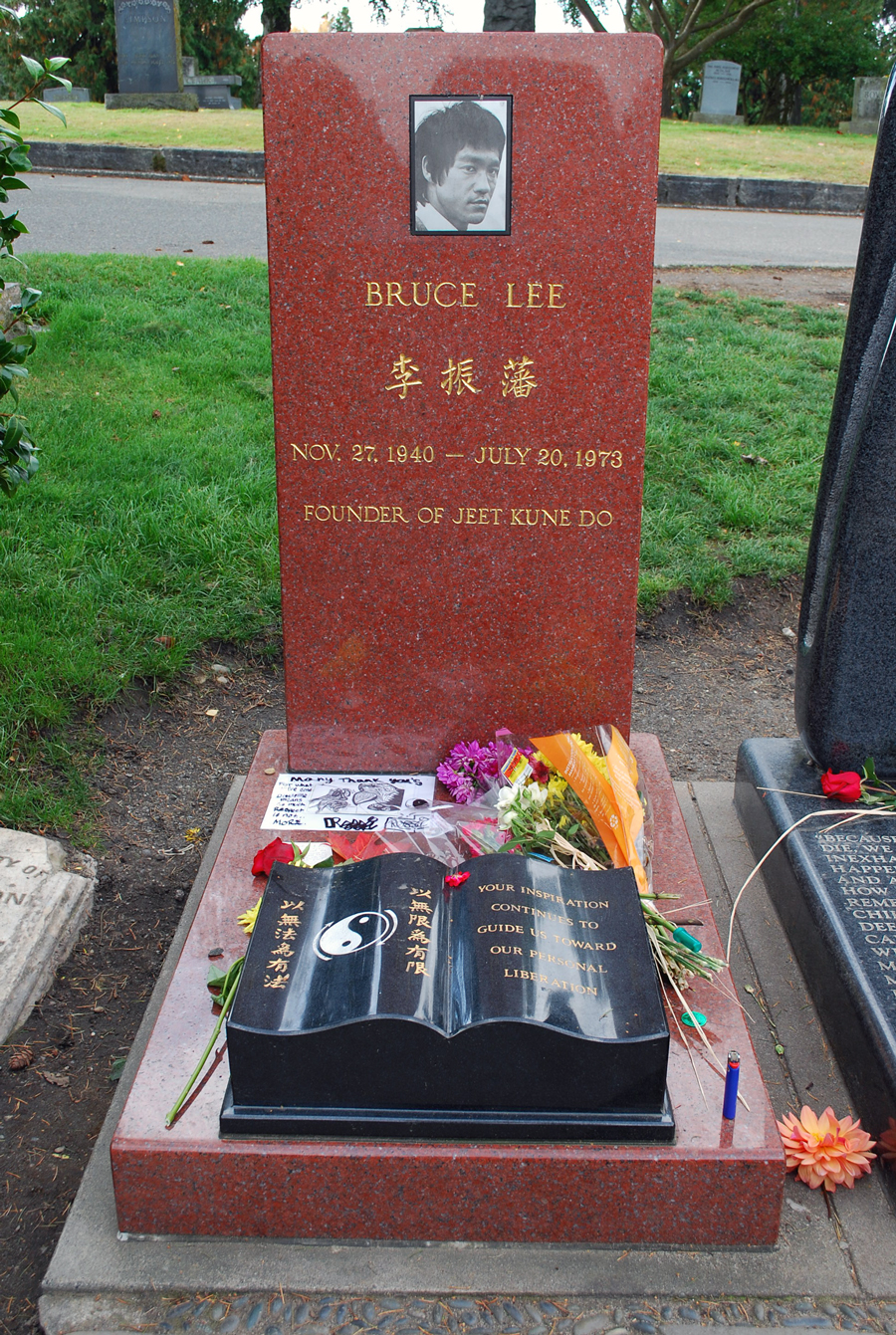
If you have any doubt about the influence of books and reading on Bruce’s life, look no further than his headstone in Seattle, part of which is an open book carved from marble. As his wife Linda said, “Bruce carried a book with him wherever he went.” While he’ll always be rightly known mostly for his martial arts innovations and movie/TV projects, his reading was the foundation that shaped his remarkable life and kept him grounded and true to his deepest values.

Let’s now take a look at some of the titles and authors that influenced Bruce.

Bruce Lee’s Reading List

While Bruce’s library contained thousands of volumes, they were primarily centered in a handful of genres: philosophy (the vast majority), martial arts (and other fighting disciplines), and self-help. Below is but a sampling of Bruce’s favorite authors and most interesting titles.

Western Philosophy:

  • Summa Theologica by St. Thomas Aquinas
  • An Enquiry Concerning Human Understanding by David Hume
  • Meditations on First Philosophy by Rene Descartes
  • The Undiscovered Self by Carl Jung
  • On Becoming a Person by Carl Rogers
  • The Works of Bertrand Russell
  • The Works of Plato
  • Art of Worldly Wisdom by Baltasar Gracian
  • Hero With a Thousand Faces by Joseph Campbell (and other Campbell titles)
  • Ethics by Benedict de Spinoza
  • Maxims and Reflections by Johann Wolfgang van Goethe

Eastern Philosophy:

  • The Works of Jiddu Krishnamurti (whom Polly notes was “one of his more important influences”)
  • Tao-Te-Ching by Lao-Tzu
  • The Way of Chuang-Tzu
  • The Book of Five Rings by Miyamoto Musashi
  • The Works of Alan Watts
  • The Analects of Confucius
  • Art of War by Sun-Tzu
  • Bushido: The Soul of the Samurai
  • Siddhartha by Herman Hesse (and many other Hesse titles)
  • Buddhism by Christmas Humphreys (and dozens of other Buddhism-related titles)
  • The Chinese Classics compiled by James Legge (all 5 volumes)
  • Living Zen by Robert Linssen (and many other Zen-related titles)


Wednesday, June 14, 2023

Lecture on the Bubishi


The video below features a lecture on the Bubishi, the bible of Okinawan Karate by Master Tetsushiro Hokama of the Goju Ryu. 


Monday, June 05, 2023

Kung Fu Masters of Taiwan


Below is a short documentary which is a visit to a bookstore in Taiwan, where the owner has a huge collection of martial arts books and recounts the history of martial arts practiced in Taiwan.


Monday, September 26, 2022

92 Insights into Kendo


Below is an excerpt from an article that appeared at Kenshi 24/7. In the article, the writer describes the history of a vintage book written on Kendo, and the author's "92 bits of wisdom."

I think this list would be of interest  to all martial artists. The full article may be read here.


1. Kendo is about striking the opponents heart with yours.


2. In shiai, neither wait nor rush, go with the flow.


3. Kakarigeiko should be short and executed at full throttle. 


4. A good maai is one in which the opponent feels close to you yet they feel it far; you should be able to strike at anytime with ki-ken-tai.


5. Both legs should act in tandem; striking with your whole body from your legs is the basis of good kendo.


6. When initiating a strike, your opponent will telegraph their intention; strike their intention.


7. The eyes are a window to the heart; when your opponent intends to strike their eyes will signal their intention - strike in that instant.


8. True strength lies in good technique, not in strong strikes.


9. Doing keiko every day is like the piling up of daily delivered newspapers.


10. A kodansha who does un-spirited keiko is inferior to a shodan.


11. If you enter tsubazeriai quickly strike and move away; in tsubazeria be careful to relax yet not be careless. 


12. The moment after a mutual-strike (ai-uchi) is decisive.


13. During keiko, always aim to get shodachi.


14. Watch the opponents movement careful and strike when they either enter in or step back.


15. Chudan kamae is the state where your heart is true with no wicked thoughts in mind; be sure you are gripping the shinai correctly.


16. Maai exists in physical space as well as mentally; from there you should be able to strike anytime in ki-ken-tai.


17. When facing an opponent you must first read the opponents mind and strike them first.


18. When facing an opponent if you have no confidence or are unsure whether to strike but do so anyway, your strike will fail.


19. In kendo you should not only think about winning or losing, but seek to understand the spiritual depth found through practice itself.


20. You shouldn’t try to forcibly attain grades, rather, through keiko you will naturally acquire status (respect).

Tuesday, June 07, 2022

Book Review: Uchideshi: Walking with the Master


My Aikido teacher, Kushida Sensei, was a long time uchideshi (inside student) of the founder of Yoshinkan AIkido, Gozo Shioda. He had tons of stories about those days.

Below is an excerpt from a book review by Ellis Amdur at the Kogen Budo blog, of Uchideshi: Walking with the Master by Jacque Payet where Payet Sensei recounts his days as an uchideshi to Shioda Sensei. The full review may be found here.

...

Payet’s book, UCHIDESHI: Walking with the Master, describes the eccentric world that Shioda created, where, for example, a telephone in the dojo was never allowed to ring more than once (and one disciple, noticing that a tiny light would illuminate on the receiver before the first ring, would leap for the phone before it sounded), or an uchideshi, waiting outside the door of Shioda’s bath, would know exactly when to enter to wash the master’s back. This is not a book which spends much time describing an advancement in physical skill: there is relatively little description on technical development, or the aikido techniques themselves, except in passing. Rather, it is the story of a progression within an individual of the training of intuition to function perfectly within a system that was, in many ways arbitrary. What I mean by this is the demands for survival for a polar Inuit of a generation ago, or a !Kung, living in the Kalahari Desert, are stark and clear. If one deviated from what was best suited—only suited—for that environment, one would die. For the Inuit, the ability to recognize, at a glance, the difference between a pile of snow and a polar bear, humped on the ice with one paw over her dark nose, had to be instantaneous. Similarly, for the !Kung, recognizing a slight discoloration in some sand which indicated that there might be water beneath the surface, had to occur as one was running after wounded prey. It might be the last water in many kilometers. For the Yoshinkan uchideshi, one had to be aware of the timbre and energy that one yelled “OSU!” to a superior, or the precise spacing that one’s senior’s shoes needed to be placed at the entryway when he was leaving, but there was no risk to life or limb—it merely felt that way, once indoctrinated. This, therefore, was a lifestyle of accepting an arbitrary social structure, established to achieve intuition by the absolutely adherence to a range of activities centered around subservience to the wishes of Shioda Gozo.

Payet tells his story with humility. He does not defend himself, as some might, with a polemic about how this method of training is requisite to become a ‘true’ martial artist. Rather, in the tradition of a natural phenomenologist, he simply tells what the experience was like for him, an unprepared and naĂŻve young man. What may be hard for the reader to grasp in my description above, is that Payet does not describe himself as obsequious—rather, he has the wide-eyed openness of a baby. The baby drinks in this strange world within which he or she has been thrown by birth; Payet did the same in the strange world within which he had entered by choice.

Perhaps the most important point in this book is that if one has the engrained habit of intuitive attention, then one has a change to absorb information that one’s teacher himself/herself can’t explain. Often, expert athletes simply have found that beautiful line towards efficient powerful action, and they have done this through intuition and simply sensing what feels right in the body. Asked to explain it, they are like the centipede asked by the fox, “With which leg do you start moving?” At which point, the centipede is frozen. But just as a baby learns to feed herself or walk with simple wide-eyed attention, Payet became a remarkably skilled martial artist (I’ve seen him) through picking up with a kind of osmosis what his teachers were doing. This osmosis (‘mirroring’) was surely enhanced by the environment he was in. (I’m not saying that Shioda’s is the only way—I learned in a different manner, for example, but it is a way that worked).


Wednesday, April 20, 2022

Firearms and the Development of Southern Chinese Martial Afts


Below is an excerpt from an article that appeared at Kung Fu Tea that described how the arrival of widespread western firearms affected the development of martial arts in China in the 19th and early 20th centuries. The full post may be read here.

 Giving Up the Gun: Revisiting a Classic Argument.

In 1979 a Dartmouth English Professor named Neol Perrin wrote one of the more popular and more widely read books on the history of the martial arts.  It was titled Giving Up the Gun: Japan’s Reversion to the Sword, 1543-1879.  While a non-specialist, and more interested in Japanese literature than military history, the book gained quite a following.  I first encountered it in high school after I developed a fascination with the Japanese sword arts.  While so many of my classmates were delving into the dark secrets of Ninjitsu, I was more interested in understanding why there was an entire island full of warriors who carried swords rather than guns until the second half of the 19th century.  Apparently students of martial studies are born rather than made.

Professor Perrin shared my curiosity on the subject.  Or maybe not.  To the great chagrin of historians everywhere, sometimes people with very little interest in their stated subject matter write historical books anyway.  Perrin was actually interested in something much more contemporary.  The true focus of his slim volume, published at the absolute nadir of the Cold War, was nuclear disarmament.  Could the developed states of the world dismantle their high-tech arsenals and slow the pace of proliferation?  At the time it seemed to be the only question worth asking.

The Japanese were an interesting test-case for Perrin.  The establishment of the Tokugawa Shogunate had been a long, bloody and uncertain process.  Further, it was an affair that swords played relatively little role in.  They had not really dominated the Japanese battlefield for hundreds of years.  As the size and technical sophistication of the Japanese feudal armies increased the sword and bow were replaced with the spear (yari) and the matchlock.  Firearms, both in the guise of matchlock rifles and cannons (some of them quite large) were the key to the ultimate establishment of the new government.

Much of this technology was quite sophisticated. The Japanese got so good at copying western weapons that they were able to modify the designs and even begin to export these arms to other, less technically advanced, buyers.  They developed devices to allow groups of gunners to engage in accurate mass fire at night (an important skill before the invention of the heavy machine gun), and they learned all sorts of lessons about how gunpowder changed the battlefield.

Then everything changed.  Once in power the new government closed the doors to social mobility and fossilized the class system.  The peasants were systematically disarmed, which was an important event as networks of religiously motivated peasant revolutionaries had been one of the groups to most successfully employ guns on the battlefield.  Even the samurai ceased to carry firearms in public.  For that matter the three meter spear, which had dominated the battlefield for hundreds of years, slipped into obscurity and was nearly forgotten by all but the most esoteric martial arts schools.  Instead there was renewed interest in the cult of the sword.

It was only in this late period that the sword became the “soul of the samurai.”  Prior to that top honors had gone to the bow, the spear and, very briefly, the gun.  Even contemporary sword masters realized that their weapon was obsolete on the “modern” battlefield of the 17th century.  At best it was a weapon of personal defense if you were unhorsed or your spear was lost.  Yet it is the sword that dominates the last era of Japanese feudal history.

Nor was this seeming loss of military technology mirrored in other areas of Japanese society.  While isolated from much of the world the Japanese did attempt to keep up on medical and scientific developments through their limited contacts with the west.  I have always been under the impression that standards of living were pretty high in Japan compared to some of the more marginal areas of southern China that I have studied, though I would need to look at some actual economic data to know for sure.

For Perrin this was the crux of the issue.  The Japanese were not forced to give up the gun by foreign domination, or social and technological decay.  It is easy to understand the loss of technology through these sorts of processes.  Instead they (meaning the political and cultural elite) made a choice to take one sort of military technology and put it back on the shelf.

This was an unprecedented moment in human history and Perrin wanted to know whether it could act as a model of nuclear disarmament.  Many of the critics of his work have fundamentally misunderstood his project.  He was not an English professor pretending to be a historian, and hence writing bad history.  He was actually an English professor pretending to be a social scientist.  Perrin’s real aim was to talk about causality.  He wanted to develop a covering law that explained disarmament, and he did so through a single, highly detailed, case study.

Japanese historians quickly pointed out that the Samurai never actually gave up the gun in any definitive sense.  They continued to maintain some coastal batteries and individual Lords maintained stockpiles of these weapons.  There were even periodic reminders by the Shogunate that all Lords were required by law to maintain large number of muskets and insure that their troops were drilled in using them, should the need should ever arise.  Pretty much the only group in Japanese society that lost its connection with firearms was the peasantry, but this relationship was not so much “given up” as “forcibly severed” as part of the maintenance of an absolutely brutal class based feudal system.

Many historians have been quick to dismiss Perrin.  He wants to talk about variables like “culture” and “choice,” where as they turn to “realist” political analysis.  The Japanese turned away from the gun because after the establishment of the new government the state entered a period of peace that lasted for 200 years.  Weapons development is expensive and socially disruptive.  No one does it just because it is fun.  Countries do it because they are forced to over the course of certain types of conflicts.

The development of firearms exploded in Europe between 1650 and 1850 not because the west was more rational, more scientific or more technologically advanced.  The real reasons were purely political.  This was a period of almost continual warfare and violent conflict.

According to this realpolitik view, weapons development happens only when it is rational to do so.  War accelerates this process.  During times of peace there are other spending priorities that will better insure your hold on power, such as public works or infrastructure spending, so this is where rulers will spend their gold. (For any international relations scholars out there that are keeping score, what I have just described is a “classical realist” theory rather than a stricter “neo-realist” account).

China: The Dragon and the Gun.

It is interesting to consider what happens when we bring China into this discussion.  China has a somewhat schizophrenic reputation on this point.  On the one hand it is credited with the invention of gun powder and the rocket, two of the more important destructive technologies of all time.  On the other hand it is burdened with images of peasant soldiers, armed only with spears, running into the face of machine gun-fire as late as the Korean War.

Rather than these being treated as isolated incidents that were the result of process failures in society’s military/industrial complex, these instances are often taken as being indicative of something about Chinese culture and its values.  It is often said that the Chinese do not value “human life.”  I have even had some of my own Chinese graduate students tell me this when trying to explain some of the more puzzling points of state policy.  Yet I cannot help but notice that all of the Chinese individuals who I associate with do value human life.  It is always some other mysterious person, who no one can quite identify, that lacks any humanity.  This should be a warning flag to those seeking to advance historical arguments based on cultural difference.  I am not saying that culture is never important, but this is a variable that needs to be employed with great caution.  Desperation makes people do “desperate” things, but that is not really the same as proving that they have fundamentally different values.

The 19th century European view was, if anything, more reductionist.  They explained their world in terms of racial categories.  In their view the Chinese lacked the mental or moral capacity to master the modern arts of warfare.  And yet these arguments always rang hollow, even to the individuals who advanced them.  The fact that it was the Chinese who initially created this entire class of weapons could not be forgotten.  Nor could the Europeans afford to overlook the furious pace of Chinese military advance.

In the 1850s Guangzhou found itself badly outgunned against the British.  By 1911 everything was different.  China was awash in modern European weapons and highly trained military specialists.  The state was militarily just as advanced as most European states.  Its defeats in the early 20th century had more to do with political divisions and a lack of unity than any actual military factors.  This means that in only 50 years China was able to radically transform not just their military arms, but the entire social and military structure that produced and supported them.  It had taken all of Europe nearly 200 years to complete this same transformation.  Clearly the Chinese reformers were quite talented.  One of the problems with the “victimization” narrative promoted by the Chinese state today is that causes individuals, in both the east and west, to systematically overlook these accomplishments.

I suspect that the success of the traditional Chinese martial arts may actually account for much of the historical misunderstanding that goes on.  For better or worse, Kung Fu has become a critical part of China’s public diplomacy.  These unarmed fighting systems seem philosophically rich and purely defensive.  I suspect that this perception has helped to ease tensions about China’s growing influence in the world.  But on the other hand, the same whiff of ancient mysticism makes these arts appear to be fundamentally incompatible with the modern world.

The supremacy of the gun over the more physical disciplines of combat is too firmly entrenched in the western mind to be easily dismissed.  It is a message that our media has reinforced repeatedly throughout the 20th century.  From cowboys exterminating Indians, to Indian Jones carelessly blowing away a Middle Eastern swordsman, we are confident in our ability to negotiate a hostile world.  The superiority of the gun seems to reinforce our broader faith in technology.

Nor is the American media alone in this assessment.  If anything Chinese story tellers have been even more enthusiastic in linking the gun to the “modern” world.  In western science fiction we can at least find a place for hand combat, whether it is Luke’s transformation into a disciplined Jedi knight, or Captain Kirk forgoing the niceties of the phaser for the simple pleasures of beating down a malicious alien with his own bare hands.

I have never run across anything quite like a Jedi knight in the Kung Fu genera.  Instead the vast majority of Kung Fu stories tend to be backwards looking.  They look back to a simpler time before the coming of the gun, when more “civilized” methods of defense still held sway.  They paint a picture of a reassuring world where ultimate power went to the individual who worked the hardest, who developed the best Kung Fu, rather than to gangster who could buy the most guns.  In the popular imagination Kung Fu is as much about justice as it is anything else.

I literally cannot count the number of martial arts films that I have seen which revolve around the introduction of firearms and how they destroy the “old order” of things.  Inevitably the hero beats the bad guy with the gun one last time, but the writing is on the wall.  The age of hand combat is drawing to a close.  In the “age of the gun” there is simply no way to defend yourself with your hands.  In fact, there is no way for the individual to defend himself against the industrialized aspect of society.

I despise this narrative.  It is not just that it gets the actual history of Chinese martial arts wrong, but it creates a vision of an unreal past.  Once you have internalized this vision it becomes impossible to understand the true history of Kung Fu even if someone stops to explain it to you.

It is a powerful narrative because it speaks to a lost “golden age” that has just slipped out of our grasp.  It captures the sorts of struggles that individuals feel in their own lives.  This is the story of a world that is passing you by.  Unfortunately it is now the only version of 19th century history that most individuals in China are familiar with.  If you ask them about the martial arts they will all tell, first we used traditional hand combat, then guns came and we modernized.

Historically speaking, this is totally backwards.  First the guns came, and then the modern martial arts developed.  What we see in China is quite similar to the puzzle that made life difficult for Perrin when he discussed Japan.

Firearms have been a fact of life in China since the 1300s.  At first they were difficult and expensive to manufacture, but the government employed large numbers of hand cannons, field artillery pieces and even massive rocket launchers from an early period.  If you are curious about what early military gunnery looked like you should check out the Fire Dragon Manual.  At the start of the Ming dynasty Chinese firearms were probably the most advanced in the world.  So what happened?


Sunday, September 19, 2021

The Dao De Jing #80: Let There Be a Small Country with Few People

The Dao De Jing is not only one of the world's great classics, it is one of the foundations of Philosophical Daoism. A free online version of the Dao De Jing may be found here. Today we have #80: Let There be a Small Country with Few People.


Let there be a small country with few people,

Who, even having much machinery, don't use it.

Who take death seriously and don't wander far away.

Even though they have boats and carriages, they never ride in them.

Having armor and weapons, they never go to war.

Let them return to measurement by tying knots in rope.


Sweeten their food, give them nice clothes, a peaceful abode and a relaxed life.

Even though the next country can be seen and its doges and chickens can be heard,


The people will grow old and die without visiting each other's land.


Friday, August 20, 2021

The Tang Dynasty Poems, #80: Endless Yearning 1

The Tang Dynasty was a high point of culture in ancient China. Especially esteemed were poems. There was no home coming or leave taking; no event too small to not be commemorated with a poem.


Some of the best poems of that period have been collected into an anthology known as The 300 Tang Dynasty Poems. A online version of the anthology may be found here. Today we have #80, Endless Yearning 1.


ENDLESS YEARNING I

"I am endlessly yearning
To be in Changan.
...Insects hum of autumn by the gold brim of the well;
A thin frost glistens like little mirrors on my cold mat;
The high lantern flickers; and. deeper grows my longing.
I lift the shade and, with many a sigh, gaze upon the moon,
Single as a flower, centred from the clouds.
Above, I see the blueness and deepness of sky.
Below, I see the greenness and the restlessness of water....
Heaven is high, earth wide; bitter between them flies my sorrow.
Can I dream through the gateway, over the mountain?
Endless longing
Breaks my heart."


Sunday, July 18, 2021

The 48 Laws of Power, #37: Create Compelling Spectacles

One of my favorite books on strategy is The 48 Laws of Power by Robert Greene and Joost Elffers.  Where The Art of War, by Sun Tzu is written as an overview of the whole topic of strategy, seeking to provide an overall understanding of the subject; and The 36 Strategies tries to impart the knack of strategic thinking through 36 maxims related to well known Chinese folk stories, Mr. Greene focuses on how we influence and manipulate one another, ie "power".

Mr. Greene draws from both Eastern and Western history and literature as his source material. Sun Tzu and Machiavelli as cited as much as wonderful stories of famous con men. 

Each of the 48 Laws carries many examples, along with counter examples where it is appropriate that they be noted, and even reversals.

It is a very thorough study of the subject and the hardback version is beautifully produced.

One of the things I admire about Greene is that he not only studied strategy, he applied what he learned to his own situation and prospered.

Today we have #37: Create Compelling Spectacles.

Shock and Awe is one aspect. A larger than life extravaganza. We're just sucked into it.  The flyovers, the fireworks. Think about product or movie premiers. 

There is just something about a huge event that is disarming, where we let our guard down and are open to the message that follows. The message takes on the size of the spectacle and itself becomes gigantic.

When you have an important message to deliver, you can make it even bigger by pulling out all of the stops.


Monday, June 21, 2021

How to Become Anti-Fragile

A post at Zen Habits described a program to develop oneself to become anti-fragile. Below is an excerpt. The full post may be read here.

As I’ve been diving into my Fearless Mastery mastermind program, with some of the most amazing people, I’ve been introducing some key ideas for training ourselves …
These are ideas I’ve been developing in my Sea Change and Fearless Training programs, as I’ve trained thousands of people to shift their habits as well as the patterns that get in the way of our meaningful work.
Here’s the problem when we try to train ourselves to change:
  1. We set out to do something regularly — exercise, meditate, write, create something, etc.
  2. We fail at it.
  3. Then we fall apart. We might beat ourselves up, get discouraged, and give up.
This is a fragile, non-resilient approach. Maybe we try this half a dozen times, and eventually we think something is wrong with us.
There’s nothing wrong with us. The problem is with the fragile approach of falling apart when we fail.
Instead, I’ve been training people with the idea of anti-fragility built into our training system.

Anti-Fragility, in Short

The idea of anti-fragility comes from Nassim Nicholas Taleb’s book Black Swan: the basic idea is that many human-made systems are fragile. Something comes to stress the system, and it falls apart. Some systems are robust or resilient, which is much better than fragile.
But even better is the idea of being anti-fragile: stress makes the system stronger.
Human systems are anti-fragile — when we exercise, we’re stressing the system, and after we recover, we’re stronger and better able to handle that stress. Bones get denser with impact. Lots of natural systems have anti-fragile mechanisms built in.
We can make human-made systems more anti-fragile by designing ways that stress will make the system better able to handle stress. Failure helps the system get stronger.
Let’s look at how to apply this idea into our training — any kind of learning, habit formation, physical or mental training, anything where we’re trying to improve something.

Key ideas for Anti-Fragility

Before we get into specifics for training systems, let’s look at some key ideas I’ve found to be useful:
  1. Expect stress, failures, crashes.
  2. Design the training system to not only be resilient, but to get stronger with stresses & failure.
  3. Start by removing fragility from the system. Examples: smoking, debt, having too many possessions, or being super hurt or pissed when you get criticism or failure.
  4. Take small risks often. Small experiments designed to help us learn from failure. Example: every day, I try to get better at doing hard work, with each day being a mini-experiment. I fail often, which means I learn often.
  5. Embrace uncertainty, risk, failure, discomfort. These become things to help you grow, rather than things to be avoided or complain about, or things that cause you to collapse entirely. Embrace variability, noise, tension.
  6. The attitude is to always learn & get better from failure. Don’t bemoan it, embrace it and learn, improve, grow stronger. Love error. When your system gets stressed, how will it respond to get stronger?
  7. Intentionally inject stress into your life – do sprints, lift heavy weights, fast, take cold showers, take on challenges, experiments and adventures.
Now let’s apply this to our training systems.


Friday, June 18, 2021

The Dao De Jing, #79: After Calming Great Anger

The Dao De Jing is not only one of the world's great classics, it is one of the foundations of Philosophical Daoism. A free online version of the Dao De Jing may be found here. Today we have #79: After Calming Great Anger.


After settling down for great anger

There are always resentments left over.

How can this be considered as good?

Therefore the sage keeps her part of the deal, 

And doesn't badger the other party.


The virtuous ascertain the content of the contract itself;

Those without virtue are concerned about it's being exacted. 


The Heavenly Way has no favorites:

It always raises up the Good. 1


Monday, April 19, 2021

The 48 Laws of Power, #36: Disdain Things You Cannot Have

One of my favorite books on strategy is The 48 Laws of Power by Robert Greene and Joost Elffers.  Where The Art of War, by Sun Tzu is written as an overview of the whole topic of strategy, seeking to provide an overall understanding of the subject; and The 36 Strategies tries to impart the knack of strategic thinking through 36 maxims related to well known Chinese folk stories, Mr. Greene focuses on how we influence and manipulate one another, ie "power".

Mr. Greene draws from both Eastern and Western history and literature as his source material. Sun Tzu and Machiavelli as cited as much as wonderful stories of famous con men. 

Each of the 48 Laws carries many examples, along with counter examples where it is appropriate that they be noted, and even reversals.

It is a very thorough study of the subject and the hardback version is beautifully produced.

One of the things I admire about Greene is that he not only studied strategy, he applied what he learned to his own situation and prospered.

Today we have #36: Disdain Things You Cannot Have.

Here is a bit of Stocism.

Remember: You choose to let things bother you. You can just as easily choose not to notice the irritating offender, to consider the matter trivial and unworthy of your interest. That is the powerful move.

Desire often creates paradoxical effects: The more you want something, the more you chase after it, the more it eludes you. The more interest you show, the more you repel the object of your desire. This is because your interest is too strong— it makes people awkward, even fearful. Uncontrollable desire makes you seem weak, unworthy, pathetic.