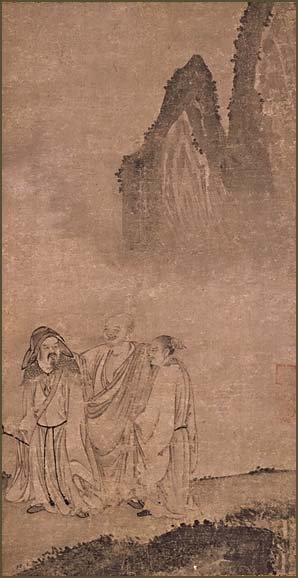
Here at the frontier, the leaves fall like rain. Although my neighbors are all barbarians, and you, you are a thousand miles away, there are still two cups at my table.


Ten thousand flowers in spring, the moon in autumn, a cool breeze in summer, snow in winter. If your mind isn't clouded by unnecessary things, this is the best season of your life.

~ Wu-men ~


Thursday, August 19, 2010

The 300 Tang Dynasty Poems, #36: At a Border Fortress

The Tang Dynasty was a golden age of culture in China. Poetry was especially esteemed. 300 of the best poems of that age were collected into the classic 300 Tang Dynasty Poems. An English translation of the anthology may be read by clicking here.


In the meantime, here is #36, At a Border Fortress:


AT A BORDER-FORTRESS


Cicadas complain of thin mulberry-trees
In the Eighth-month chill at the frontier pass.
Through the gate and back again, all along the road,
There is nothing anywhere but yellow reeds and grasses
And the bones of soldiers from You and from Bing
Who have buried their lives in the dusty sand.
...Let never a cavalier stir you to envy
With boasts of his horse and his horsemanship

Monday, August 16, 2010

Kata and Aikido

Below is an excerpt from a post by Diane Skoss, who is a long time practitioner of classical Japanese martial arts. The whole article may be read here.

Non-aikidoka are often confused when I talk about kata in aikido — “You mean like what they do in karate?” Even most aikidoka are aware of kata only as a term referring to form as opposed to application, or in reference to Saito Sensei’s solo or paired weapons training sequences. Morihei Ueshiba apparently did not approve of the kata training method, believing that “static” prearrangement of techniques interfered with the direct, spontaneous transmission of techniques from the gods. Thus, in most styles of aikido, kata as a set of prearranged techniques is not used as the primary training method. Kenji Tomiki, like his master Jigoro Kano before him, felt that kata was a valuable teaching tool and incorporated it into his system. Today, most Tomiki practitioners could tell you that a kata is a set of techniques practiced with a partner for teaching the basic principles of various aspects of Tomiki aikido.

In fact, the Japanese term kata encompasses all of the above… and more. Donn Draeger defines kata as “prearranged form” and goes on to explain in his Classical Bujutsu (p. 56) that “kata became… the central training method for all bujutsu… [because] it is the only way by which the action that characterizes the bujutsu can be practiced without the practitioners being wounded or killed.” Obviously, during the Sengoku Jidai (Age of Warring States), the warrior had ample opportunity to experience direct spontaneous technique on the battlefield, and preferred to concentrate his training time on perfecting the skills that would provide the base from which such techniques could arise when needed. This was done through innumerable repetitions of kata, practiced with one partner as “doer” (shidachi) and the other as “receiver” (uchidachi).

Warriors were evidently willing to risk their lives based on this type of training, perhaps because many of the kata techniques and sequences were believed to be the divinely inspired creation of the founder of the ryu. In any event, kata contained the knowledge and experience acquired by successes on the battlefield, either of an individual martial genius or as an accumulation of the experiences of many. Each technique (also, confusingly to the Westerner, sometimes referred to as kata) in a kata sequence represents a specific situational study—a particular maai, kamae, attack pattern, or weapon—and the sets were organized in various ways to emphasize particular lessons, usually of increasing complexity. Using these reasonably safe, predetermined sequences, warriors were able to train at the edge to develop the reflexes, intuition and courage to survive in battle.

Kata was considered an essential component of the spiritual “forge” of training, which became increasingly important as the classical traditions evolved into peacetime ways. “Kata are filled, as it were, with physical koan, or conundrums, situations that evoke technical crises” (Draeger, Classical Budo, p. 52). In order to solve these puzzles a process of intuitive learning-through-action must occur, and this investigative process gradually reveals the technical and spiritual truths essential to mastery.

Friday, August 13, 2010

Vermeer Bonanza!

A friend sent me a link to a veritable bonanza of articles on the Dutch painter, Johannes Vermeer. Below is an excerpt of the main article. The read the whole thing as well as the others, click here.

Jan Vermeer

Updated May 4, 2009

Just about the only thing we know for certain about the 17th-century Dutch master Johannes Vermeer is the thing that matters most: he was a miraculous painter. What was miraculous about him, among other things, was that he painted nothing, or mostly nothing: a woman reading a letter, or asleep at a table. But he made it seem as if time had nearly stopped in these pictures, and the effect is like slow-motion film: the ordinary suddenly looks extraordinary. Put another way, Vermeer eternalized moments that we all live, the ones when nothing much is happening, and gave them an almost mystical gravity.

Is this what makes him so popular? Partly, perhaps. His beautiful works are an effortless and hypnotic pleasure. A painting like "Woman With a Pearl Necklace" is a typical, well, jewel, full of strange portent: the young woman gazes at herself in the mirror as a diffuse golden light pours through the leaded window and glints off her earring, the yellow satin of her fur-trimmed jacket and the hand-wrought nails of a chair. The image is about vanity, to be sure, but also spirituality, since the woman, in her near rapture, looks as if she might be lifting up a host, not a necklace.

Tuesday, August 10, 2010

Three Laughters of the Tiger Ravine

Kokei Sanshō 虎渓三笑 
Three Laughers of Tiger Ravine


Three Laughers
at Tiger Ravine
by Chūan Shinkō
仲安真康 (mid +15C)
Tokyo Nat’l Museum
spacerBelow text courtesy of JAANUS. Chinese = Huxi Sanxiao. An allegory about three Eastern literati (東晋) who realize by accident that spiritual purity cannot be measured by artificial boundaries. One day the poet Tao Yuanming 陶淵明 (Jp. = Tou Enmei, +365-417) and the Taoist Lu Xiujing 陸修静 (Jp. = Riku Shuusei, +406-477) traveled to the Donglin 東林 temple on Mt. Lu 廬山 to visit the Buddhist theologian Huiyuan 慧遠 (Jp. = E On, +334-416) who lived there as a recluse, vowing never to cross the stone bridge over the Tiger Ravine (Jp. = Kokei 虎渓) that marked the boundary of the sanctuary. After an evening together, Huiyuan accompanied his friends as they left the temple. Deeply absorbed in conversation, Huiyuan inadvertently walked with them across the Tiger Ravine bridge. When the men realized what had happened they broke out in spontaneous laughter -- hence the title of the anecdote "Kokei Sanshou" or "Three Laughers of the Tiger Ravine." It is this moment that is usually depicted in paintings. The story probably originated with the late Tang poet Guanxiu 貫休 (Jp. = Kankyuu +832-912). Variations on the theme stress that the three men represent China's three creeds -- Confucianism (Tao Yuanming), Buddhism (Huiyuan), and Taoism (Lu Xiujing) -- and that in the instant they crossed the bridge all were enlightened by realizing that narrow adherence to one philosophy or religion is contrary to true wisdom. Notable works include those by Chinese artist Ma Yuan 馬遠 (Jp. = Ba En, late +12th century), and, in Japan, by Chuuan Shinkou 仲安真康 (mid +15th century), Shoukei 祥啓 (late +15th century, Kohouan 孤逢庵, Daitokuji 大徳寺), Kanou Sanraku 狩野山楽 (+1559-1635; Myoushinji 妙心寺), and Ike no Taiga 池大雅 (+1723-76, Manpukuji 万福寺, Kyoto). <End JAANUS quote>
Symbolism in This Artistic ThemeBridge = Buddhism, Crossing to “Other Shore”
Boundary = Taoism, Polarity, Yin/Yang, Natural Laws
Adherence to Strict / Rigid Rules = Confucianism
Confucius (Confucianism) = Tao Yuanming 陶淵明
Lao tsu (Taoism) = Lu Xiujing 陸修静
 Shakyamuni (Buddhism) = Huiyuan え遠 

Actually, I wanted something a little less scholarly in the explanation of the import of this incidence, and as I was looking around, I found a blog post that sums it all up very nicely. A portion is excerpted below. You can read the whole post at Church of the Churchless. Enjoy.

Three laughers at the tiger ravine

Today I came across a scroll, painted by Bangaku, of “Three Laughters at the Tiger Ravine.” This anecdote explains their laughter.
Three_laughers_at_tiger_ravine

"This is an allegory in which three literati realize by accident that spiritual purity cannot be measured by artificial boundaries. One day the poet Tao Yuanming and the Taoist Lu Xiujing traveled to the Donglin temple on Mt. Lu to visit the Buddhist theologian Huiyuan who lived there as a recluse, vowing never to cross the stone bridge over the Tiger Ravine that marked the boundary of the sanctuary.

After an evening together, Huiyuan accompanied his friends as they left the temple.

Deeply absorbed in conversation, Huiyuan inadvertently walked with them across the Tiger Ravine bridge. When the men realized what had happened they broke out in spontaneous laughter-- hence the title of the anecdote 'The Three Laughers of the Tiger Ravine.'"
Ray Grigg, in his “ The Tao of Zen,” tells the story somewhat differently in a chapter on “Playfulness.” And he’s describing a drawing of the scene by Bunsei. But the meaning is the same.
[The drawing] shows a Taoist, a Confucian, and a Buddhist circled together in uproarious laughter. Apparently the Buddhist had taken a vow never to leave the monastery but, in the enthusiasm of visiting with his two friends, he inadvertently wanders over the bridge of the ravine that defines the monastery’s grounds.

The distant roar of a tiger breaks the spell of their visit and they realize the vow of confinement has been broken. They clasp each other’s hands and laugh. This is the playful spirit that supersedes vows and teachings and ideologies.
Three_laughers_at_tiger_ravine2
I like how Bangaku depicts the faces of the men. The image brings a smile to my own heretical face. Freedom! Release! Tiger roar!

These guys aren’t out to cause trouble. The Buddhist’s friends didn’t visit him with the intention of making him break his vow. They just ended up walking over the bridge naturally. And when the vow was broken, they laughed about it. Naturally.

Saturday, August 07, 2010

Women's Self Defense, circa 1947

Note: July 5, 2012.

This has been one of the most popular posts on Cook Ding's Kitchen since it was originally published. I thought that I'd freshen it up a bit.

On July 14, 2012, the logo below will have a live link attached to it. The link will take you to the jumping off spot for the Women's Self Defense Blogging Carnival, where many articles on that topic may be accessed. This post will be my contribution to that worthy cause.


The video clip below features one Ms. Mary Parker, who was apparently well known in judo/jujutsu circles during her time. She is rumored to be the aunt of Patrick Parker.
 
I love these old videos. Too bad those jumper things the ladies are wearing went out of style, I think they look great.

Wednesday, August 04, 2010

The Home Dojo

Ever want to build a home dojo? For those interested in a martial art which is based on throws and grappling, a show stopper is usually mats. They can be very expensive.

Below is an excerpt from an article on how to build inexpensive yet serviceable mats. The whole article may be read here.


Building a mat on a tight budget.

For many of us the most time consuming and costly part of starting a dojo will be our mat. The “mat” is the central focus of our physical Dojo, so it’s important that we have a robust mat we can be proud of. However for most of us, cost is an issue. Many start their schools out of their garages, basements, or inexpensive warehouse space. While a mat is definitely something we don’t want to “skimp” on, a really nice “store bought” mat can be staggeringly expensive. This is especially true if you are fortunate enough to have a large space.

When selecting the type of mat you need, there are many questions you’ll have to ask yourself. What are the requirements of my space, should be your first question. Do you need a mat that can be put away after every training, or will it be permanent? Do you need to use the space for something other than Aikido. Often times people will run their Aikido school out of a church or youth group building. In a case like this you cannot use a permanent mat because you’ll need to remove the mat for the other functions that the space is being used for.

The size of your space and the cost to “mat” it is important as well. If you have a large space, filling it with real tatami, or faux-tatami is going to get expensive fast. Common tatami size is 71″ by 35.5″ (180cm by 90cm), close to 6 feet by 3 feet. The price range of tatami is going to be between $150 and $1000 (USD) per mat.

At that price 8 mats (only 12 feet by 12 feet) is not cheap, let alone a large 100-200 mat space.

When we built our mat these questions became very important. Cost turned out to be the most prohibitive factor for us. The mat we built was based on a mat we had trained on at Aikido of Fresno for years. The design is hard enough so that it doesn’t feel mushy and hard to move on. Yet flexible so you can fall on it over and over without injury. The mat is softer then faux tatami on concrete, but much firmer then a sprung floor covered in tatami. It’s a permanent mat, so not ideal for spaces that must be used for other purposes. But the cost is insanely low. By far the least expensive of all the options we found.

We built our mat for $450, and it’s about 350 sq ft. Covering the same space with faux tatami would have cost us around $2850 (not including shipping). The best thing is it doesn’t cost much more as the mat’s size increases. It’s a perfect mat for your garage dojo at home, or for your commercial school in a large warehouse. You can build a really large, quality mat with this design for very little money, and for most of us that’s pretty important.

Sunday, August 01, 2010

Maybe 10,000 Hours Isn't The Answer

Ever since Malcolm Gladwell's book, "Outliers" came out, there has been a lot of discussion about accumulating training time on the clock (or calendar). After all, "kung fu" indicates a skill acquired by hard work over a long period of time. After all, it's so simple and straight forward - just rack up 10,000 hours and voila, you're a master!

My own opinion had been that we only serve to drive ourselves crazy by trying to figure out ways to cram in more and more training time. Budo study after all, is meant to enhance our lives; not replace it. Spending all one's time training in my view, would be a pretty bleak existence.

My view is that the martial art I study is trying to teach me to move in certain specific ways, and if I make that way of moving habitual, then I am reinforcing that, training during every waking moment.


But here below is an excerpt from an article that takes an entirely different direction. It's written by George Leynard, who is a senior aikido teacher. The entire article may be read by clicking here. Please do. It's very thought provoking.

Aikido - The Theory of Limits (Part1)

One of my students a while back gave me a book on the Theory of Limits. Suffice it to say that a) it was totally and completely over my head after about four chapters or so and b) it totally changed how I thought about the process of teaching and training.

Without getting too technical, what the book said was that, in a complex system like a factory, in order to increase output it is essential to analyze the different factors that went into production and arrive at which is the "limiting factor". Resources can be devoted to all of the other factors with little or no increase in the out, hence the "limiting factor.

If one treats the acquisition of Aikido skills as just such a complex system, with increase in skill level being the "output" desired, one can see how the theory of limits would be a useful way to think about ones training or how one would teach.

If most people were asked what the limiting factor was in their training, I think that most would reply "time". Most folks simply do not have the time to train as they would like. If they only could train more, then they would really be able to take their training to a higher level... But is time REALLY the true limiting factor. Most of the time I would say not.

I believe that the limiting factors for most Aikido folks fall into one of several categories. These all have to do with very basic and fundamental factors which means that they represent true "limiting factors" which, if not corrected make any progress impossible.

A few years ago, Ushiro Kenji Sensei, the Karate teacher was asked what one single thing would he point to that would, if addressed, make Aikido better. He didn't hesitate a second before replying "the attacks". I think that he is absolutely right and I would like to talk about the various issues with our attacks that make them the "limiting factor" for most Aikido practitioners.

Thursday, July 29, 2010

Just Shut Up and Train

Below is an excerpt from an article from Steven Pressfield's blog. Mr. Pressfield often writes about the internal obstacles that prevent us from achieving our aspirations. This is the topic of one of his books, The War of Art.While he is specifically writing about writing, everything he has to say applies to any worthwhile endeavor, including martial arts training.


One of those obstacles is having to do something else first, or for conditions to be just right before we train. I know that I've been guilty of this. You come home from work late, so you blow off training instead of training later. You have to be somewhere, so rather than  shortening your workout, you blow it off altogether. You're "tired" or "not in the mood" or whatever. 


Just shut up and train. The Lenten Challenge has been a great exercise in getting over this twisted thinking. Below is an excerpt from the article. The whole thing may be read here. Enjoy.

Do It Anyway

By Steven Pressfield | Published: May 26, 2010

This is an important post. I say that because this piece addresses (after procrastination, which is the #1 champ), the single greatest excuse/reason/cop-out that prevents aspiring writers, artists and entrepreneurs from taking action to pursue their dreams.

That excuse is, “First I have to _____________.”
“___________” can be anything from “finish my research” to “pay the rent” to “get rid of my slacker boyfriend.” I’m not saying such excuses can’t be real or serious. “Stop drinking,” “get out of rehab,” “recover from suicide attempt.” They can be absolutely valid and true. But they’re still Resistance. They’re still bullshit.

Here’s the counter-mantra: “Do it anyway.”

Am I being overly hard-core to assert this? No. I’m being kind.

The surest antidote to the state of misery and paralysis that we find ourselves in when we’re under the spell of “First I have to _________” is to sit down and do our work anyway.

Tales from the trenches

This past year hasn’t been the worst of my life—but it’s right up there. I’ll skip the personal details because of the pain it might cause to people dear to me, but suffice it to say that my head, my heart and my butt have been swimming for their lives this past year. My artistic self-confidence, which has been bedrock for me for years, took a major hit about six months ago. I’m still not out of the woods. At the same time, outside commitments (most of which, to be honest, are voluntary and positive), family emergencies and other imperatives have whacked the hell out of my working time.

But here’s the weird part: my work has never been better. I’ve got three projects going, and they’re all hitting

on eight cylinders.  Yeah, it’s slow. Yes, it’s hard. But the stuff is good.

It’s saving my life. Certainly it has preserved my sanity.

In other words . . .

In other words: Do it anyway.

We don’t have to do anything else first. We don’t need to cure our neuroses, conquer our fears, overcome our bad habits. We don’t have to be sane; we don’t have to be solvent. We can be totally screwed up. None of these real-world troubles has anything to do with our creative selves.

The part of our psyches that we write from, or paint from, or conceive new entrepreneurial or philanthropic ventures from . . . that part exists in a wholly different dimension from the part of us that is mucking up our personal lives. There’s no connection. The twain don’t meet.  No matter how balled-up we may be in our outer world, our internal fortress of solitude remains waterproof, soundproof, bulletproof.

Monday, July 26, 2010

Senshusei

This is an excerpt from an article that appeared in the Japan Times. It's about Senshusei, which is the name of the training program carried out by the Yoshinkan Aikido Headquarters for the Tokyo Riot Police. My sensei, Kushida Sensei, once taught this program.


In recent years, foreign students who were willing to commit to the grueling 11 month program have been allowed to join. This is recounted in the book, "Angry White Pajamas." The full article may be read here. Enjoy.


Tuesday, April 27, 2010

News photo
It was a riot: Carter and classmates pose for a shot with the riot police who joined them on the 11-month Senshusei Aikido course at the Yoshinkan Honbu Dojo. ANDREW CARTER
THE ZEIT GIST

Battered Briton survives aikido ordeal

Punishing course leaves Englishman bruised but hungry for more 'cultivation'


By DAMIEN OKADO-GOUGH
At the end of February, a group of international students graduated from the Tokyo-based Yoshinkan Honbu Dojo, one of the most intensive martial arts training centers in the world.

Yoshinkan (meaning "hall for cultivating the spirit") is a style of aikido founded by Gozo Shioda after World War II. Made famous by the controversial book "Angry White Pyjamas" by Robert Twigger, the Senshusei Aikido training course was initially started at the dojo in 1957 to train members of the Tokyo riot police. In 1991 the 11-month program opened its doors to applicants outside the police force, and since then the course has attracted recruits from all over world.

One such recruit, Englishman Andrew Carter, 24, who graduated from the course this year, spoke to The Japan Times about his motivations for starting the program and his experiences over the nearly yearlong course.

"I always wanted to join the British Army's Royal Marines when I was in my teens, but in university I went off the idea of the military — the killing people part — but I still wanted to experience something similar in terms of the training," he recalls. Then he read "Angry White Pyjamas," and after coming to Japan as an English teacher on the JET program, he decided to sign up for the Senshusei course.
 ...

The Senshusei course is famous — some might say infamous — for the severity of the training. Injury is not just possible, it's seemingly inevitable. The first training session of the course, says Carter, was "interesting."
"It was an hour of nonstop, difficult exercises. Out of 10 of us, one guy's legs gave out and he collapsed. I collided with another guy and he went to hospital with a cut to his head; I got a black eye out of that clash. One guy's nose started bleeding due to too many press-ups."

And this was only the first training session. For the next 11 months, Carter and his fellow trainees would endure three such sessions a day, five days a week.

"We all had bleeding backs due to hundreds of backward break-falls. The cuts would reopen each day and the backs of our dogi — uniforms — would turn red with blood stains. You're not allowed to start a training session with a dirty dogi, so one of the guys would tape women's sanitary towels to his back to soak up the blood."
...
Shugyo is a Japanese word that means "commitment to a discipline," and trainees on the Senshusei course must try to get a deep understanding of shugyo.

"Shugyo makes a great impact in the rest of your life; without some form of it, real training is impossible."

Soon after starting the course, Carter came to realize that he did not fully understand this concept.

"Others were studying techniques in their spare time while I was working or resting. It soon became clear that I was the weakest in the group as I was constantly making technical mistakes. I spent many embarrassing training sessions in front of my peers making mistakes. It was during this year that I decided I needed to re-evaluate my way of approaching life if I am to ever to be worthy of my black belt, if ever I'm to fulfill my full potential as a human being."

"I now see myself as a very different person. I used to drink and socialize a lot and leave studying to the last minute, but my year in the dojo has had a profound effect on me. It teaches you that you have to be focused, you have to predict what's coming up and study it and you have to be aware constantly of your own movements as well as being aware of a strict culture and of the teacher's needs."

"At the end of the year I see so many areas that I can improve on, in both aikido and in my life. But this is not a negative thing; it is very possible that without the course I would have never come to realize this. For me the course really unlocked a desire to do my best in all areas of life, not just the physical side of it, as I originally thought this year would develop."