Here at the frontier, the leaves fall like rain. Although my neighbors are all barbarians, and you, you are a thousand miles away, there are still two cups at my table.


Ten thousand flowers in spring, the moon in autumn, a cool breeze in summer, snow in winter. If your mind isn't clouded by unnecessary things, this is the best season of your life.

~ Wu-men ~


Monday, February 18, 2008

I Ching Resource


I find the study of the I Ching to be bewildering. Never the less, it's a book that I want to someday study in depth. I've found a resource here that might just help me get started. You can also click on the title of this post to be directed to the I Ching with Clarity web site. Please pay a visit.

An excerpt from the website:

People have turned to the I Ching for some 3,000 years to help them uncover the meaning of their experience, to bring their actions into harmony with their underlying purpose, and above all to build a foundation of confident awareness for their choices.

Down the millennia, as the I Ching tradition has grown richer and deeper, the things we consult about may have changed a little. But the moment of consultation is much the same. These are the times when you're turning in circles, hemmed in and frustrated by all the things you can't see or don't understand. You can think it over (and over, and over); you can 'journal' it; you can gather opinions. But how can you have confidence in choosing a way to go, if you can't quite be sure of seeing where you are?

Only understand where you are now, and you rediscover your power to make changes. This is the heart of I Ching divination. Once you can really see into the present moment, all its possibilities open out before you - and you are free to create your future.

Friday, February 15, 2008

Dragons


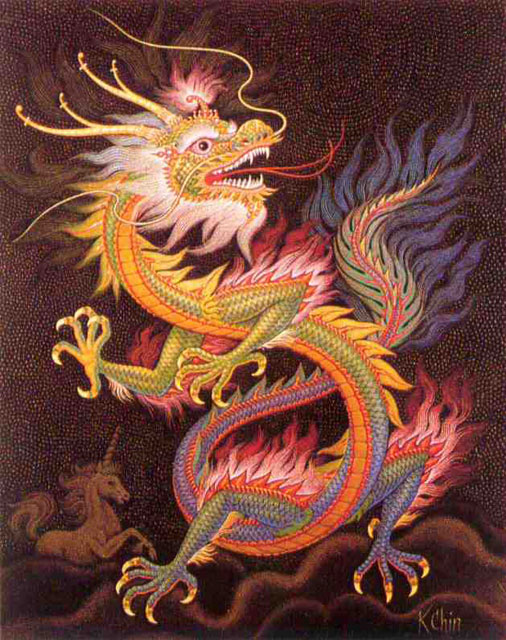
If you click on the title of this post, you'll be directed to a page on Chinese Dragons. Below are some excerpts.

Chinese Dragons

The Chinese dragon is a symbol of wisdom, power, and luck in Chinese culture. Unlike Western dragons, oriental dragons are usually seen as benevolent and kind. Dragons have long been a symbol in Chinese folklore and art. Temples and shrines have been built to honor them.

Through the symbol of the dragon, many Chinese see divine attributes which they aspire to themselves. In fact, the Chinese are sometimes referred to as "descendents of the dragon." The dragon is held in reverence and respect in Chinese culture. It is unseemly to defile a depiction of a dragon. Dragons are referenced by several Chinese proverbs.

Chinese dragons control the rain, rivers, lakes, and sea. They can ward off wandering evil spirits, protect the innocent, and bestow safety unto all. They are called lung or long in the Chinese language.

They fly in the sky among clouds. Most pictures of Chinese dragons show them playing with a flaming pearl. Legend has it that the pearl gives them their power and allows them to ascend into heaven.

The Legend of the Carp says that a carp able to leap over the mythical Dragon Gate will become a dragon. Many have sought out the true location of this Gate, but none have found it. Several waterfalls and cataracts in China are believed to be the location of the Dragon Gate. This legend is an allegory for the drive and effort needed to overcome obstacles.

Chinese dragons have serpentine bodies, four legs, and are usually without wings. They are said to be a composite of various other animals-the body of a snake, the antlers of a deer, the talons of an eagle, the soles of a tiger, the scales of a carp, and the eyes of a demon. It is said that Chinese dragons have 117 scales.

They are usually depicted with four toes. In the traditional symbol of the emperor, the dragon is depicted with five. In Japan, dragons are depicted with three toes.

There are nine types of classical Chinese dragons. They are as follows:

  1. Tianlong, the Celestial Dragons, are the celestial dragons who pull the chariots of the gods and guard their palaces.
  2. Shenlong, the Spiritual Dragons, control the wind and the rain.
  3. Fucanglong, the Dragons of Hidden Treasures, are underworld dragons which guard buried treasures, both natural and man-made. Volcanoes are said to be created when they burst out of the ground to report to heaven.
  4. Dilong, the Underground Dragons, are earth dragons whose task it is to preside over rivers and streams. According to some accounts, they are the female counterpart of the Shenlong and they fly only in order to mate.
  5. Yinglong, the Winged Dragons, are the oldest of all eastern dragons and the only kind with wings.
  6. Qiulong, the Horned Dragons, are considered to be the mightiest dragons.
  7. Panlong, the Coiling Dragons, are water dragons believed to mostly inhabit the lakes of the Orient.
  8. Huanglong, the Yellow Dragons, once emerged from the River Luo and presented the legendary Emperor Fu Hsi with the elements of writing. They are known for their scholarly knowledge.
  9. Lóng Wáng, the Dragon Kings, are rulers over each of the four seas, those of the east, south, west, and north. Although their true form is that of a dragon, they have the ability to shapeshift into human form. They live in crystal palaces guarded by shrimp soldiers and crab generals.

Thursday, February 14, 2008

Daoist Immortal


Maybe becoming a Daoist Immortal is a bit of a stretch goal, but perhaps living to be 100 in good health isn't. Below is an excerpt from a newspaper article discussing this. If you click on the title of this post, you'll be directed to the full article.

StarTribune.com

Even some with chronic disease can live to 100, thanks to aggressive treatment

February 13, 2008

CHICAGO - Living to 100 is easier than you might think. Surprising new research suggests that even people who develop heart disease or diabetes late in life have a decent shot at reaching the century mark.

"It has been generally assumed that living to 100 years of age was limited to those who had not developed chronic illness," said Dr. William Hall of the University of Rochester.

Hall has a theory for how these people could live to that age. In an editorial in Monday's Archives of Internal Medicine, where the study was published, he writes that it might be thanks to doctors who aggressively treat these older folks' health problems, rather than taking an "ageist" approach that assumes they wouldn't benefit.

For the study, Boston University researchers did phone interviews and health assessments of more than 500 women and 200 men who had reached 100. They found that roughly two-thirds of them had avoided significant age-related ailments.

But the rest, dubbed "survivors," had developed an age-related disease before reaching 85, including high blood pressure, heart disease or diabetes. Yet many functioned remarkably well — nearly as well as their disease-free peers.

Overall, the men were functioning better than the women. Nearly three-fourths of the male survivors could bathe and dress themselves, while only about one-third of the women could.

The researchers think that may be because the men had to be in exceptional condition to reach 100. "Women, on the other hand, may be better physically and socially adept at living with chronic and often disabling conditions," wrote lead author Dr. Dellara Terry and her colleagues.

Rosa McGee is one of the healthy women in the study who managed to avoid chronic disease. Now 104, the retired cook and seamstress is also strikingly lucid.

"My living habits are beautiful," McGee said in an interview at her daughter's Chicago apartment. "I don't take any medicines. I don't smoke and I don't drink. Never did anything like that."

Until late 2006, when she fell in her St. Louis home, McGee lived alone and took care of herself. Now in Chicago, she is less mobile but still takes walks a few times weekly down the apartment building hallways, with her daughter's help.

McGee credits her faith in God for her good health. She also gets lots of medical attention — a doctor and nurse make home visits regularly.

Genes surely contributed — McGee's maternal grandparents lived to age 100 and 107.

But while genes are important, scientists don't think they tell the whole story about longevity.

Wednesday, February 13, 2008

Free Yiquan eBook


If you click on the title of this post, you'll be directed to a website entitled J.P.Lau's YiQuan Research. There you will find a free eBook on Yiquan available for download.

The author says right up front that this book is no substitution for live instruction. At around 300 pages, however, it looks like a very thorough overview of the training methods and aims of Yiquan.

Mr. Lau is a student of Yao Cheng Rong, whose father was the named the successor of the founder of Yiquan, Wang Xiang Zhai.

If you have any interest at all in this martial art, the book is well worth checking out.

Tuesday, February 12, 2008

Ma-ai: The Importance of Distance


Ma-ai (間合い) which is translated as "Distance" or "Interval" is a very important concept in Japanese martial arts. Below is an article from the Aikido Journal on this topic. If you click on the title of this post, you'll be directed to the whole article. Enjoy.

Maai

by Diane Skoss

My cousin, who runs a karate school in San Jose, California, says that the one who controls the distance in an encounter is the one who controls the situation. One of the shihan of the Japan Aikido Association, when asked about how, using aikido, to deal with a karate practitioner, replied simply, "Maai."

We've all heard similar statements and all have been admonished during training to be aware of the maai, often translated as combative engagement distance, but perhaps more accurately rendered "combative interval." When I first heard the word in a Tomiki aikido dojo in the U.S., I thought it referred to a simple spatial relationship-the distance at which I could, in a single movement, reach an opponent with my attack. Conversely, I also discovered, it was the distance at which an attacker could reach me!

What I didn't quite get at first was the extent to which this was not one, but two, sometimes vastly different, distances. When my then training partner, Meik Skoss, casually remarked, over coffee and donuts after jukendo (bayonet Way) training one morning, "Of course, you know that my maai in relation to you, will always be different from yours to me--even though the distance between us is constant," I nodded, and pretended to have the foggiest notion of what he was talking about. It became clearer soon after when I ran into my friend Bill, who is over six feet tall, in the company of his girlfriend, who is five foot nothing. If the two of them were to stand side-by-side facing me, at (Bill's) arms length away, I would be fully within Bill's maai, and just outside of his girlfriend's. They would both be in my maai. If Bill took one step back, he might very well be out of my maai, yet I would still be within his. These differences are naturally based on the length of each individual's arms and legs. Two more elements, speed and timing (hyoshi) can also affect the effective combative interval. What it all adds up to, is judging the constantly changing maai, different for each individual and each type of attack, is incredibly complicated. And of course, our teachers tell us, we must learn to make this evaluation virtually subconsciously and instantaneously.

Thursday, February 07, 2008

Netsuke


Unique to Japan are small functional sculptures called Netsuke. A netsuke was used to secure the cords of a pouch back in the days when men did not carry wallets. Below is an excerpt from the Wikipedia article on netsuke. If you click on the title of this post, you'll be directed to the full article. Please do, as there are some pictures there of many more netsuke.

As today is the Chinese New Year, I added a picture of a rat netsuke to accompany the article.


Japanese artists starting in the 17th century cleverly[citation needed] invented the miniature sculptures known as netsuke (Japanese:根付) to serve a very practical function. (The two Japanese characters ne+tsuke mean "root" and "to attach".) Traditional Japanese garments - robes called kosode and kimono - had no pockets. Men who wore them needed a place to keep personal belongings such as pipes, tobacco, money, seals, or medicines.

The elegant solution was to place such objects in containers (called sagemono) hung by cords from the robes' sash (obi). The containers might take the form of a pouch or a small woven basket, but the most popular were beautifully crafted boxes (inro), which were held shut by ojime, sliding beads on cords. Whatever the form of the container, the fastener that secured its cord at the top of the sash was a carved, button-like toggle called a netsuke.

Such objects, often of great artistic merit, have a long history reflecting important aspects of Japanese folklore and life. Netsuke production was most popular during the Edo period in Japan, around 1615-1868. Today, the art lives on and carvers, a few of whose modern works command high prices (US$10,000 or more), are in the UK, Europe, the USA, Japan and elsewhere. Prices at auctions in the USA for collectible netsuke typically range from a few hundred dollars to a few thousand. Inexpensive molded, faithful reproductions are available in museum shops and elsewhere for $30 or less.

Tuesday, February 05, 2008

Gentle Persistence


This post is about some observations I’ve made regarding my Taijiquan teacher over the past several months. She is Sifu Genie Parker, and she’s been at this for 20 years. If you click on the title of this post, you’ll be directed to the school’s website.

The single quality of hers that strikes me over and over again is her gentle persistence, which I consider Daoism put into everyday practice.

She has her goal in mind: to teach us Taijiquan. But there are obstacles, chief among them being our unwillingness to incorporate the refinements to our form and practice that she teaches. She’ll even make reference to “rubber corrections.” She’ll teach us something, and we wont’ do it. She’ll teach it again, and we still won’t do it. So she teaches us again…

She has a gentle persistence. “At this point of the form, check where you foot is. If it’s in the wrong place, put it in the right place. If you do this enough times, eventually it will go to the right place and you can correct something else.” If you didn’t practice yesterday, practice today. Eventually, if we keep at it, we’ll do it the right way.

Of course as time passes, the GM of our style will change the way the form is done, and we’ll have to learn a different way to emphasize something else, so we’ll to change our practice. Another lesson.

She doesn’t worry about things over which she has no control. For example, we get new people showing up to study all of the time. Few of them stick around more than one or two lessons. This is normal at any martial arts school. At the beginning, the fall out rate is huge. Still, she spends time with every new beginner, giving them every bit of attention. She doesn’t seem to regret what many would consider this investment in futility. Of those who decide to stick around, they seem to stick around for a very long time. This is a sign of a healthy school. That is the yin and yang of things.

She doesn’t really lecture on Daoism or philosophy. She doesn’t need to. She provides with an example each time we come to class.

Thoreau said: Philosophy practice is the goal of learning. I believe my Taijiquan teacher has achieved much.

Monday, February 04, 2008

Zen and Culture.


This is an excerpt from an article at the White Wind Zen Center website. If you click on the title of this post, you'll be directed to the entire entry. I found it through the Zenfilter blog. Enjoy.

"Some people think that Japanese culture is the same as Zen and that Zen is a Japanese thing. These people understand nothing. Zen is originally Indian. It is also Chinese. And then it was practised in Japan when Dogen zenji opened Kannon-dori-in. There is also Korean Zen. Now Zen is in Canada, America, Europe. Zen is about the art of being human, not any culture. Mind and body have no culture. Zen has no place because all places, all lands, nations, mountains and rivers are in the Mind of the Buddhas and this Mind is Zen."

Saturday, February 02, 2008

Having just finished shovelling the snow


Having just finished shovelling the snow, one's thoughts turn naturally to ... Flower Arranging!

If you click on the title of this post, you'll be directed to the Aikido Journal, specifically to a blog entry by Dave Lowry. Mr. Lowry is a senior practictioner of Classical Japanese Martial Arts, and was taught ikebana (flower arranging) by the wife of his kenjutsu sensei. There is an excerpt below. Also, if you click here, you will be directed to the Wikipedia article on ikebana. Enjoy.

Of all the requisites faced by the budoka (“martial artist”) contemplating the construction of a new dojo or training facility, the tokonoma (“alcove”), with its space for the display of arranged flowers, could rank in importance somewhere between solar-powered showers and cashmere mats. Pragmatism must sometimes take precedence over aesthetics. Safe, durable training floor surfaces, adequate dressing facilities, and so on, are more apt to concern dojo builders than will a shelf devoted to flower arrangements. Later on, the tasks of training, teaching, and maintaining the dojo are more likely to occupy its inhabitants than are such matters perceived solely as decorative like the arranging and display of flowers. This is reasonable. But it also risks the development of dojo—and we need not look far to find examples of these—that are physically healthy but seriously lacking in their collective soul. They are filled with budoka who are learning well the outer, physical aspects of their art. Yet something seems missing, something internal, unidentifiable in words by the students perhaps, although palpable if by no other sense than by its absence. A good many trends that today surface in budo (“martial Ways”) training, the recent interest in some of the spiritual aspects of the martial Ways, for example, appear fundamentally to be efforts at nurturing or reestablishing this spirit, this attitude, this matter of what we might call the budo’s “soul.”