Here at the frontier, the leaves fall like rain. Although my neighbors are all barbarians, and you, you are a thousand miles away, there are still two cups at my table.


Ten thousand flowers in spring, the moon in autumn, a cool breeze in summer, snow in winter. If your mind isn't clouded by unnecessary things, this is the best season of your life.

~ Wu-men ~


Thursday, July 20, 2006

Moon in the Water


If you click on the title of this post, you'll be directed to a page of Zen resources. The specific page is full of Zen poetry and koans.

Enlightenment is like the moon reflected on the water.
The moon does not get wet, nor is the water broken.
Although its light is wide and great,
The moon is reflected even in a puddle an inch wide.
The whole moon and the entire sky
Are reflected in one dewdrop on the grass.

Dogen

Tuesday, July 18, 2006

Afraid to Give Up the Ghost


This is the first page of a story about the belief in ghosts on Taiwan. For the full story, click on the title of this post, and you'll be directed there.

Afraid to Give Up Ghosts
Mainland China may have left otherworldly beliefs behind, but in Taiwan ... well, you'd better just do what the spirits say.
By Mark Magnier, Times Staff WriterJuly 18, 2006

TAIPEI, Taiwan — Chin Wei considers for a brief moment a blockbuster American ghost movie and scoffs. "I saw 'Ghostbusters,' but that's not how it's done," says the author of several ghost books and the host of various radio and television paranormal programs. "You can't get rid of ghosts that easily, especially with those funny, weird machines. That's just comedy."

In Taiwan, ghosts are rarely a laughing matter. On TV, in daily conversation, at temples and in the deepest recesses of the unconscious, they maintain a firm grip on island society. Taiwanese are ghost-crazy — or rather, crazy to avoid them. A recent survey of Taipei college students found that 87% were believers, and some say that could be on the low side.

"I'd say the other 13% would probably hedge their bets if you questioned them closer," says Marc Moskowitz, an anthropologist at Lake Forest College in Illinois who has studied Taiwan's spirit beliefs.

"Many Taiwanese feel it's best not to anger the ghosts, just in case they do exist."

Ghosts have been an integral part of Chinese culture dating to at least the Shang Dynasty, with 3,500-year-old oracle bones from the period depicting a big-headed, bent-kneed phantom.

But China has seen much of its otherworldly belief system erode under the Communist Party's assault on religion and superstition. That has left Taiwan, which split from China in 1949 after civil war, a rich repository of this living tradition, one that draws scholars eager to study Chinese ghost practices in their purest form.

"On the mainland, we're more cut off from our culture by socialist education and propaganda, and I don't believe in ghosts," says Wang Shen, 28, a Beijing-based website designer.

"That's not necessarily a good thing, though. People here aren't as nice as they were before, when they feared retribution."

Up four dirty flights of stairs in a north-central neighborhood of Taipei, past grungy walls with peeling paint and landings with missing lightbulbs, is the Tian Yu Tang spiritual center. It's a rainy weekday, but several people wait in the anteroom for their consultation. An oversized TV blares beside a large Buddhist altar bedecked with five candles, a porcelain tiger and a revolving prayer wheel. Nearby sits a Tweety Bird coffee cup and the Chinese version of Elle magazine.

Fifty-four-year-old Liang, who declined to give her first name, is here to connect with her mother's ghost, who keeps visiting her during the night asking for money. Liang says that when she offered her jewelry, the ghost said she wanted only cash. Parapsychologist Hsu Tzu-he fixes Liang with an intense stare and informs her that jewelry is indeed no good down there. Mom's spirit is trapped in a ghost channel unable to transcend to the next world, she adds during the 15-minute, $15 session.

With a few prayers and a proper funeral ceremony, however, Mom can be elevated out of purgatory. Hsu hands Liang a tissue as tears of anxiety and relief course down her face. But there's more. Liang's dead father has been reborn and is now a 1-year-old Japanese boy, Hsu adds, occasionally glancing at a computer screen with rows of numbers.

For those looking for an out-of-this-world experience of a different sort, the company also offers a 20-stop tour of hell, including a review of the punishments evildoers can expect. The company says the experience prompted one fashion-obsessed customer to become a monk.

"After you tour hell, you can better appreciate paradise," Hsu's mother, who helps out with consultations, said, asking not to be identified.

Those not under direct attack from the netherworld can watch those who are, on numerous TV variety and ghost shows. No friendly, pudgy Caspers here. Late-night programs, timed to avoid scaring children, include amateur and professional video of haunted houses, sightings and other unexplained phenomena, helpfully explained by paranormal, feng shui and religious experts. Some say the small screen goes too far.

"Most of the time you don't want to bother ghosts," says Wang Jun-kei, 38, an employee in the telecommunications industry.

"With all those reporters chasing the ghosts around, no wonder they get angry and stirred up."

Ghosts don't just attack people's psyches, they might even be threatening Taiwan's military security. Ghost experts say some Taiwanese soldiers believe that certain vehicles, weapons and flags of military units, particularly units that suffered horrific casualties during the war against the Communists in the 1930s and '40s, have ghosts attached to them. The military brass grew concerned several years ago after learning that some soldiers were afraid of the dark and were trying to appease the spirits of their broken weapons and disabled vehicles with prayers before ordering up repairs, says Chen Wei-min, host of the popular TV ghost show "Passing Through Yin and Yang."

"Commanders became concerned that soldiers wouldn't dare stand outside at night or use their weapons," says Chen, author of 14 ghost books, including "Ghost Talk in the Army."

Thursday, July 13, 2006

The 36 Strategies: #16: When you want to take captives, leave them on the loose for a while.


Next to The Art of War by Sun Zi, the 36 Strategies is most widely known book of strategic thought. It is a good idea to understand strategy, if for no other reason, to recognize when someone is trying to implement a strategy on you. Here is number 16.

16. When you want to take captives, leave them on the loose for a while.

Fleeing enemies may turn again and strike desperately if pursued too hotly. If they are given room to run, on the other hand, they scatter and lose their energy. Then they can be taken captive without further violence.

In other words, it may be advantageous to allow the opponent to thrash around a bit before making one's move. There is no need to be in an unneccesary hurry.

Tuesday, July 11, 2006

Who needs fiction: Bulwer-Lytton Fiction Contest for bad writing


Click on the title of this post for the story ...

"Detective Bart Lasiter was in his office studying the light from his one small window falling on his super burrito when the door swung open to reveal a woman whose body said you've had your last burrito for a while, whose face said angels did exist, and whose eyes said she could make you dig your own grave and lick the shovel clean."

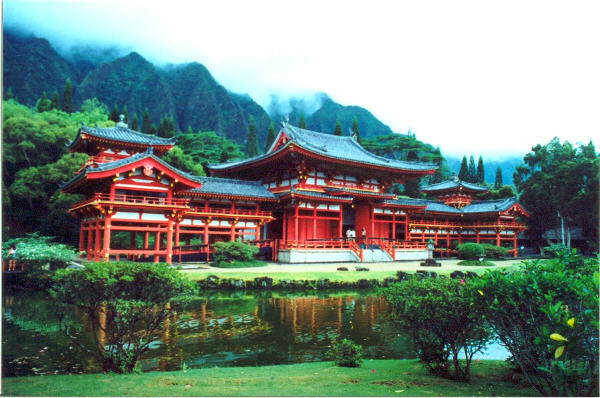
Byodo-In


If you click on the title of this post, you'll be directed to the original Wikipedia article, which has more information, links, etc.

Built in 998 in the Heian period, Byōdō-in (平等院) is a temple in the city of Uji in Kyoto Prefecture in Japan. The most famous building in the temple is the Phoenix Hall or the Amida Hall. It is a Buddhist temple, established by Fujiwara no Yorimichi in 1052: the former owner, Minamoto no Toru, used the building as a country villa. Additional buildings making up the compound were burnt down during a civil war in 1336.

Byōdō-in consists of a central hall, flanked by twin wing corridors on both sides of the central hall, and a tail corridor. The central hall houses an image of Amida Buddha. The roof of the hall displays statues of fenghuang, the Chinese phoenix, called hōō in Japanese.

The Phoenix Hall (鳳凰堂 hōō-dō), completed in 1053, is the exemplar of Fujiwara Amida halls. It consists of a main rectangular structure flanked by two L-shaped wing corridors and a tail corridor, set at the edge of a large artificial pond. Inside, a single golden image of Amida (c. 1053) is installed on a high platform. The Amida sculpture was executed by Jocho, who used a new canon of proportions and a new technique (yosegi), in which multiple pieces of wood are carved out like shells and joined from the inside. Applied to the walls of the hall are small relief carvings of celestials, the host believed to have accompanied Amida when he descended from the Western Paradise to gather the souls of believers at the moment of death and transport them in lotus blossoms to Paradise. Raigo paintings on the wooden doors of the Phoenix Hall, depicting the Descent of the Amida Buddha, are an early example of Yamato-e, Japanese-style painting, and contain representations of the scenery around Kyoto.

There is a garden with a pond in front of the building, which in 1997 was dredged as part of an archeological dig.

Japan commemorates its longevity and cultural significance by displaying its image on the 10 yen coin. In December 1994, UNESCO listed the building as a World Heritage Site as part of the "Historic Monuments of Ancient Kyoto". The Phoenix Hall, the great statue of Amida inside it, and several other items at Byōdō-in are national treasures.

A full-size replica of the temple was built in 1968 at the Valley of the Temples on O'ahu, Hawaii. See Byodo-In Temple.

Monday, July 10, 2006

300 Tang Dynasty Poems: #17 The Beautiful Xi Shi


The Tang Dynasty was considered a high point in Chinese culture. Poetry was especially esteemed. If you click on the title of this post, you'll be directed to an online version of the famous anthology, 300 Tang Dynasty Poems. #17 follows:

Wang Wei
THE BEAUTIFUL XI SHI

Since beauty is honoured all over the Empire,
How could Xi Shi remain humbly at home? --
Washing clothes at dawn by a southern lake --
And that evening a great lady in a palace of the north:
Lowly one day, no different from the others,
The next day exalted, everyone praising her.
No more would her own hands powder her face
Or arrange on her shoulders a silken robe.
And the more the King loved her, the lovelier she looked,
Blinding him away from wisdom.
...Girls who had once washed silk beside her
Were kept at a distance from her chariot.
And none of the girls in her neighbours' houses
By pursing their brows could copy her beauty.

Sunday, July 09, 2006

Media weekend


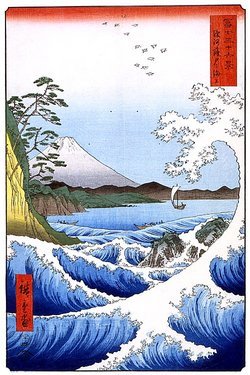
On Friday, I picked up a book at Barnes and Noble for $14.98: 100 Views of Edo by Ando Hiroshige (ISBN: 0760772916). It's a beautiful volume. Each of the woodblock prints faces text which describes the scene, what it was like in Hiroshige's time, it's significance, etc.

I saw the new Pirates of the Caribbean movie. It was a lot of fun, but I was disappointed that there was no fencing sequence that even came close to the one in the first movie; and the ending left me unsatisfied. Kiera Knightly could use to eat a sandwich. Lovely girl, but way too skinny.

Finally, I saw The Last Samurai on cable. The cinematography and costumes were fabulous. I only wished the fighting sequences were a little less flashy, and more "classic." I was able to pick out some words in Japanese, so I'm coming along on that front.

Thursday, July 06, 2006

Journey Across the Roof of the World


If you click on the title of this post, you'll be directed to the full article.


Journey across the roof of the world
By Jane Macartney

There's a train that puts Tibet in touch with the outside world - and more firmly under China's grip

As the train climbed towards the highest railway pass on Earth, funny things began to happen.
Pens leaked. Air-tight bags of crisps and peanuts burst open. Laptops crashed and MP3 players stopped working. Passengers began feeling nauseous, and some reached for their oxygen masks. A few were sick.

But few of the 500 passengers on board were complaining. For railway buffs, this was as close as it came to paradise. We were on board the first passenger train to journey the 4,000km (2,500 miles) from Beijing to the ancient Tibetan capital of Lhasa and the final 1,110km yesterday took us up through the 5,072m (16,640ft) Tanggula Pass and across the roof of the world.

As the 19-car T27 train climbed around hairpin bends on banks and bridges, Ivor Warburton could hardly contain his excitement. “This is everything I had hoped and a bit more,” the former British Railways executive exclaimed.

Outside the sealed windows, protected by ultra-violet filters, shaggy yaks ran startled from the train, rare antelope grazed on the grasslands, snow-capped peaks glistened in the sun and fat marmots scampered into their burrows.

This journey was made possible by what President Hu of China called a “miracle” of engineering.

“We have the courage, confidence and ability to stand among the advanced peoples of the world,” he declared when he officially opened the line on Saturday.

It took more than 30,000 workers five years and more than £2.3 billion to build. About 550km of it runs over unstable tundra, requiring raised causeways and underground cooling pipes to prevent the ice melting. It is the world’s highest railway, surpassing Peru’s Lima-Huancayo line, which reaches 4,800m, and the highest station is in Nagqu, a town at 4,500m (14,850 ft).

Chinese officials consider it a testament to the success of their country’s economic reform and its rise as a major world power. State-controlled newspapers published pictures of villagers waving at the pssing train, and television showed President Hu congratulating workers who built the line.

But the line is also a political statement. It cements Beijing’s writ over Tibet, 56 years after the Chinese army marched into the remote Himalayan fastness. Along the line, paramilitary People’s Armed Police were stationed at intervals of about a kilometre, each standing at attention, back to the train, gazing out over grasslands where scarcely a human being was to be seen.

“The People’s Armed Police are here to protect the railway” read a banner at one station, though they may be more worried about scavengers eager to steal the rails than saboteurs wanting to disrupt services.

Previously, the journey from Beijing to Lhasa would have taken days, if not weeks, by road and rail. It can now be completed in 48 hours, for a fare of as little as £25 for those prepared to sit bolt upright on hard-backed chairs.

The one-way air fare of more than £200 is beyond the reach of most Tibetans and Chinese, and hardly an adventure. The rail journey takes you from one of the most densely populated parts of the planet, through endless hours of farmland, and then up through the rocky desert of the Himalayan foothills into boundless grassland.

Yesterday the train left Golmud — once the last station on a line that used to end abruptly in the sands of Qinghai province — at dawn.

It stopped to change its ordinary locomotives for three diesel-powered 3,800-horsepower engines made by GE in Erie, Pennsylvania. The engines had been adapted to pull 15 carriages and a generator car up from 2,816m to altitudes of more than 5,000m where the lack of oxygen reduces power by as much as a third.

Mr Warburton, whose company RailPartners hopes to launch a luxury tourist train along the line by late 2007, admired the achievement as we climbed at a gradient of one in 50. “This is brilliant because the climb is relentless,” he said.

Wednesday, July 05, 2006

A Teahouse in HangZhou


If you click on the title of this post, you'll be directed to a photo essay with narration, which describes a teahouse experience in Hangzhou which is unlike any other you're likely to encounter.