
Today we have another guest article by Jonathan Bluestein. Enjoy.
The
Lost Art of Buddah’s Guardian
By
Jonathan Bluestein
Among the many arts taught by late
master Zhou Jingxuan was a style called ‘Shaolin Jingang
Bashi’, or ‘The Eight Posture’s of Shaolin’s Buddha’s Guardian. This rare
martial art, now almost lost, is an exquisite tradition that I have had the
privilege to study in part from master Zhou. Here is the story behind it.

A secret history
The Shaolin Monastery as we know it
today is a modern invention, sponsored by the Chinese Communist Party. The
original temple, which existed for several centuries, was destroyed and later
rebuilt several times. A focal point for martial arts traditions from its early
days, the temple first became well known for its staff techniques and later for
empty-handed martial arts. The monks, being Buddhist, hold to a faith that
forbids violence. However, the circumstances of occasional visiting bandits,
thieves and armies forced them to adapt their practice for survival. Following
many years of civil unrest and internal conflicts in China, the location of the
temple was nearly deserted in the 1970s and 80s, when the Chinese Government
decided to invest in it and introduce many new monks to rejuvenate lost
traditions. Yet the motivation was anything but religious. The place, now
famous worldwide because of various books and films, was growing into a tourist
attraction, and the government recognized its money-making potential. Thus,
over the next few decades and to our present day, the Shaolin Temple gradually
became the ‘martial arts Disneyland’ of China, with countless other competing
‘theme parks’ masquerading as ‘martial arts academies and schools’ popping up
in the nearby mountains and valleys of Hebei and Shandong. These places now
offer school-boarding conditions and sometimes even hotel-like accommodations for
those souls searching for a self-made fantasy of being a Chinese warrior.
Frankly, what is being taught is the athletic and sports-oriented modern wushu,
with the traditional arts long forgotten.
Fortunately for everyone, the
original arts of Shaolin were not all lost. Throughout the centuries, once in a
while a monk would leave the temple, a process that had been accelerated and
multiplied whenever the temple’s population was under great duress. The monks,
who spent a lifetime training in the martial arts, often did not neglect their
practice, and taught what they knew to layman they met on their path. This is
how the Shaolin arts spread far and wide. Back in the day, such arts were
commodities of great use. They helped maintain people’s health in an age with
less advances and not readily available medicine. Their practice aided in
building strong bodies, and teaching independent farmers and villagers how to
defend their territory from raids and enemies. Such valuable knowledge, people
were willing to pay much for, or at least offer the teacher living arrangements
to teach them.

Then it so happened that a traveling
Shaolin monks met with a local man from Tianjin city, whose name was Shi
Yushan. This was likely in the early 20th century. The late Shi
ended up learning a special martial art from the monk, whose name was lost to
us – Shaolin Jingang Bashi (少林金剛八势). This art is
no longer practiced at the Shaolin temple, although poor modern imitations of
its most basic movements are occasionally demonstrated by some monks. These
were likely copied from books or similar, and are not the original art. The
art, it should be noted, was quite rare to begin with, because it had been an
‘inner-court style’ – a more advance level art, that was only taught to
experienced monks. In fact, back in the day it did not even have a formal name.
It was simply called ‘Nei Yuan Quan’ – ‘Inner Material’.
Jingang (金剛), known
as Vajrapani in Hindu, is the bodyguard of the Buddha. The original name in Hindu
means (one with) Lightning in Hand. Jingang in the context of Shaolin and its
religion is a combative war-mongering deity that is always portrayed with angry
and intimidating expressions and postures, and is considered the protector of
the temple. The statues of various Jingang are common sight in Buddhist temples
throughout China. His very existence demonstrates well the departure of many
Chinese Buddhists from their original pacifistic Indian origins, and their
embracing of violence as means to an end under dire circumstances. The worship
of the Jingang shows that the Chinese Buddhists who created its image were keen
on receiving aid from a god of war – and for good reasons. To this day, the
imagery of the Jingang can be found in various Shaolin-derived martial arts –
even Chen style Taiji Quan.
After the art of Jingang Bashi ceased
to be taught at the temple, it seems to have survived in only two lineages.
Great master Li Ruidong (1851-1917), who created a very expansive system of
Taiji Quan, have somehow managed to learn this art, and incorporated some of it
into his Taiji. Sadly, in the process he also ceased to teach Jingang Bashi as
a whole, and little of it survived in his line. Shi Yushan, a contemporary of
Li Ruidong, was the only one who managed to keep the art alive.
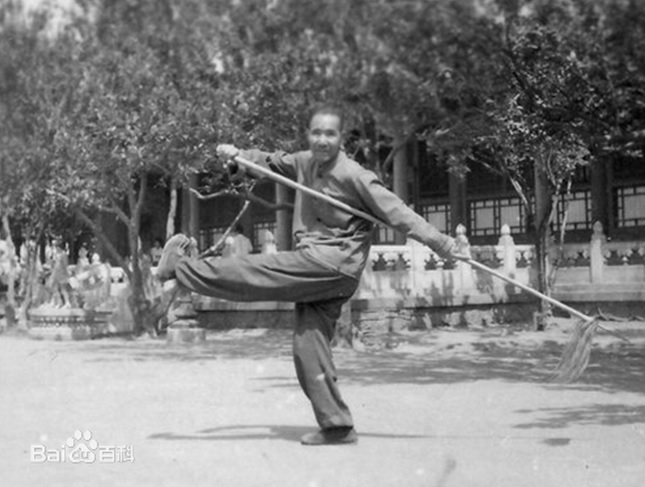
In the picture:
Master Tian Jinzhong, top disciple of Shi Yushan, with his spear.
Following his years with the Shaolin
monk, master Shi returned to his native city of Tianjin. There, he became
famous, and known by the nickname ‘Iron Luohan’ (铁罗汉) for his ability to effortlessly
absorb powerful strikes to his body at will. He subsequently became the manager
of the ‘Tianjin’s 11th Chinese Martial Arts Academy’, a respectable
institution intended to spread the arts publicly (a new social theme at the
time).

During that period, Shi was hired to teach a child – young Tian Jinzhong (田金钟). As common in traditional Chinese
education, Tian’s wealthy family aspired to provide its children with many
private tutors, to instruct them in the various arts, traditions and sciences
of the vast Chinese cultural heritage. Tian excelled in his studies of the art
and inherited master Shi’s complete system, becoming famous for his skills with
the spear. After receiving a complete transmission,
Tian also became a student of Wu
Xiufeng, who is said by many to be the greatest teacher of Baji Quan to have
lived during the 20th century, and whose art is considered a branch of its own:
‘Wu-style Baji Quan’. This art too, Tian learned fully.
In his study of these two arts,
master Tian saw many complementary elements. Jingang was very swift, agile,
quick, flexible, unpredictable, light, crisp and mobile. Baji was very heavy,
powerful, unified, unyielding, forceful, rooted, blunt and violent. By
combining the strong points of both arts, master Tian was able to create a
tradition that offered the best of both worlds. Although he maintained separate
teachings of the two styles, each one of them had undergone renovations and
innovations based on the unique skillsets of the other. Therefore, the
successors of Tian Jinzhong, although their Baji came originally from Wu
Xiufeng, refer to their art as ‘Tian style Baji Quan’ rather than ‘Wu style’.
Here is the only surviving video we
(outside of China) still have of master Tian, demonstrating the Qing Long Jian (Green
Dragon Sword) of Jingang. It should be noted that the performance is somewhat
casual, also omitting parts of the form, as Tian was not interested in sharing
his knowledge completely with strangers (a typical traditional Chinese
mindset).
One of Tian’s gongfu brothers under Wu Xiufeng was master Zhao Fujiang (赵福江; - 2007). With a level of skill seldom seen even in China, master Zhao was able to create a new art, Yin-Yang Baji Quan, by combining his extensive knowledge of Baji Quan, Xing Yi Quan and Da Cheng Quan. Here is a very lengthy documentary about master Zhao. Those among you who do not understand Mandarin Chinese may feel free to skip to parts containing more action.

Despite being recognized as a great master in his own right, who founded his own system of martial arts, Zhao Fujiang always admired and looked up to his older gongfu brother, Tian Jinzhong. He admitted to have never achieved Tian’s level of skill in the arts.
Master Tian passed away age 74, in
the year 1990. Through decades of teaching Tian too, like his teachers, became
a famous figure in the city of Tianjin. His instruction was sought by many. Two
lucky individuals were able to study master Tian’s complete arts: Shen Jiarui and Sun Zhenyao. Sworn gongfu
brothers, they continued to teach their arts together for decades. Master Shen
was known to be the more heavy and powerful, and master Sun as the more light
and agile. Together, they made a great team. Alas, about a decade ago master
Sun suffered a severe hip injury and could no longer train. Master Shen continues
to teach, but is not retired, and is currently in his 70s.

In the picture:
Master Sun Zhenyao (left), master Shen Jiarui (right), and master Zhou
(behind them). Image is from the early 2000s.
Masters Sun and Shen were able to
transmit their arts fully so far to only one student – their top disciple, late
master Zhou Jingxuan. Sadly, Zhou shifu passed away this year, age 50, from
medical complications of a stroke. Click here for a short biography of his life
and teachings.
Late master Zhou became the embodiment of Jingang Bashi, and was the last
inheritor of this complete system. So skilled and knowledgeable was he, that
his manifestation of the art combined the strengths of both his teachers. That
would not be surprising given the many decades master Zhou had spent studying
the arts with countless teachers. Moreover, he not only received in-depth
private tuition from masters Shen and Sun, but was also corrected and taught at
times by Tian Jinzhong himself, and was a long-term student of his gongfu
brother, Zhao Fujiang, whom I mentioned before. With such profound instruction,
it was only natural that Zhou shifu would with time achieve a high level of
mastery in this art. Because most of my own exposure to the art had been
through master Zhou, from now on in this articles, examples and anecdotes would
mostly be directly based on his teachings, which his photographs and videos
illuminating this wondrous cultural asset of China.

In the picture:
Various martial arts practitioners and teachers from Tianjin. Master
Zhou is kneeling on the furthermost left corner. Right behind him with the
glasses stands master Tian Jinzhong. The nearly bald man standing aside Tian is
his gongfu brother, master Zhao Fujiang. Image is from the 1990s.
As master Zhou’s fame grew far and
wide, he gained access to studying and exchanging knowledge with many teachers.
At one point in time, he developed an interest in Li style Taiji Quan. This
system was developed by Li Ruidong (1851-1917), who practiced the Yang style
Taiji of Yang Luchan and learned the entire Jingang Bashi system from an
unknown teacher. Li incorporated much of Jingang into his broad, extensive
martial arts system, but ceased to teach it as an art during his lifetime.
Master Zhou located a group of dedicated teachers who practiced Li’s Taiji, and
made an agreement with them – they would teach him their Taiji, and he would
impart unto them all that he knows of Jingang Bashi. He was also accepted as an
indoor disciple in that family under master Li Zhaoyin, student of master Li
Ziqin (this was the seventh time Zhou had undergone such a ceremony and earned
that kind of honour under a martial arts master). Zhou shifu managed to study
most of their style, but how much they got from him remains unclear. This
learning experience helped further hone his Jingang, adding the modified
content taught by Li Ruidong, which was slightly different to what he had
already studied with masters Shen, Sun, Tian and Zhao.
Master Zhou was technically my
grand-teacher, but most of my Pigua Zhang and some of my Xing Yi Quan I learned
directly from him. The rest I studied with my main teacher, shifu Nitzan Oren, a
fellow Israeli who is late master Zhou’s top disciple. They are both family to
me.
Shifu Nitzan studied with Zhou shifu on a daily basis for 7 years straight
while he lived in the city of Tianjin. Indeed, since the days of Shi Yushan,
all practitioners of this art were natives of that city. Initially, shifu
Nitzan learned mostly Xing Yi Quan from master Zhou, who would on occasion
supplement his studies with some Pigua Zhang, Baji Quan and the exploration of
various weapons and their usage, as well as some Qi Gong practices (36 Methods
Qi Gong, Ba Duan Jin, etc). After roughly 5 years of daily practice, master
Zhou began to urge Nitzan to further and deepen his studies. He would often
tell Nitzan that “he had nothing more to teach him as far as Xing Yi is
concerned”, though unsurprisingly he would always have more methods, skills,
techniques and corrections for him every week. The truth was that the clever
master Zhou knew all too well that in order for Nitzan’s gongfu to become
greater, he needed to gain inspiration from new studies. This sent Nitzan on
two new paths. Firstly, at Zhou’s recommendation, he found a new teacher to
learn from, master Wu Bingwen, who taught Song style Xing Yi Quan. Secondly, at
the same time and also with Zhou’s encouragement, he began to study Jingang
Bashi. Thus, Song style Xing Yi and Jingang Bashi became the focal points of
Nitzan’s study during his last two years in China.
He would also continue to
study Jingang Bashi from master Zhou after that time on occasion, returning to
China and having Zhou visit and teach us here in Israel. This continued until
master Zhou’s untimely passing. Luckily, Nitzan was able to learn most of
master Zhou’s Jingang Bashi, and also document almost all that he had studied
on video, with clear instructions and demonstrations by master Zhou on
everything.
I was also quite lucky and fortunate
to have had the opportunity to study a little bit of Jingang directly from
master Zhou. I was taught the eight basic combinations of the art, but also a
very long segment of the highest, most sophisticated form of it, known as ‘Luohan
Gong’. It remains an enigma as to why Zhou shifu chose to teach me that set
of skills, which had never taught to anyone else; as even though I have been
training in his arts for many years at that point, I had not practiced enough
of this particular art to true appreciate and do justice to this long form. I
suspect that Zhou was fearful that the art may become lost, and as he grew
older sought to pass on as much of it as possible to whomever was willing to
learn. Master Zhou and I were not close as friends because of the language
barrier (my Mandarin is very basic), but we had a strong bond and understood
each-other very well.
I believe Zhou shifu always had faith in me, and in my ability to understand what he was trying to teach me. Thoughts of this almost bring tears to my eyes, as nowadays I am currently the only person actively and openly teaching his traditions (though shifu Nitzan will likely return to teaching in the future). This faith master Zhou had in me is a trust that I feel I cannot fail. I must live up to his high standards of excellence, and this article is a part of my genuine attempt to keep Zhou’s legacy alive and kicking.
Historic Clarification
There has been some confusion over
the origins of Jingang Bashi that should be addressed. Historican Kang Gewu
suggested a relationship between Jingang Quan and Bagua Zhang. This is easily
mistaken to be related to the subject of this article, both because of the name
and also since Jingang Bashi uses the Bagua theory and the Yi Jing’s 64
hexagrams as a framework for the structure of its curriculum – much like Bauga
Zhang. However, this is misguided. Jingang Bashi is not the same art as Jingang
Quan, and these two are among several Chinese martial arts that use ‘Jingang’
in their name. Also, while Bagua Zhang very much a Daoist art, Jingang Bashi is
fiercely Buddhist, both in its origins and in the way it is practiced.
The skills of the Bodhisattva
Ever since its days as an inner-court
style at the Shaolin Temple, Jingang Bashi was known as a ‘martial art for
martial artists’. There are two main reasons for this:
1. The art is challenging to teach to
beginners and assumes the practitioner already has some foundations built into
his body through the practice of other styles.
2. The arts contains a truly vast
arsenal of techniques and fighting methods, which provides ‘solutions’ to
nearly any possible fighting scenario, with the sole exception of
ground-fighting. In doing so, it can serve to fill-in technical gaps of
knowledge in any martial artist’s arsenal.
The curriculum of Jingang Bashi
interestingly resembles in structure the way various styles of Bagua Zhang
created theirs. The ‘Ba Shi’, or ‘Eight Postures’, refers to the art being
segmented into many groups of 8 combinations. Once a set of 8 separate
combinations is taught, the next can be studied, and each of these groups
builds upon and evolves previous material.
The art begins with the 64 Firm
Hands (六十四硬手). First are taught the 8 most basic techniques, called
Liu He Ba Shi – Six Harmony Eight Postures. These techniques are the
jibengong of the art, are less focused on actual fighting applications, and are
meant to forcefully stretch one’s body to an extreme degree with very elongated
postures. These are later evolved into the eight Jin Gang Ba Shi , which
illustrate how the first hands can be used in combat. The cycle of the basic
hands continues to amount until the practitioner has learned eight different
groups of 8 combinations – or 64 movements and techniques total in this group
called the 64 Firm Hands. At this point, all of the material is still
made of standalone methods, without any forms to connect them. Each stage of
learning is meant, as stated before, to be an evolution of the previous one,
and the similarities between techniques in both external shape and principle
makes them easier to study and memorize over time.
Master Zhou would also teach
beginners special Zhan Zhuang (stand post) methods for this particular art. Although
Zhou had extensively studied Xing Yi Quan (with no less than 4 teachers), the
Zhan Zhuang he taught in his Jingang Bashi system were of independent origins,
likely borrowing concepts and methods from ancient Qi Gong practices such as
the Yi Jin Jing (Muscle-Tendon Classic 易筋經) and Si Xui Jing (Marrow-Cleansing
Classic 洗髓经). The Zhan Zhuang of Jingang require
more internal stretching and twisting than those of other arts, and are
challenging to hold correctly, especially since distinctive breathing skills
are involved. Often, as a prerequisite for Jingang’s more specialized Zhan
Zhuang, master Zhou would also teach Xing Yi’s Hun Yuan Zhuang (Cheng Bao
Zhuang) for a few months. Here are a few examples of the types of postures that
would be taught (there are several others not shown here). Shown Zhuang are
very basic.


Once the Liu He Ba Shi are well
drilled and the foundations of the style’s Zhan Zhuang are set, the 64 Hard
Hands are taught. These are eight groups of eight combinations, which are
very combat-oriented. With these, the experienced practitioner may notice that
there are included in the art many techniques commonly found in Xing Yi Quan,
Baji Quan, Pigua Zhang, Shuai Jiao, Fanzi Quan, Luohan Quan and other
northern-Chinese styles. How this came to be is a mystery, since master Zhou
did not make these up, and his Jingang teachers (and their teachers) did not
practice Xing Yi or Pigua or any other arts apart from Jingang and Baji.
Regardless, such similarities were a blessing for master Zhou, since he had studied
several of the styles featuring comparable techniques before arriving at
Jingang. This meant that to begin with, the art came very naturally to him, and
he was able to transmit it with great depth.
As the 64 hard ones become
second-nature, the practitioner will make a transition into the practice of
their more advanced form – the 64 Soft Hands. These are also segmented into
8 groups of 8 combinations. These are built as set reactions to fighting
scenario attacking or responding to attacks, and anticipating various
reactions, providing elaborate ‘solutions’ to any tactic the opponent may come
up with.
There is more stepping and kicking involved, and the footwork should be akin to
that of dancer – very mobile and swift, light and agile, almost hopping around
yet remaining grounded. Although the mechanics are very different, the rhythm
is reminiscent of good Western Boxing.
Here at this stage are also first introduced more refined body mechanics which
are often similar to those seen in the Internally-oriented arts. The
practitioner here seeks to begin development of the art’s trademark power,
which has a very snappy quality to it, and is unique to this style. This power
combines the whipping character of Tongbei and Pigua strikes with the forceful
nature of Shaolin arts. Also shown with the 64 soft hands is the higher-level
footwork, which is key for the application of the art in combat. Jingang likes
to surround the opponent with rapid and unpredictable stepping patterns, which
require much lightness and agility. This calls for physical dexterity and
flexibility of mind, too.
As a training aid in the mastery of
the 64 hands’ intricate footwork, the practitioner will work on moving through
the drawn path of a ‘magic square’. This type of drawing or diagram is known as
the ‘Magic Square’ in Western culture, but has older roots in Chinese culture,
going back many thousands of years to the famous Luo Shu 洛書 (ancient
diagram; below on the left). This later became another notable Chinese symbol
more similar in shape to the Western Magic Square, known as the Nine Palaces.
The latter is used for the training of footwork in Bagua Zhang and several
other Chinese martial arts as well, and is mentioned in Sun Lutang’s books. The
purpose of this strange and counter-intuitive stepping pattern is to teach the
body to be able to naturally transition around and into any obstruction and
attack, being able to naturally evade and outmaneuver any threat. Sun Lutang
wrote that a prolonged practice of this method has the capacity to “profoundly
change the practitioner”.

Some of the 64 soft hands have been
combined into a form known as ‘Mian Zhang’ (Cotton Fist). The Northern
Shaolin origins of the art are very apparent in this form, which features many
commonplace Shaolin techniques and footwork patterns. It is the first long form
to be taught, and is excellent for cardiovascular conditioning. The latter
ability is important for the practice and use of the art, since it relies on
much movement in space as part of its overall combat strategy. In fact, the art
is no less mobile than Western Boxing, and its footwork is more complex, too.
In Mian Zhang is first seen the
Mandarin Duck Kick, which is also common in Chuo Jiao, Fanzi Quan and many
other Northern-Chinese arts, and later appears in more advanced forms of
Jingang as well (see second 35 in the video above). This kicks and many other
movements as such require a great degree of flexibility. Below is an image of
master Zhou training a child student to achieve that level of flexibility,
which is key to learning many moves and methods. Interestingly enough, though
many consider this to be an upward-driven kick, one aims to be hitting on the
way down as well, which can result in a devastating chest blow.
The practitioner who is already
familiar with the 64 soft hands and the Mian Zhang form would be encouraged to
combine the hands at will, creating elaborate and novel combinations without a
fixed routine. This is essential for learning true fighting flow.

Training will continue with learning
the Lian Shou Quan (Linking Fist Hands). These are eight very short
forms which are practiced explosively. The practitioner charges forwards in a
straight line, executing the entire form with 10-12 steps and “in a single
breath”. These linking forms add a strong anaerobic conditioning component to
the training. Their purpose is to train one’s body and spirit to initiate and
end a fight with a short, continuous streak of unstoppable action. One becomes
like a string of firecrackers being lit and exploding in quick succession,
issuing force and shaking hearts without letting one’s heart settle. The
emphasis is also put on creating superior smoothness and transitioning from one
technique to another.
Next in line on the curriculum are
two complementary forms: Qing Long Quan (Green Dragon Fist) and Hei
Hu Quan (Black Tiger Fist). These advanced hand forms carriy the ultimate fighting
flavor of the art and are highly regarded. While most of Jingang Bashi is
practiced at a walking pace or very fast speeds, these forms are traditionally
also practiced at slow and very slow speeds, and in a flowing manner akin to
Taiji Quan. The Green Dragon (Qing Long) teaches flexibility of motion through
the idea of attaining a ‘Dragon Body’, while Black Tiger yields through
practice a heavy power that can be issued sideways.
The Dragon and Tiger have
long been considered completing opposites in Chinese culture. The Dragon is the
god of the East, and relates to the Wood element, spreading wide with
dexterity. The Tiger is called ‘Black’ (Dark) because of its vicious
techniques, but is actually based on the White Tiger, the god of the West,
associated with the Metal element, being heavy and sinking in nature. In our
lineage, the two gongfu brothers Sun Zhenyao and Shen Jiarui represented these
two animals in their personality and spirit. Sun the agile and quick was like a
dragon and excelled with Qing Long Quan, while Shen the strong and heavy tiger
is known for his Hei Hu Quan.
Here are two separate versions of the
Qing Long Quan by master Zhou:
Below is are videos of Shen Jiarui
performing Hei Hu Quan (in his 60s at the time), and master Zhou teaching that
form to his student, Ingus. Although it is written in the videos that this is a
“Baji Quan form”, in fact our Baji tradition borrowed it from Jingang:
Once the Green Dragon and Black Tiger
forms are mastered, weapons must be introduced before the final stage of
training is achieved. The weapons of Jingang Bashi, the Spear, Dao, Guan Dao
and Jian (in this order), are essential not only for their own sake, but also
for the development of superior shen fa (body method). Each of the weapons has
its own dedicated long form, but is first taught through separate exercises and
drills. Each weapon also teaches a specific set of battlefield concepts. For
instance, the Jingang Dao is unique in that often one hand holds unto the back
of the blade, and the weapon is then used somewhat like a staff.
Without the unique shen fa developed through wielding these weapons, the
practitioner cannot gain the more advanced intricacies of the system’s minute
body mechanics and Nei Gong. This is especially true for the Jian (straight
sword) of the style, which epitomizes its splendid light footwork and coiling internal
momentum. In second video among the following two, much of this is apparent in
master Zhou’s teachings:
Another video of the Jian, by late
master Tian Jinzhong, is included earlier in this article.
The Jian of Jingang utilizes the tassel
to practical training purposes. With various methods and techniques, the
movement of the tassel and the place where it lands relative to one’s body, are
used as indicators of precision in body alignment and timing. In Jingang the
tassel is therefore actually quite useful for these reasons, though in other
arts it is mistakenly thought of and used as an ornamental piece.
The art culminates with an amazing
form called ‘Luohan Gong’. This form is comprised of no less than 18 sections,
containing 8 movements each (144 movements total). The walking pattern of the
form has the practitioner advancing forward doing one section, then turning
around in half a circle and continuing with the other section, and so forth.
This walks the practitioner around drawing a very long snake-like path, which
interestingly ends at a position quite far from the origin point. Rather than
being a unilaterally balanced form that goes in all directions and end up where
one began, the form has different training goals in mind. It assumes that those
other attributes just mentioned should already be ingrained in the practitioner
from the practice of other forms and methods over the years. This form now
serves to catalogue the entire art in a single stream of techniques.
Furthermore, the form is practiced very slowly, with little explosive power, unless
a section of it is drilled independently. The focus shifts to advanced
breathing methods, and the practice turns very internal and Taiji-like. Great
softness is encouraged, and the form flows without interruption or stoppage.
Much of the shen fa from the weapons is now incorporated into the hand methods,
which together with newly-taught nei gong and breathing gains a whole new feel
and perspective. The art then transcends its initial focus on technical
prowess, and transitions into a practice driven by movement principles.
This is a video of Zhou shifu
demonstrating the first 4 sections of the Luohan Gong form:
Here is specified the art’s complete curriculum,
in general terms. There are several additional methods and drills which I have
omitted, but overall the following represents the bulk of the teachings:
64 Firm Hands
六十四硬手
|
||||||||||||||||||||||||
Liu He Ba Shi
六合八式
Six Harmonies Eight Postures
The Jibengong of the art
|
Jin Gang Ba Shi
金刚八式
Jin Gang Six Harmonies
Basic martial applications
|
|||||||||||||||||||||||
1
|
1
|
1
|
1
|
1
|
1
|
1
|
1
|
|||||||||||||||||
1
|
1
|
1
|
1
|
1
|
1
|
1
|
1
|
|||||||||||||||||
Wen Gong Ba Shi
文功八式
Cultured Skills Eight Postures
Build a calm mind and strong tendons |
Wu Gong Ba Shi
武功八式
Martial Skill Eight Postures
Teaches the power issuing of the art
|
|||||||||||||||||||||||
1
|
1
|
1
|
1
|
1
|
1
|
1
|
1
|
|||||||||||||||||
1
|
1
|
1
|
1
|
1
|
1
|
1
|
1
|
|||||||||||||||||
Xing Gong Ba Shi
行功八式
Effective Skills Eight Postures
Shows how to link movements and execute them
together
|
Zhuan Gong Ba Shi
转功八式
Revolving Skills Eight Postures
Changes
in direction are explored with these
|
|||||||||||||||||||||||
1
|
1
|
1
|
1
|
1
|
1
|
1
|
1
|
|||||||||||||||||
1
|
1
|
1
|
1
|
1
|
1
|
1
|
1
|
|||||||||||||||||
Qun Zhang Ba Shi
群战八式
Group-fighting Eight Postures
How to fight against multiple opponents
|
Gong Fa Ba Shi
功法八式
Skill Method Eight Postures
Unites the entire scheme of the first 64 hands into a
single framework
|
|||||||||||||||||||||||
1
|
1
|
1
|
1
|
1
|
1
|
1
|
1
|
|||||||||||||||||
1
|
1
|
1
|
1
|
1
|
1
|
1
|
1
|
|||||||||||||||||
Zhan Zhuang 站桩
Standing postures intended for developing structure
and working on some of the Nei Gong of the system.
|
||||||||||||||||||||||||
64 Hard Hands
六十四刚手
|
||||||||||||||||||||||||
8
|
8
|
8
|
8
|
8
|
8
|
8
|
8
|
|||||||||||||||||
64 Soft Hands
六十四柔手
|
||||||||||||||||||||||||
Xun Huan Zhang
8
|
Fan Zi
Shou
8
|
Zhi Chuo Zhuan Huan
8
|
Kun Shou
Shi
8
|
Shun Feng
Sao Ye
8
|
Shan
Men Zi
8
|
Zhai Shen Huan Ying
8
|
Ning Bu
Bo Lan
8
|
|||||||||||||||||
Mian Zhang
Cotton Palm – A form
|
||||||||||||||||||||||||
Learning free flow with the 64 soft hands
|
||||||||||||||||||||||||
Lian Shou Quan
Linking Fist Hands – eight short forms
|
||||||||||||||||||||||||
1
|
1
|
1
|
1
|
1
|
1
|
1
|
1
|
|||||||||||||||||
Qing Long Quan & Hei Hu Quan
Green Dragon Fist and Black Tiger Fist – two forms
|
||||||||||||||||||||||||
Wu Hu Duan Men Qiang
A spear form
|
||||||||||||||||||||||||
Wu Hu Duan Men Dao
A broadsword form
|
||||||||||||||||||||||||
Jingang Dao
A broadsword form
|
||||||||||||||||||||||||
Jingang Guan Dao
A halberd form
|
||||||||||||||||||||||||
Qing Long Jian
Green Dragon Straight Sword – a form
|
||||||||||||||||||||||||
Luohan Gong
One form, eighteen segments of 8 combinations
|
||||||||||||||||||||||||
8
|
8
|
8
|
8
|
8
|
8
|
8
|
8
|
8
|
8
|
8
|
8
|
8
|
8
|
8
|
8
|
8
|
8
|
|||||||
The art of Shaolin Jingang Bashi is a
treasure of Chinese culture, the work of many generations perfected into a
superb fighting system. In it is contained a knowledge from countless styles
and an experience based on a lifetime of exploring them. My heart aches
thinking that this amazing martial art is now almost extinct. I have hope for
the future though, as the art remains safe in the body and mind of my teacher,
Nitzan, who is worthy of its keeping. May we live to see many excellent
practitioner come to learn this special art from him, so it could continue to
benefit future generations.
All rights of this article are and the pictures within it are reserved to Jonathan Bluestein ©. No part of this article may be reproduced or transmitted in any form or by any means, electronic or mechanical, including photocopying, recording, or by any information storage and retrieval system, without permission, in writing, from Jonathan Bluestein.

______________________________________________
Jonathan Bluestein is best-selling author, martial arts teacher, and head of Blue Jade Martial Arts International. For more articles by shifu Bluestein, his books and classes offered by his organization, visit his website at: www.bluejadesociety.com
You may also subscribe to Shifu Bluestein's youtube channel, which is regularly updated with rare and fascinating martial arts videos:
https://www.youtube.com/channel/UCR0VUbThdexbXJb9BBSKMbw
You may also subscribe to Shifu Bluestein's youtube channel, which is regularly updated with rare and fascinating martial arts videos:
https://www.youtube.com/channel/UCR0VUbThdexbXJb9BBSKMbw
All rights of this article are and the pictures within it are reserved to Jonathan Bluestein ©. No part of this article may be reproduced or transmitted in any form or by any means, electronic or mechanical, including photocopying, recording, or by any information storage and retrieval system, without permission, in writing, from Jonathan Bluestein.


