Here at the frontier, the leaves fall like rain. Although my neighbors are all barbarians, and you, you are a thousand miles away, there are still two cups at my table.


Ten thousand flowers in spring, the moon in autumn, a cool breeze in summer, snow in winter. If your mind isn't clouded by unnecessary things, this is the best season of your life.

~ Wu-men ~


Showing posts with label biography. Show all posts

Monday, February 09, 2026

Reminiscing


At Ellis Amdur's Kogen Budo Blog, there was a recent post where the author reminisces about his early days training in Japan ... in Chinese martial arts. An excerpt is below. The full post may be read here.


In 1977, thanks to an introduction from Donn Draeger, I began training with Wang Shujin. Here is a video that spans from the  the early 1960’s (black-and-white) to a year before his death (color), when I met him.  We would meet at a temple near Shibuya, if I recall correctly, and in the bitter cold, try to imitate him as he went through his version of the Nanjing Synthesis taijiquan form. This form was created by Chen Pan Ling (here a portion performed by his son, Chen Yun Ching). Wang’s form was very different – he emphasized the elements of xingyiquan and baguazhang that Chen included in this form.

Wang had first started going to Japan to teach in the late 1950’s, I believe. There were several reasons for this: First of all, he was a practitioner of a syncretic religion called Yiguandao. Wang was a high-ranking member of this movement, and engaged in missionary activities, both in Taiwan and in Japan. Secondly, Wang was sponsored in his visits to Japan by Toyama Ryūsuke, one of the sons of Toyama Mitsuru, the founder of the Gen’yosha (‘Dark Ocean Society’). What people do not realize about the uyoku, the so-called Japanese right-wing is that they were intimately intertwined with religious movements, both within Japan and elsewhere. [Toyama was closely associated with the Oomoto-kyo of Deguchi Onisaburo and hence, Ueshiba Morihei of aikidō as well.] Many of men of the right were profound idealists (among the most dangerous of people) and others saw religion as a perfect avenue to move people in the direction that they wanted them to go. The early tairiku ronin (‘continental adventurers’ – agents provocateurs, spies, terrorists) were in large numbers Nichiren and Jodo Shinshu (the Nishi and Higashi Hongwanji) Buddhists, as were some of the most significant strategists who drove the invasion of Northern China.

Toyama Ryūsuke was also closely associated with Shindō Musō-ryū jo. Toyama Mitsuru sponsored various martial arts organizations, particularly from his home-town of Fukuoka, and his leading successor, Uchida Ryōhei was a practitioner of, among other things, this medium-length stick art. The Toyama family had sponsored the sponsors of Shimizu Takaji, the famous teacher of this art. Wang initially stayed at Toyama’s mansion, and through this connection, met and associated with many prominent Japanese martial artists. [NOTE: I have portrayed a lot of these men and this milieu in historical fictional form in Little Bird & The Tiger}.

There are lots of stories about Wang that, not being there, I will not waste time repeating (these often are merely, “He was the strongest man I never saw . . .”). I think, however, that it is probably hard to appreciate how formidable he was from looking at videos: he was really fat, and although he’s certainly agile in the earlier films, if one is not familiar with the purpose of his training, it all seems to be stilted, flowery or senseless. I will recount the only incident that I witnessed, for which I will give a little background.

One of Wang’s teachers was Wang Xiangzhai, the founder of dachengquan, also known as yiquan. This martial art was an attempt to distill the essence of the already pared-down pugilistic style of xingyiquan, focusing on solo training, particularly ‘post standing.’ Among Wang’s fellow students was Sawai Ken’ichi, who founded a Japanese version of this art, which he called Taikiken. Sawai was a very pugnacious man, and both he and Wang used to have training groups on the grounds of Meiji Shrine. Acquaintances of mine, some of whom studied with one or the other, told me that Sawai used to walk over to Wang’s area and berate him, saying he was wasting his time teaching baguazhang, xingyiquan and taijiquan: all he needed was dachengquan! Wang used to laugh and keep on moving. Sawai was a friend of the founder of Kyokushin Karate, Oyama Masutatsu. They had a close relationship and students of each would cross-train with the other. Thanks to this connection, some of Oyama’s students also trained with Wang Shujin. When I was practicing, one Kyokushin karate free-sparring students was among us; a very hard looking man, with a face scarred with numerous splits from kicks or punches to the face.

Wang was very ill at that time, perhaps a year before his death. He had a melanoma which had metastasized, and as one can see in the later portion of the linked video, his legs were stiff. He used to shuffle rather than walk. So, please understand, what I am about to describe was not a fight, or even a free sparring session. Wang asked the karateka to take a punch at him. He brushed it past his face – his forearm was about as big as my calf – and embraced him around the lower back, simultaneously smashing his belly into the man’s torso. It knocked all the wind out of him, and he collapsed to the ground, wheezing. [Wang thought this funny, and I recall his rumble, like an elephant digesting, that passed as his laugh]. So, what I saw was circumscribed – but lord, was it powerful.Wang was renowned for this. He would allow anyone to punch or kick him anywhere below the neck. Beyond that, he could absorb the punch and pulse it back out with such power that one risked a dislocation of the shoulder.

But I must confess – at the time, I didn’t get it. I saw how strong he still was, even while he was gravely ill. And I’d heard from others, Donn Draeger among them, what an absolute powerhouse he was when younger. But I could not see how standing around in the cold, trying to imitate him as he moved through a ninety-nine movement taijiquan form would do anything for me. [As I have written elsewhere, on a couple of occasions, I came early and saw him by himself, assiduously going over very simple movements as well as various post-standing exercises, something I was later informed was the key to his power. He practiced them four hours or more a day.]  At any rate, I didn’t get it, and after a couple of months, respectfully resigned the class, and moved on to Muay Thai.

One thing that always stuck in my mind, however, was his ability to take blows, particularly full-on kicks to the groin. And unlike some tricksters, he wasn’t cocking his pelvis forward at the moment of impact, or messing with timing so that he didn’t receive the full impact. By all the accounts I heard, he just stood there phlegmatically and took the kick, expressionless. And he did this with some of the most formidable karateka in Japan, in public demonstrations.

Saturday, January 31, 2026

In Memory of Quintin Chambers


At Ellis Amdur's Kogen Budo blog, there was a remembrance of Quintin Chambers, one of the first westerners to study classical Japanese martial arts in depth. Below is an excerpt. The full post may be read here. 

When a big bell tolls, the sound seems to sink into your soul, affecting you deeply.  In the Japanese koryū community the news that Quintin Chambers Sensei had passed most surely had that very same effect.

He trained in judō and aikidō, but when he found the koryū, he became enthralled by it. Quintin was one of the foreign koryū pioneers in Japan that trained under both Shimizu Takaji Sensei in Shintō Musō-ryū (SMR) and Otake Risuke Sensei in Katori Shintō-ryū (KSR).  Shimizu Sensei authorized him to instruct in SMR which he did in Hawai’i.  He taught the art to a group that always remained small; the required fee was sincere effort and thought about the art.

Describing Quintin’s demeanor is actually quite easy.  He was the quintessential British gentleman until he wielded a weapon.  You then faced a serious warrior with impenetrable zanshin. Quintin’s body was sinewy; the intent he exuded could be imposingly dangerous. However, he was absolutely not a typical budō jock.  This became immediately obvious as he spoke with the British Received Pronunciation acquired in England’s Public School System and at Cambridge University.  He could, for example, wax eloquent on languages, classical music, and politics.  Both his technique and language were precise.  Quintin taught the omote techniques but consistently sought the ura, insisting that the omote can get you killed.  Since KSR is a strong sword-based tradition, he also had great insight for the uchidachi side of SMR.  He thought the path of training is not a matter of how many years you must strive; rather, it was how many decades.

We remember him fondly and respectfully.  Anyone who trained with him knew it was an honor to have done so.  The good knight’s name and reputation will resonate long into the future.


From Joe Cieslik

I was fortunate in my travel plans and was able to visit and talk with Chambers Sensei several times before he passed. Right up to the end, he was concerned about his students and their training. He treated everyone with courtesy and respect. Because of his consideration, his students always tried to reach the high bar that he set. He accomplished a great deal in his life with talent, integrity, intelligence, dedication, athleticism and an innate generosity. I feel the world has lost someone completely irreplaceable and is a lesser place.

From John Howland

To anyone who knew him, any description of Quintin Chambers, the public man, would present an easily recognizable constellation of features. He was gentlemanly, charming, and considerate of others. His deep, resonant voice carried easily–he might have made a fine opera singer, but he always kept his volume down a few notches below oratorical. He was erudite and witty. His humor never coarse, but sometimes (oh, so gently) biting.

Quintin is well-remembered for his compassion. He loved animals and had an optimistic view of humankind. He once said, “Wherever you go, anywhere in the world, you find good people. That is the norm.” His handsome, angular features (sometimes pensive, sometimes creased into a boyish grin) were unforgettable. My wife always referred to him as “Dear Quintin.”

In contrast to his privileged background, Quintin chose to be a man of the common people. He denounced the vestiges of the class system in England and complained that his accent would make him unwelcome in a cockney bar. He was content to spend more than half-a-century living in the gentle climate and multi-ethnic diversity of the Hawai’ian Islands.
Chambers the critic was a somewhat different animal. His intense desire was to seek the combative utility beneath the pedagogical norms and performative aesthetics of the ryūha. It is well known that he and his training partner, Donn Draeger, conspired to establish what was then the International Hoplological Research Center in Hawai’i. What is less known is that one of his main reasons for volunteering to leave Japan before Draeger was the concern that his young son not be brought up in the Japanese public school system. He explained, “Their critical thinking is zero.”
Quintin the warrior was a man of highest integrity who expressed a willingness to fight for a cause at a moment’s notice. This was the man who ordered his students to hold back while he went, alone, to deal with a motorcycle gang who had threatened violence against one of them. Teacher, critic, warrior, friend; for all of these we are ever indebted.

Monday, July 28, 2025

Crossing the Threshold


At Budo Journeyman, there is an interesting post about the generations of Japanese martial artists who were active as the transition was being made from the traditional classical martial arts (koryu) into modern(ish) budo.

An excerpt is below. The full post may be read here. 

A theory that there was one snapshot in Japanese history that created a uniquely fertile environment for martial art growth. A historical ‘perfect storm’.

I am grateful to my friend Carl O’Malley for prompting this train of thought.

1890’s or early 1900’s Japan. Otsuka Hironori (then known as Otsuka Ko) was just a boy, but he remembered distinctly first-hand experiences of the remnants of the then defunct and disenfranchised samurai class.

In his book he mentions a certain Mr Suzuki Yoshio, who he described as a seventy-five year old samurai; an elderly warrior from a different age, who had been obviously dramatically and suddenly made obsolete and virtually unemployable as a result of the restructuring of Japanese society in the 1868 Meiji Restoration.

Otsuka Ko describes Mr Suzuki’s demeanour; his look of distrust; even a small boy could be seen as a potential threat. Reading between the lines, for me there seems to be more than a hint of toxic hyper-vigilance, as well as a man being out of his time.

Similarly, Otsuka’s mother’s uncle was another elderly relic. Whether he lived with the family or nearby, I don’t know, but Ebashi Chojiro was a retired/redundant martial arts teacher of the Tsuchiura clan, then based in Ibaraki and disestablished in 1871.

Ebashi’s presence in the youngster’s life was not insignificant. I mention this because these characters were on the tail-end of the historical social circumstances that swirled around the young Otsuka and his extended family.

As he was maturing and growing up, Otsuka’s cultural references, his markers of identity, of who he was, where he came from and where he might go to, gives us a picture of an individual pulled in two directions; the historical past and the modernising future.

A personal reflection.

Now, you might say that doesn’t make him unique… because, aren’t we all in the same boat?

If I look at my own situation.

I was born just thirteen years after the end of WW2; my grandparents were Victorians (granny was born in 1888, the year that Jack the Ripper was prowling the streets of Whitechapel) massive generational differences there.

To a lesser degree than Otsuka’s, like everyone from my generation, I think I can also map out my own life into two distinct epochs:

Internet age and Pre-Internet age.

There is nothing insignificant about those two eras and, in a way, I feel fortunate to have experienced both of them.

But, to return to the martial arts theme.

Otsuka and the other Japanese martial artists crossing the eras.

As mentioned, it was Carl O’Malley who proposed the idea that maybe the Japanese martial artists from that particular timeframe had something special that was not available to the later generations.

As a kendoka; he suggested that younger kendo practitioners had only ever known the modern iteration of kendo as a sport. Whereas for those who trained in kendo in the very early 20th century, it is possible that a large percentage of them had experienced the older forms of kenjutsu, with the blade and the bokken, (not the shinai), and everything that entailed. They would have had Koryu (‘Old School/Tradition’) roots. They were swordsmen first and sporting kendo practitioners second.

Time for some concrete evidence.

First example; Nakayama Hakudō (1872 – 1958).

Here we have a perfect model of a swordsman who bestrode both eras. Look at the years…

Nakayama is cited as started his sword training in a traditional Ryu (Shindō Munen-ryū) in 1891, (this was the school founded in the early 18th century by Fukui Hyōemon Yoshihira, a man who sharpened his skills through duelling in death matches). But, he was actually learning some aspects of swordsmanship from the age of eleven.

Nakayama’s training in the Old Schools would have been very traditional, but based on the deadly serious business found at the edge of the razor-sharp sword.

Nakayama’s dedication to the sword art inevitably involved the bold move of modernisation and significant revision of the older material through kendo and Iaido. My brief description does him no justice – for a fuller story, follow this link: https://www.budokanworld.com/theforgottenlineage


Saturday, June 14, 2025

The Yagyu Clan


Over at Budo Journeyman, there has been a series of posts about famous martial arts families, both east and west. Recently there was a post about the Yagyu clan; famous swordmen in Japan. 

I had no idea that they continued to hand down the art within the family beyond the 2nd or 3rd generation.

Below is an except. The full post may be read here.


In this part:

· Iemoto, family traditions passed on.

· The Yagyu school of swordmasters.

Iemoto.

There is a thing in older Japanese culture and the Arts called, ‘Iemoto’ 家元. It means, ‘family foundation’. It is/was to be found in the tea ceremony, calligraphy and traditional music. But, critics say that it suffers terribly from, rigidity, nepotism (clearly; because you are inclined to prioritise family connections over ability); as well as authoritarianism and a lack of a democratic process.

Well, maybe the last two are the most contentious ones. Particularly ‘democratic process’? Democracy is often described as ‘the best of a whole load of bad ideas’. Churchill said, “The best argument against democracy is a five-minute conversation with the average voter”. In current UK politics, he had a point.

You could also make an argument that ‘genes do not maketh the man’, but who is qualified to comment? Certainly not me.

And then there is the idea of a hierarchy of competence based on merit. It’s a tricky one. Have a look at French and Raven’s ‘Bases of Power’, particularly ‘Legitimate Power’ and match it off against ‘Expert Power’. It is unusual for any head of an organisation to not claim that their authority comes from the idea that they are the definitive expert in their field.
https://en.wikipedia.org/wiki/French_and_Raven%27s_bases_of_power

The Yagyu clan. Mid 16th century to the modern age.

In this deep dive into dynasties, it would be negligent of me to miss out the Yagyu clan of sword masters.

According to the common understanding, currently the Yagyu have taught their system for thirteen generations.

Let me put that in perspective; a sword school that came out of a very practical life or death world, that somehow managed to survive into the current age, when really, through pressure from the modern world, the Japanese abandoned the sword in the 1860’s. How did that happen?

Let me return briefly to Part 1 and the world of Domenico Angelo in 18th century London. Although, in Europe, the firearm had subsumed the sword as preferred weapon, the Angelo’s (over time) allowed fencing to be turned into a sporting art form where blood was never really drawn.

Whereas, in Japan, the martial arts became almost institutionalised, and despite its antiquated radically conservative image it’s still around, even the Old Schools, the Koryu. In part, it survived into the modern age because of sportification and that there were moves to slap a preservation order on some of the Koryu.

This certainly seemed to happen to the Tenshin Shōden Katori Shintō-ryū school of Bujutsu, of which the teachings of the school were designated an ‘Intangible Cultural Asset of Chiba Prefecture’ in 1960. I accept that for the modern Japanese that kind of martial arts, even though it is a national treasure, is not really hip and trendy; but, amazingly, it’s still hanging on.

The Yagyu.

The story of the Yagyu clan seems very hit and miss; it looks like their fortunes yoyoed and were dependent in lucky alliances.

The beginnings – First generation; Yagyu Munetoshi (1527 – 1606).

Although genealogically the Yagyu clan were well-connected, Munetoshi’s father was a minor landed lord.

Munetoshi, himself, rose to prominence as a military man through a series of unstable alliances before coming to the notice of an up-and-coming clan leader called Tokugawa Ieyasu. By the time that encounter had happened Munetoshi had put away his ambitions to be a warlord and retired to his fiefdom to refine and teach sword skills. You see, in his developing years as a martial artist, Munetoshi had experienced some lightbulb moments through encounters with other skilled swordsmen, notably, Kamiizumi Nobutsuna master of the Shinkage Ryu school of swordsmanship, an experience that both humbled and enlightened him; thus, we see the birth of Yagyu Shinkage Ryu.

The summons from Tokugawa Ieyasu came very late in Munetoshi’s career, but not so late that he was to prove the supremacy of his style by taking Tokugawa Ieyasu’s bokken off him (while unarmed) and knocking him on his ass.

The humbled Tokugawa was smart enough to recognise Munetoshi as an asset and a deal was established where Munetoshi’s son, Munenori, (second generation) was to become hereditary sword teacher to the newly emerging Tokugawa clan and its supremacy as Shogun in Japan.

Development across the generations.

As mentioned above, 13 generations and still around. But, it was not without its bumps in the road. It’s all too complicated to go into here but not all of the Yagyu successors and the various branchings-off seemed to be as skilled politically and socially as their earlier forebears. The clan/school branches did spread out which created a kind of Yagyu Shinkage monopoly, resting in part upon their reputation as sword teachers to the Shogun. But also, that the branches spread beyond the capital of Edo.

Sprinkled among the Yagyu teachers were some big hitters, who became almost mythical and their stories developed into legends and seeped into popular fiction as romantic heroes.

Overall, this is a solid combination that other generational martial arts families could learn from.

Tuesday, June 10, 2025

Keeping it the Family: Aikido and Shorinji Kempo


At Budo Journeyman, there has been an interesting series about martial arts being a family tradition for good or ill.An excerpt from the  final installment, which examines both Aikido and Shorinji Kempo is below.The full post may be read here.

In this final part; keep at the back of your mind these two continuing threads (it will help readers understand the framework of what I am exploring here).

1. The three-generation rule.

2. Iemoto (Family lineage passed on).

Content:

· The adopted son.

· Aikido.

· A brief note about Wado Ryu.

· Shorinji Kempo.

· Conclusion.

Adoption and non-familial transmission.

I don’t want to drift too far off my ‘keep it in the family’ theme but, what if the family pass on the tradition outside of the family; including adoption?

The ‘adopted son’ concept is something found all over the older Japanese martial traditions. Sometimes a promising student will be encouraged to marry into the family to make things easier to pass the lineage on to him. The Japanese do not seem as up-tight as westerners in these things. Modern westerners seem unconsciously aware of blood and genes; perhaps because science has influenced our thinking for much longer than in Japan (there may also be biblical and other cultural reasons).

Also, outside of my current remit, clearly; it’s not compulsory for the traditions to go through the family line, but I want to stay with my theme.

What about the current generations of family traditions in the broader Japanese martial arts?

Aikido.

Aikido seems to have reached its third generation:

· Ueshiba Morihei (1883 – 1969) First generation and founder.

· Ueshiba Kisshomaru (1921 – 1999) son of the above.

· Ueshiba Moriteru (1951 to present day).

Lined up is potentially the 4th generation; Ueshiba Mitsuteru, born in 1981.

The progression from Morihei to Kisshomaru is an interesting one, something that throws up the issue of generational responsibility.

Put simply; Ueshiba Morihei was a martial artist of almost God-like ability; his son was always going to find that a difficult act to follow. (I would actually say; not ‘difficult’ but impossible). This is an extreme example that appears with other ‘second generation’ family inheritors (see below).

A basic Googling around reveals that there was disquiet when Kisshomaru took over the running of the firm. There were those who said that his emphasis on a particular style of teaching suppressed the idiosyncratic nature of Aikido, and alternative interpretations were not given the credit they deserved.

In part, I am sure that comes from the mercurial nature of the system and its original founder. Kisshomaru was always going to struggle with that.

...

Shorinji Kempo, another example.

Shorinji Kempo is a kind of hybrid Japanese martial arts system, very difficult to categorise. Founded in 1947, it stands out among the other modern styles. Part karate, part jujutsu and supposedly part Chinese Chuan-fa. Is it a religion, is it a cult (in Robert Twigger’s book ‘Angry White Pyjamas’ a ‘friend’ describes it as such – I couldn’t say). Or is it just a well-marketed business? (Current membership figures says 1.5 million members in 33 countries, that is pretty impressive).


Monday, June 02, 2025

Gracie's All The Way Down


At the Budo Journeyman blog, is a series of articles about martial arts dynasties. There was a recent post about the celebrated Gracie family of Brazilian Jiu Jitsu fame. An excerpt is below. The full post may be read here.

Still looking at the three-generation rule I want to carousel through other family dynasties.

In this third piece, I will look at:

Gracie Jiu-Jitsu.

I always liked the simple historical fact that the Gracie’s originally came from Scotland. It made me think of ‘The Clans of the Highlands’, you couldn’t get more tribal than that.1

In reading around the subject (another one which I have zero practical experience of) I found myself going down a whole Brazilian rabbit hole, and really had to discipline myself to stick with the ‘three-generation rule’.

This is going to be a lightning tour and I do hope the GJJ and the Brazilian Jiu-Jitsu community will forgive me.

First impressions: the Gracie family really do go for huge families (yet the ‘Mrs Gracie’s’ never seem to get a mention. They must have been heroes in themselves. Incidentally, Carlos Gracie is said to have fathered 21 children, most of them became black belts in Jiu-Jitsu; I wonder if that’s some kind of record?).

So, this leads me to the second observation; patriarchal family structures. I would posit that this particular dynamic promotes a strong brand of masculine-based family loyalty and pride, a distinct kind of energy. Possibly here we see some of the ingredients for success.

Gracie’s triumphant.

I found myself looking for some references on a kind of Gracie family business model. What did the clan get right? Before I fully get into the whole brand identity thing, let me dip into the origins story.

Early decades of the 20th century. The Gracie family have already worked to develop an entrepreneurial spirit; but this needs a little background.

The beginnings.

It all really starts with a Brazilian chance encounter for one of the early family patriarchs, Gastão Gracie, who in 1916 went into the circus business and came across a Japanese ex-pat called Maeda Mitsuyo who used to be a rising judo star in Kano’s Kodokan from 1895 to 1904. In that same year, 1916, Maeda travel to the Americas and barnstormed his way through open fighting circuits all the way through to his arrival in Brazil. Read up on Maeda’s life; it’s a hell of a story.


First generation.

As I understand it, Gastão Gracie did not train under Maeda, but two of his sons did; the elder, Carlos Gracie and younger brother Helio. Both of these are generally considered as first generation of what was to become Gracie Jiu-Jitsu.

This was the founding of the generations.

The impression I get is that this form of fighting, so far removed from Japan, does not deserve the name its detractors give it, i.e. ‘Pseudo-judo’. It has Japanese origins but developed its own distinct identity that suited the environment it was later to flourish in.

Some people say that the Gracie/Maeda style came out of a Kodokan project intended to break the ground impasse; hence the emphasis on the ground game. I am not qualified to comment, but it sort of makes sense.


Friday, May 16, 2025

Keeping it in the Family


At Budo Journeyman, there was an interesting piece about how the family "fortune" (in this context, martial arts expertise, ie founding a martial art) generally tends to degrade over the generations, within th the family. It's interesting to think about, although there are some counter examples: Aikido is headed by the 3rd generation headmaster as is Shorinji Kempo

An excerpt is below. The full article may be read here

A comparison of examples of ‘martial arts’ that were handed down through the generations, and how they survived, or didn’t.

In this part:

· Domenico Angelo – European fencing tradition.

· In part 2: Yang family Tai Chi.

The three-generation rule, as applied to family fortunes.

There is a theory that, in general, wealth in families only lasts for three generations.

The basic model is that the first generation is the entrepreneur, an individual who makes bold and ambitious moves to establish a reputation, connections, unafraid to go out on a limb, and thus accumulates wealth and status. Quite often, uprooting to another part of the world.

The generations that follow could be threatened by several factors:

· Inheritance passed through too many offspring, which dilutes the assets.

· The inability to weather life’s calamities.

· Internal strife, divorce, fallings out, etc.

· Bad business decisions.

· Poor management; inability to bring people onside, or handle external threats.

· Being blindsided and unable to judge the trends and change with the times.

But you can also include a more poisonous factor; changes in values, mixed in with complacency by just taking things for granted. If you like; a feeling of entitlement, that your pedigree means that the world owes you a living.1

If martial arts skills are family assets (alongside other assets) I think it would be interesting match the above criteria to dynasties of martial artists through a small selection of examples.

Case 1: The Angelo School of Fencing – England 18th and 19th centuries.

Domenico Angelo (1716 – 1802) was an Italian-born master of fencing who, through some clever and opportune patronage ended up in London in 1750, initially after an affair with a well-known English actress. But he caught the eye of the very highest in London society, including The Duke of Pembroke and the dowager Princess of Wales. Here was the progenitor, the entrepreneurial start of the line.

Just what was it that defined Maestro Angelo’s unique qualities?

· Amazing courage; in first setting up a business in the heart of a new city (in Soho Square), but also the guts to be able to take on challengers in duels, building up a solid reputation.

· Connections; not necessarily through his own countrymen, (his merchant father actually cut him off when he found out that his son was earning his living through the sword) leading to patronage, and therefore financial backing.

· An excellent pedigree as a skilled swordsman. Firstly, through the Italian method of fencing, but then in Paris, studying under the famous Bertrand Teillagory.

There was an urgency among the English aristocracy for the training of their youth in the art of the sword. This was based upon the perceived risks of all these young bucks running around Europe, getting drunk and doing ‘The Grand Tour’, fresh meat to any ambitious thief, highwayman or footpad. In a nutshell; the skills were in demand.

His significant contribution was the publication an elite folio/book published through the backing of over 300 well-connected aristos. This was to become the Angelo family bible for the next generations; which, as we shall see was not necessarily a good thing.


Friday, April 25, 2025

The Development of Nakada Shin Ryu Jujutsu in Europe


Over at Ellis Amdur's excellent Kogen Budo blog, there is a guest post that looks at Nakada Shin Ryu Jujutsu. An excerpt is below. The full post may be read here.


Pre-War Jiujitsu in Europe

Before the second world war, jiujitsu was taught as an independent system throughout Europe. [1] There was no influence from arts like karate or aikidō; furthermore, jiujitsu was different and separate from jūdō. This jiujitsu may have been a bit stiff, and probably relied more on strength than we are led to believe when we read the books and newspaper articles from that period, but its practice still developed formidable fighters, who fought matches against boxers, wrestlers and sometimes just plain street fighters. Some of these matches were organized, while others were unruly affairs, the result of an impromptu challenge during what was intended to be a demonstration of the art. Jiujitsu had to prove its mettle and the record shows that it did.

Post-War Jiujitsu in Europe

After the second world war, jiujitsu waned in popularity. It had to compete with others arts like jūdō, karate, aikidō, taekwondo, kung-fu, to name just a few. And frankly, jiujitsu did not do so well against these more sophisticated, complete martial art forms, both in terms of popularity and effectiveness. This was not only the situation in my country, the Netherlands, but the same could be seen in countries throughout Europe. Jiujitsu became marginalized.

The old-timers mostly kept to themselves, training in small clubs, teaching the techniques that were now deemed old-fashioned and outdated. Others, who wanted to modernize jiujitsu, created systems with extensive curricula, and standardized methods of teaching and examination. It was not unusual for some teachers to train a bit in karate or aikidō, and add some elements of these arts to their jiujitsu. Their focus was on creating a system that could be taught over a several years period with a uniform curriculum, and a grading system equal to jūdō. What emerged was a form of European jiujitsu that had a lot of one-technique pattern drills. On the plus side, thanks to the efforts of those modern minded teachers, jiujitsu became more popular again and the numbers of practitioners increased. On the other hand, these changes often diminished the self-protection value of jiujitsu in a serious way, and thus altering the essence of the art.

My Own Path

I started training jiujitsu at the age of fourteen, in 1975. My first instructor of both jiujitsu and jūdō was Johan van der Bruggen, who had trained under Nakada Taiji, in Surabaya, Indonesia. Based on what he taught, our best guess is that Nakada was a student of Tenjin Shinyō-ryū (天神真楊流); he is not listed as a yudansha at the Kodokan. There were actually a surprising number of  Tenjin Shinyō-ryū practitioners who settled in a number of areas throughout the world in the late 19th century and early 20th century, founding independent schools that shared much the same curricula: something very similar to early jūdō, along with various kata practices as well.  Van der Bruggen also studied with Koizumi Gunji and Kawaishi Mikinosuke, well-known pioneers of European jūdō. Van der Bruggen used Kawaishi’s system of teaching jūdō.

In 1987, I began training in Kano-ryū jiujitsu with Tony Hughes, a student of James Hipkiss. Hipkiss was a student of Koizumi Gunji (and to a lesser degree, Abbe Kenshiro). He was dissatisfied with the increasingly sportive direction of postwar jūdō, and attempted to preserve the jiujitsu and jūdō he had learned from Koizumi as one art.

After a few years, I began training in Shinkage-ryū jūjutsu (真蔭流), from Archibald Johnson. Shinkage-ryū is one of the most widely used appellations among Japanese martial arts. This particular ryūha, created in the Meiji period, was founded by Imaizumi Hachiro (今泉八郎). Imaizumi studied Sekiguchi Shinshin-ryū jūjutsu (関口新心流) and Kusunoki-ryū kenpō (楠流拳法) from Imaizumi Ryūsetsusai Tomoaki, later taking his teacher’s family name. He later studied Tenjin Shinyō-ryū under Iso Mataemon and Araki-ryū bōjutsu & torite from Taiboku Kuranosuke (大木蔵之進), a vassal from Iyo-Matsuyama province. In 1883, Imaizumi became a police instructor in Shitaya, Tokyo. He founded the Enbukan dōjō. He died in 1906. The Shinkage-ryū that Johnson taught was a typical Meiji era jūjutsu, mostly stand-up arms-length grappling, with take-downs rather than jūdō type throws, and locks and pins.

After establishing my own dōjō, I continued to seize the opportunity to train in other systems. Most notably, I attended many seminars with Henry Schubert, from Germany, who had lived in Japan for a considerable time, and fortuitously, lived right down the street from the Inoue family, the headmasters of Fusen-ryū jūjutsu. He studied extensively with them and after returning to Germany, adhered to what Inoue sensei told him, enthusiastically spreading what he had learned.

Not for everyone

After these many decades of training, my own jiujitsu developed into something different, almost by its own will. It is not a style I “created;” rather, it “came into being.” It is a combination of all the older forms I’d learned, most notably the Shinkage-ryū and Fusen-ryū, as well as Kano-ryū.

One more encounter had a very significant effect on the development of my current practice. Some years ago, Ellis Amdur came to Holland to teach a very intense week of Araki-ryū torite-kogusoku. One thing he said really stayed with me: “Araki-ryū is one kata.” Although I never became his formal student, these words inspired me to rework everything I had learned. During his visit, Amdur sensei rather informally taught one set of five brutally simple kata from the Araki-ryū torite curriculum, entitled Gohō no Dan. He later gave me permission to use this set as I saw fit. Thus, a small portion of Araki-ryū, filtered through our own perspective, is part of our curriculum. We distilled all of this down into five kata for jiujitsu, each of them rich in content and information, informed also by my experience as a jūdōka.

After training for some thirty years, it became apparent to me that what we did had become different from other schools of jiujitsu. I decided to name the style after my first teacher’s school and since he had already passed, asked his son (his legal heir) for permission to do so. He graciously granted me permission. I wished to pay full respect to my first teachers, who gave me the physical grounding upon which everything since was built. Therefore, I named my current school, Nakada Shin-ryū.

The ultimate question, though, is this: Does it work against a resisting opponent? I’ve taught this compact system to Security Liaison Officers, and others who need effective techniques at close range, and they report that it has been very useful to them in the course of their work. We have only a few people training, all of them long-time practitioners of budō. We are not to be found on the internet nor do we advertise. Our training is not for everyone. It is not because the training is overly tough nor is the system is very difficult to learn. It is not for everyone because it is boring. When one trains in the essence of an art, stripping away everything that is not necessary, you are left with very little material to work with. That is difficult for a lot of people: for most, I dare say. On the other hand, it makes a few of us very happy. Besides that, since we train for the real world, we have to be practical, and thus we get by with only a few kata.

Five kata for jiujitsu may not seem like much, but with all the variations possible on several levels, there is still quite a lot to train. Besides jiujitsu, we have a few iai kata as well as kata for tantō (single edged dagger). The kata provide structure and context, and they each contain rudimentary techniques. Having said that, the kata contain a lot more than is obvious at first sight.


Tuesday, March 11, 2025

Taikiken Documentary


Taikiken is a Japanese offshoot of Yiquan. There are many similarities ... and some differences. 

There was a friendship between the founder of Taikiken and of Kyokushin Karate that blossomed into much cross training between the best fighters of both groups, which had an additional effect.

The documentary is below. Enjoy.

Monday, February 24, 2025

The Passing of Wing Chun Master Kernspecht


Master Kernspecht was a leading figure in Wing Chun in Europe. He had a large organization and a vast number of students.

Frequent contributor Jonathan Bluestein as a close friend of Master Kernspecht and gave a eulogy at his funeral, which is below.

A guest post by Mr Bluestein on the Wing Chun of Master Kernspecht may be found here.


Saturday, January 11, 2025

Vintage Goju Ryu Karate Video


Senior Goju Ryu Karateka Teruo Chinen settled in Spokane Washington in 1969. From that base, he taught his version of Goju Ryu all over the world. Below is a vintage video of him and his practice.


Sunday, November 24, 2024

The Passing of Kina Toshimitsu of Okinawan Kenpo


Below is an excerpt from Ikigai Way about the passing of one of the notable karate masters of modern Okinawa. The full post may be read here.

On October 29th, 2024 we learned about the passing of Kina Sensei. I’d like to take this opportunity to discuss his impact on the world of Okinawa Kenpo Karate.

Born October 13th, 1941 and growing up in a post-World-War-II Okinawa, Kina Toshimitsu felt the need to get stronger as he became an early teen. His father told him to study karate and recommended a dojo in Nago. Nago was considered remote in the northern part of the island compared to the populous Naha, but there was a famous school operated by a gentleman named Nakamura Shigeru. Nakamura Sensei was renowned for his technique and striking power and it seemed like a perfect place for Kina to develop his abilities.

As time passed Kina Sensei developed a reputation as a talented fighter. He distinguished himself by winning kumite and kata divisions in the 1960 All Okinawa Open Karate Tournament¹ and placing well in a variety of other competitions. His reputation for kumite drew respect from competitors and dojo-mates alike.

Kina Sensei was a contemporary of other notable Okinawa Kenpo practitioners such as Odo Seikichi, Oyata Seiyu, and Nakamura Taketo.

According to Kiyan Toru, Kina Sensei often ran his classes much like that of Nakamura Sensei himself. There was a focus on individual training, ranging from makiwara to hojo undo to kata. Kumite was held utilizing the protective bogu gear of which Nakamura Sensei was an early adopter. Nakamura Sensei also taught kobudo, which Kina Sensei absorbed while seeking additional correction from Chibana Kenko Sensei². He learned bo, nunchaku, tonfa, and sai, but became very proficient with the sai. He also developed an affinity for the karate kata Kusanku.

Kina Sensei continued to teach throughout the decades, drawing no excess attention to himself and attending many events in a gentlemanly manner. He had an unassuming dojo in Shuri built out of a small community building.

Kina retained a loyal and diligent group of students but also hosted visitors from abroad. I had the good fortune to visit in 2023 to train with sensei.


Saturday, November 09, 2024

Saturday, August 31, 2024

Bruce Lee's Fore Arm Workout


The Art of Manliness blog has had several posts about Bruce Lee. Most recently, there was one on Bruce Lee's fore arm workouts. Those fore arms didn't come about from simply punching Wing Chun dummies.

An excerpt is below. The full post may be read here.

If we’ve learned one thing this year about what the ladies find attractive in men, it’s forearms: forearms sticking out of rolled-up sleeves; forearms gripping steering wheels; forearms handling tools. Women love the look of a man’s well-developed forearms.

Strong forearms are functional too: they improve your throwing capacity and help you lift, carry, and hold things better.

If you’ve wanted to build bigger, stronger, more defined forearms, today we’ll get a tutorial on how to do so from someone who raised forearm development to an art: Bruce Lee.

A Dragon’s Forearms

Last month, we detailed the all-around physical training protocols Bruce Lee used to build his strong and chiseled physique.

But there wasn’t room in that article for delving into how Lee worked his forearms, an area of his body he was especially committed to developing. Lee believed that forearm strength was essential to punching power and grip strength, capacities that were fundamental to his life’s great goal: becoming the best martial artist in the world. And, as someone who desired to fully express the beauty of his body, he appreciated the aesthetics of muscular forearms as well.

Lee’s wife Linda called him “a forearm fanatic.” The martial artist Bob Wall remembered: “Bruce had the biggest forearms proportionate to anybody’s body that I’ve ever seen. I mean, his forearms were huge! He had incredibly powerful wrists and fingers—his arms were just extraordinary.” Another friend said that “If you ever grabbed hold of Bruce’s forearm, it was like grabbing hold of a baseball bat.”

The forearms include numerous muscles that can be broadly categorized into two groups: the flexors (on the underside of the forearm) and the extensors (on the top of the forearm).

To develop truly meaty forearms, you’ve got to do exercises that work both of these groups of muscles. As you do so, your forearms will not only develop in size, definition, and strength, but you’ll improve the stability, endurance, and stamina of your wrists and grip as well.

Lee only lifted weights three times a week, but he trained his forearms every single day, doing a variety of exercises that trained all of their muscles.

While Lee commissioned the creation of several special forearm-training apparatuses, most of the exercises he did, which we’ll detail below, can replicated by the average joe:


...


Bruce Lee performed a dedicated forearm workout every day. Here’s an example of one of his typical routines:

  • Underhand Wrist Curl: 4 sets x 17 reps
  • Overhand Wrist Curl: 4 x 12
  • Leverage Bar Curl: 4 x 12
  • Reverse Leverage Bar Curl: 4 x 12
  • Reverse Curl: 4 x 6
  • Wrist-Roller: 4 complete windings
  • Leverage Bar Twist: 3 x 10

In addition to doing his daily dedicated forearm workout, Lee also did forearm exercises at random times throughout his day, whether he was at home or on a movie set. According to his wife Linda, he did Zottman curls whenever he had a spare moment, often performing them with one arm while he read a book with the other.

He also used a gripping machine he had designed and kept in his office and cranked out reps on it when he had moments of downtime in between tasks and squeezed his sponge gripper as he went about his daily routine. You can replicate these exercises by keeping a gripper (I like these from Captains of Crush) in your desk drawer and squeezing out a few reps whenever you have a chance.

With a little dragon-like passion and a dose of Lee’s dedication, you’ll be filling out your shirt sleeves in no time.


Sunday, August 04, 2024

Bruce Lee's Reading List


The last article posted here was an excerpt from The Art of Manliness, which examined Bruce Lee's training regime and philosophy. In that article, there was a link to a list of books that Bruce Lee had in his library and that he had read.

I thought it would be worthwhile to post an excerpt from that list here. The full list may be read here.

From nearly the moment of his birth in 1940, Bruce was a fury of energy. As a youngster, he earned a nickname which translates to “never sits still.” And yet there was one thing that could calm him down and hold his attention for hours on end: comic books (especially of the kung-fu variety). From there, he graduated into reading Chinese wuxia — what biographer Matthew Polly calls “sword-and-sorcery martial arts novels.”

His spare time was consumed with reading and frequenting bookstores — before kung fu took hold of his life, he even dreamed of owning a used bookstore himself. Even though he had a great relationship with books, he was a pretty terrible student at school. Polly notes he was “a particularly poor student, one of the worst in his class,” even getting expelled once. Like many notable men throughout history, an aptitude for reading did not mean an excellence or even an interest in compulsory schooling.   

It was during college — as is the case for many of us — that Lee’s mind was opened up to new ideas and subjects. Even though he didn’t graduate, Lee took classes in philosophy and psychology that particularly piqued his interests (neither of those were his major — which was drama — but he interestingly later claimed that he studied philosophy in school). He would not only read, but copiously take notes, add neat underlining (sometimes even using a ruler) and marginalia, and transcribe his favorite passages into notebooks. He was not a mere consumer of texts, but actively engaged and wrestled with new ideas, letting the Great Conversation shape his own philosophy and thinking.

After college, reading became part of his regular daily routine. He never held a true 9-5 job, so his days were pretty free to be whatever he made them. In the mornings, he’d work out, running and doing a certain number of kicks, jabs, punches, etc. The afternoons were reserved for either reading or making social calls. And in the evening, he’d spend time with his family, lift weights a few times a week, or continue his reading. He cultivated both mind and body, every single day.

While he read broadly his whole life, there were periods of time where he dove deeply into a single topic, looking to achieve mastery, gain inspiration, and come up with new ideas. When developing his signature kung fu style — called jeet kune do — he devoured not only martial arts titles, but also hoards of fencing and boxing theory, combining ideas from multiple disciplines. Like all innovations, his kung fu was not born spontaneously from his head, but through an amalgamation of ideas from the course of physical exercise and self-defense history.  

Another time he did a deep dive was after he had been rebuffed by Steve McQueen on a kung fu movie project. Lee had an idea for a plot, but McQueen couldn’t commit to starring because he didn’t want anyone riding on his coattails (a classic move from the famously vain and self-centered actor). Lee was furious, and became determined to make his own destiny rather than rely on others to help him out. To that end, he delved into the classics of self-help, putting into practice Napoleon Hill’s advice to write down a specific goal and recite it out loud day and night. From then on, he would seek to make his own projects come to fruition and be in full control of their development.

Yet another instance of this is when he was laid up in bed due to a back injury sustained during one of his morning workouts. Given Lee’s famous energy, he was of course miserable being stuck in bed. He needed something to at least keep his inner self active, so he read the entire works of Indian mystic and philosopher Jiddu Krishnamurti, which at the time was probably 30+ books.

In addition to books, Lee subscribed to the major fitness magazines of the day, becoming an innovator in that arena as well and working weightlifting into his regimen in a time where that was actually considered an unsafe and counterproductive practice.

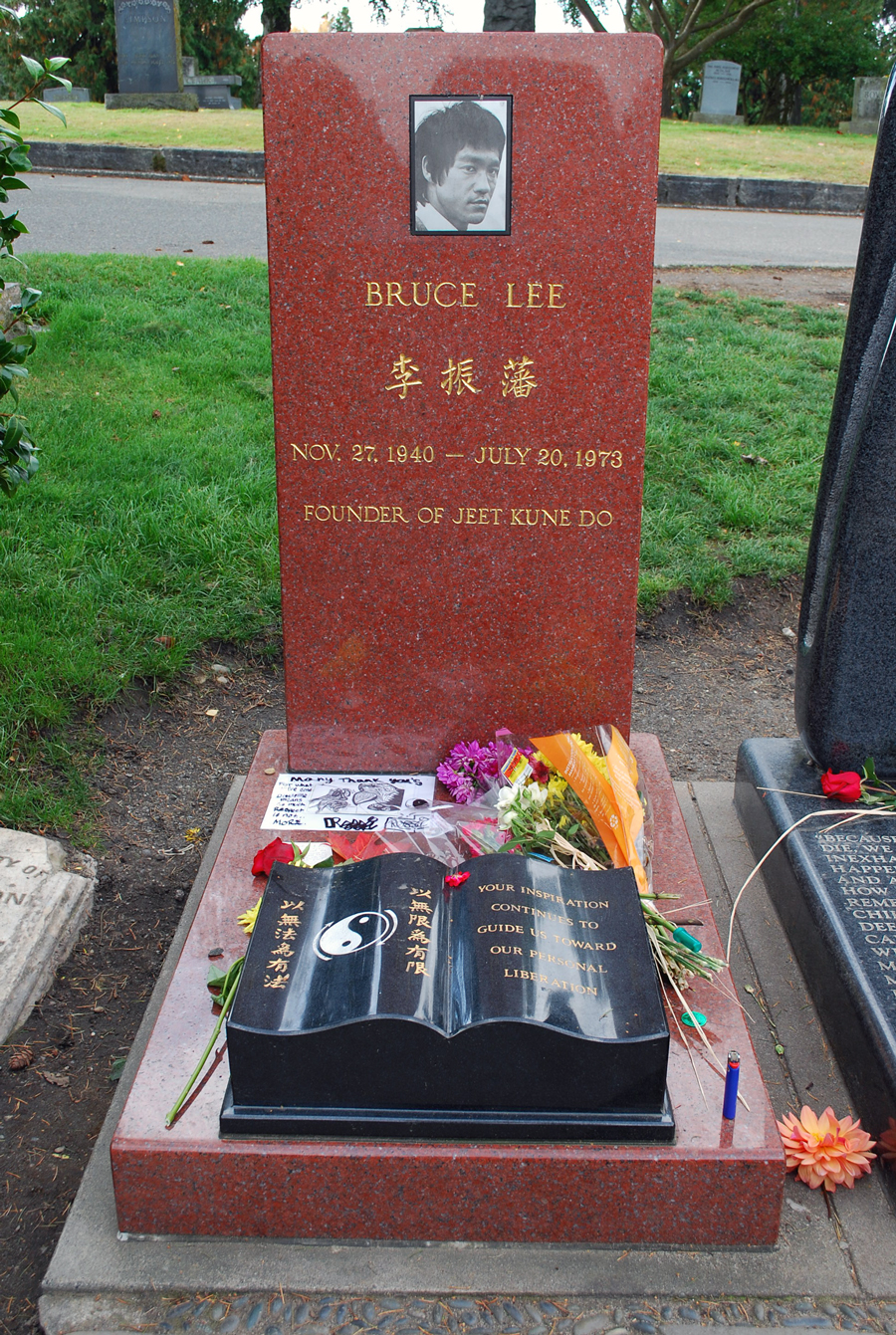
If you have any doubt about the influence of books and reading on Bruce’s life, look no further than his headstone in Seattle, part of which is an open book carved from marble. As his wife Linda said, “Bruce carried a book with him wherever he went.” While he’ll always be rightly known mostly for his martial arts innovations and movie/TV projects, his reading was the foundation that shaped his remarkable life and kept him grounded and true to his deepest values.

Let’s now take a look at some of the titles and authors that influenced Bruce.

Bruce Lee’s Reading List

While Bruce’s library contained thousands of volumes, they were primarily centered in a handful of genres: philosophy (the vast majority), martial arts (and other fighting disciplines), and self-help. Below is but a sampling of Bruce’s favorite authors and most interesting titles.

Western Philosophy:

  • Summa Theologica by St. Thomas Aquinas
  • An Enquiry Concerning Human Understanding by David Hume
  • Meditations on First Philosophy by Rene Descartes
  • The Undiscovered Self by Carl Jung
  • On Becoming a Person by Carl Rogers
  • The Works of Bertrand Russell
  • The Works of Plato
  • Art of Worldly Wisdom by Baltasar Gracian
  • Hero With a Thousand Faces by Joseph Campbell (and other Campbell titles)
  • Ethics by Benedict de Spinoza
  • Maxims and Reflections by Johann Wolfgang van Goethe

Eastern Philosophy:

  • The Works of Jiddu Krishnamurti (whom Polly notes was “one of his more important influences”)
  • Tao-Te-Ching by Lao-Tzu
  • The Way of Chuang-Tzu
  • The Book of Five Rings by Miyamoto Musashi
  • The Works of Alan Watts
  • The Analects of Confucius
  • Art of War by Sun-Tzu
  • Bushido: The Soul of the Samurai
  • Siddhartha by Herman Hesse (and many other Hesse titles)
  • Buddhism by Christmas Humphreys (and dozens of other Buddhism-related titles)
  • The Chinese Classics compiled by James Legge (all 5 volumes)
  • Living Zen by Robert Linssen (and many other Zen-related titles)


Thursday, August 01, 2024

Bruce Lee's Training Regime


Over at The Art of Manliness blog, there was an extensive article on the techniques and philosophy of Bruce Lee's training regime. I thought it was an impressive article. 

An excerpt is below. The full post may be read here.

Bruce Lee is a legend.

He revolutionized movies and martial arts.

He also boasted incredible strength and all-around physicality.

Lee could place his fist one inch from the chest of a man twice his size and unleash a quick, cobra-like strike that’d send his opponent flying. 

Lee could perform push-ups using just two fingers of one hand. 

Lee wasn’t huge, but his lean, chiseled, defined physique was widely admired, and bodybuilders like Arnold Schwarzenegger, Lou Ferrigno, Flex Wheeler, Shawn Ray, and Dorian Yates all acknowledged the impact it had on their careers.

Co-star and fellow martial artist Chuck Norris described Lee’s ripped physique as “muscle upon muscle.”

A woman who asked if she could touch Bruce Lee’s flexed bicep (a common request he appreciated receiving) described it as “warm marble.”

How did Lee develop his strength and physique? Was he simply a genetic freak?

Nope. If you look at early pictures of the Little Dragon, he was a pretty scrawny guy.

Instead of genetics, Lee systematically and relentlessly built his body with physical training.

Thanks to the meticulous research of martial artist and writer John Little, we know exactly what Lee did to achieve his results. Little shares the details of Lee’s fitness training in his 1998 book Bruce Lee: The Art of Expressing the Human Body. The book is an absolute gold mine of fitness history and information, and I highly recommend picking up a copy.

In today’s article, we take a look at the principles that informed Bruce Lee’s training and the components of his regimen that turned a man into a legend.

Throughout his childhood, Lee was incredibly active. He got in trouble at school, and his spiritedness drove him to mischief and street fights. If Lee had grown up in the 21st century, he probably would have been diagnosed with ADHD. His hyperactivity inspired his family to call him “never sits still.”

To channel Lee’s energy into less destructive activities, his father signed him up for kung fu instruction under the tutelage of master Ip Man. Thus, at age thirteen, Bruce began the lifelong practice that would make him a worldwide legend.

By the time Lee was in his twenties, he had developed enough physical conditioning to excel as a martial artist, but remained a skinny guy.

Then came a moment that would take his physical training to the next level.

In the early 1960s, Lee lived in Oakland, CA, and had begun teaching kung fu. Lee didn’t discriminate in who he took on as a student, and according to some accounts, some traditional Chinese kung fu masters in the area weren’t happy with him teaching the martial art to non-Chinese. So in 1964, they presented an ultimatum to Lee: take part in a kung fu battle against their best fighter; if Lee lost, he had to shut down his kung fu class.

While different versions of exactly how the fight went down exist, according to Bruce, the fight lasted three minutes and primarily involved him chasing his opponent around a building until he forced him to submit.

Despite winning, Lee was disappointed with how he performed. He was unhappy about the shape he was in and had begun to feel that the parameters of traditional martial arts were impractical for street fights. He concluded that to realize his full physical potential and become the best martial artist in the world, he’d need to move beyond kung fu and expand his repertoire of physical modalities.

This moment of discontent not only inspired Bruce Lee to get serious about his physical fitness, but birthed a martial art and overall life philosophy he called Jeet Kune Do or the Way of the Intercepting Fist.

In moving forward from the fight, Lee sought to develop a physical training system that emphasized “practicality, flexibility, speed, and efficiency” and drew from a wide range of training methods.

While Jeet Kune Do sounds like a formal martial art style like Tae Kwon Do, Lee intended it to be “the style of no style” — a martial art that transcended formal rules and incorporated the best ideas from various disciplines.

To find these ideas, Lee became a devoted student of the art and science of physical training.

Even though Bruce had struggled in school, he had a strong commitment to continuous learning and was a voracious reader throughout his adulthood. Over his life, he amassed a huge personal library of over 2,500 titles.

He trained his mind by reading Eastern and Western philosophy (Summa Theologica by St. Thomas Aquinas; The Book of Five Rings by Miyamoto Musashi), as well as American self-help (As a Man Thinketh by James Allen; How to Win Friends and Influence People by Dale Carnegie).

He also religiously studied everything he could get his hands on about training the body.  

Lee thought there was something to be learned from all combatives and read books about boxing by Jack Dempsey, Joe Louis, and Rocky Marciano, texts on karate and aikido, and over sixty volumes on fencing.

In the 1960s, bodybuilding magazines were the primary sources of information on strength training, and Bruce Lee subscribed to them all. If he found an article that contained useful information, he’d clip it and put it in his filing system.

Lee also browsed used bookstores and bought copies of health and fitness books from the late 19th and early 20th centuries, including Strength and How to Obtain It by bodybuilder and strongman Eugen Sandow and The Application of Measurement to Health and Physical Education written in 1945 by H. Harrison Clarke.

Lee continued to add fitness books to his extensive library throughout his life and never let a set lens contort his reading choices; if a book or magazine had some useful info in it, he bought it and read it.

Besides magazines and books, Lee would ask his friends and students for training advice. Two men who had a huge influence on Lee’s physical education were James Yimm Lee and Allen Joe. James Lee (no relation to Bruce Lee) was an Oakland-based martial artist and weightlifter, and Allen Joe was the first Chinese-American bodybuilding champion. Both men introduced Lee to the way of the iron and helped develop his first weightlifting program.


Lee’s study of all aspects of physical training led him to experiment with different fitness modalities, including barbell training, isometrics, plyometrics, circuit training, running, and stretching.

His practice of these diverse modalities all had a single goal: becoming a better martial artist.

While Lee only chose exercises that would help him improve as a fighter, because martial arts require the full spectrum of physical capabilities (strength, power, speed, endurance, and flexibility), Lee systematically trained all these capabilities; he didn’t specialize.