Here at the frontier, the leaves fall like rain. Although my neighbors are all barbarians, and you, you are a thousand miles away, there are still two cups at my table.


Ten thousand flowers in spring, the moon in autumn, a cool breeze in summer, snow in winter. If your mind isn't clouded by unnecessary things, this is the best season of your life.

~ Wu-men ~


Showing posts with label Jonathan Bluestein. Show all posts

Monday, February 24, 2025

The Passing of Wing Chun Master Kernspecht


Master Kernspecht was a leading figure in Wing Chun in Europe. He had a large organization and a vast number of students.

Frequent contributor Jonathan Bluestein as a close friend of Master Kernspecht and gave a eulogy at his funeral, which is below.

A guest post by Mr Bluestein on the Wing Chun of Master Kernspecht may be found here.


Wednesday, February 12, 2025

Chinese Astrology


Our frequent guest poster, Jonathan Bluestein has made a free ebook on Chinese astrology available. below is an excerpt. The book may be accessed (for I don't know how long) here.


My name is Jonathan Bluestein. I am an Israeli Jew, and an interdisciplinary scholar. My main areas of expertise are in the fields of Traditional Martial Arts, Traditional Chinese Medicine and Chinese Philosophy. I am also versed in various other areas of study, such as Middle Eastern and World History, Jungian Personality Psychology and Law. The exciting and fascinating subject of Chinese Astrology, interfaces quite well with my other areas of study. Thus, in the year 2024, I embarked on a mission to learn more about it, via meticulous research. As I have often done with my prior learning ventures, I have found that writing about a thing makes for a splendid way to become intimately familiar with it. This book before you here, presents with the fruits of those efforts. The tome which is in your possession, is a work-in-progress. I have intentionally and happily made it available for anyone to copy, share and distribute freely, as long as changes are not made. Newer versions of this work, shall be released periodically. Over time, I hope to include in it, dedicated chapters for a total of 60 years of astrological analysis and interpretation. Why 60 years, you might ask? That question shall be answered clearly and succinctly, in the next chapter. This book is neither an experiment in fortune-telling, nor an instrument for gaining material or spiritual advantages. It is a deep and captivating exploration of how Chinese Astrology can be used as a practical medium for the betterment of people’s everyday lives.Iwould like to thank fellow scholar and Chinese Astrology expert, Gregory David Done, for his fine work in this field. I have often been inspired by his writings and insights, and this is reflected in the text before you here.

Sunday, November 03, 2024

Book Review: Martial Arts Politics Explained: History, Culture and Comedy by Jonathan Bluestein


It has been said that if there is more than one person in a room, politics is at play. 

Anyone who has spent any time in the martial arts world knows that martial arts politics is as common an pervasive as the air that we breathe.

Martial Arts Politics Explained: History, Culture and Comedy by Jonathan Bluestein, examines this phenomenon.

What the book is not: it is not a blow by blow description of the continuous shedding of derivative styles of Kyokushin Karate, the divisive split in Aikido when Koichi Tohei left the Aikikai or the homogenization of the 9 Tae Kwon Do kwans into the ITF and WTF; although there are some descriptions, such as the fragmentation of Ed Parker's Kempo. This book, however, makes them all more understandable.

What the book does is look beyond the usual easy explanations for martial arts politics, such as money, status, etc to the deeper issues that are at play.

Even the types of schools and organizations of martial art can influence it's politics. There is a difference between a strict "traditional" Japanese dojo, a MMA gym or Taijiquan in the park. 

The styles may lend themselves to what may become politics. A good point is that Okinawan (and later Japanese) Karate styles all have basically the same forms, techniques and training methods. What differentiates them is where the teacher chooses to place his emphasis and which other styles of martial arts and teachers he may have trained with in the past. Wado-Ryu Karate, for example, has a heavy influence from a traditional style of Japanese Jujitsu.

A section of the book I particularly enjoyed was an lengthy overview of the history and practice of Krav Maga, the Israeli martial arts. Krav Maga was always something I wanted to know a little more about, but was something I couldn't quite pin down. It's all much more clear now.

One of the features of the book that I very much enjoyed were guest chapters written by current martial arts masters regarding their own experience with martial arts politics. It's refreshing to read the inside story. 

And then there are the cults and clowns that seem to float around the periphery of the martial arts world. The book takes a good look at them as well.

Martial arts practice is a path which demands that we carefully select our steps, or we will stumble. Martial Arts Politics Explained: History, Culture and Comedy represents a flashlight which helps to illuminate the path, at least as far as some obstacles go, to help us to avoid pitfalls.

I enjoyed Martial Arts Politics Explained: History, Culture and Comedy. I think you will too.

https://a.co/d/1ZmeRmK

Saturday, February 06, 2021

A Martial Arts Vow of Poverty?


Today we have a guest post from Jonathan Bluestein on the idea that somehow, martial arts teachers should be modest to the point of poverty. Enjoy.

Do Martial Arts Teachers Vow to be Poor?


There are many myths pervading in the public about the martial arts, as a result of people having watched one too many a movie about them. One of the worst is the idea that a martial arts teacher must be modest, to the point of being poor.   

Yesterday I was conversing with a very esteemed intellectual, someone whom I do not know well, but I respect. That person wrote to me the following: "There is also, however, another polarizing issue common in the martial arts world - publicizing one’s teacher on a public forum".   
I was haunted by that statement for a few hours, having written by such an otherwise knowledgeable and respectable person. He had come to believe that martial arts teachers should not advertise their skills and teachings - not even by proxy through their own students. I am here to tell you, that such a point of view is not only technically mistaken, but is also inherently inhumane, for several reasons:   

Firstly, I have been in the martial arts for many, many years. As a teacher and author, I get to speak with dozens of other martial artists every week. I do believe that people who share an idea as expressed above, are not even one in a thousand. It is not a popular opinion in our time.   
Secondly, such a notion completely negates the need for a professional to make a living in a respectable manner. The world of the 1960s and 1970s, when people could gain a clientele solely by word of mouth, is gone. This is an impossibility for the majority of self-employed persons and professions, especially martial arts teachers. In a market wherein everybody competes over advertising, and often put much money into it also, one cannot afford to sit at home and wait for income 'to happen'.       

Thirdly, that this mode of thought belittles and depreciates the profession of the martial arts teacher, relative to others. No one would dream to demand of a lawyer, a doctor or even a carpenter, that they ought not advertise their service, or order their clients to refrain from writing good things about them in public. Why then, expect such things of a martial arts teacher?

Fourth, that this contrasts with the basic humane values of a family. In traditional martial art instruction, wherein there are good relationships, the students gradually become almost like the family of the teacher. What in life gives one more pride and joy, that one’s offspring going about the world and happily share their positive impressions of the person who taught them skills and virtues? Would that not be the delight and pleasure of any parent, that their children demonstrate such devotion, affection and allegiance? This is one of the humane pleasures we experience in life, and to view this as being ‘wrong’ is an insult to the nature of our species.

The teachings of martial arts must follow virtues in a commonsensical manner. When a notion such as modesty overrides one’s ability to put food on the table, it becomes a moot point. We must not only refrain from acting in such ways that are contradictory to success and happiness, but also endeavour to educate the general public, that they ought not expect us to be silly, just because it appeals to their mistaken conception of what a martial arts teacher ought to be.

We should remember also, is that Modesty is an extreme – the opposite of Vanity. What is to be expected by the virtuous person is not the worship of Modesty, but the application of Propriety. That is, being appropriate relative to the circumstances. Is that not one of the main lessons derived from the practice of any martial art?


Jonathan Bluestein is best-selling author, martial arts teacher, and head of Blue Jade Martial Arts International. Check out his website for more information about his books and the martial arts taught by his organization: www.bluejadesociety.com
You may also subscribe to Shifu Bluestein's youtube channel, which is regularly updated with rare and fascinating martial arts videos and lectures:    
https://www.youtube.com/channel/UCmg7ZGfBdToVl_p_KAfMR2A


All rights of this article are reserved to Jonathan Bluestein © 2020. No part of this article may be reproduced or transmitted in any form or by any means, electronic or mechanical, including photocopying, recording, or by any information storage and retrieval system, without permission, in writing, from Jonathan Bluestein.


Monday, December 21, 2020

Martial Arts Business Success and Failure


The following is a guest-post by martial arts teacher and author, shifu Jonathan Bluestein. This article is a chapter taken from his book, ‘The Martial Arts Teacher 2’.


Opportunities Skip a Locked Garden
By Jonathan Bluestein
 

Why is it that some martial arts schools fail, and others succeed? People usually talk about business and money. But there is much more to it. In this article, I wish to present you with a point of view about martial arts business success and failure, which you would likely and read or hear about elsewhere.

The world is full of people who wonder: “Why is it that I never got my opportunities to do great things in my life and career?”. Honestly speaking, the answer is nearly always that such a person is himself to blame. How many people are in your neighbourhood? In your city? In your country? Even a tiny fraction of these people, associated with you as martial arts students or partners in business, could have made you rich, successful and perhaps even happier. But of these countless possibilities for action and interaction, one often manifests an amazingly small number of useful relationships. Why is that?    

Well theoretically, if you could appeal to more people, that would be a good start. This is where things get complicated. We want to remain authentic with our teachings, so there is only so much we are willing to change in who we are, in order to look and sound like what other people want. Indeed, at the extremes, those martial artists who sell their soul for a profit, are lowly and unworthy. But there is another way, a simpler way, to attract other people and opportunities. This can way can be pursued by means of changing one’s attitude, rather than one’s personality or behaviour. Changing our attitude can attract people to us on all walks of life. One proven technique for changing one’s attitude and attracting more people and possibilities, is adopting a mentality of abundance. Let us see how a good argument for this mentality of abundance was made in an ancient allegory, from the Book of Mencius.        

This scholar Mencius whom I mentioned just now, was a successor to Confucius, lived several generations after that great sage-scholar, and studied with his grandson. Like his forerunner, Mencius also traveled between the old Chinese kingdoms, and sought to teach and inspire morality among their rulers and citizens. His exploits and teachings are in part recorded in the Book of Mencius. The first two chapters of that book tell stories of the conversations Mencius had with various kings. In their conversations, the sovereigns look to make their kingdoms more efficient and profitable, and encounter novel and unusual suggestions from Mencius which they did not expect.

One king whose name is Xuan, is baffled as Mencius confirms to him, that another Ancient King by the name of Wen, had a park the size of 35 square kilometers. King Xuan finds something confusing about ancient King Wen’s garden. Mencius tells King Xuan, that albeit king Wen’s park being this large, no less than 35 square kilometers, the citizens of king Wen’s nation still thought of their king’s park as being ‘small’. King Xuan points out, that his own park is only 20 square kilometers, and still his people think it is ‘large’ – despite his park being smaller than that king Wen owned. King Xuan then inquires with Mencius, what could be the reason for this – that king Wen’s people considered their sovereign’s park as ‘small’ though it was large, while his (king Xuan’s) park was talked of as being ‘large’ while it was relatively smaller? After all, king Xuan would like his people to view him as a benevolent ruler, and not someone who lives too lavishly.   


Mencius has a simple and clear explanation for this. He tells king Xuan, that the park of king Wen was indeed large in size, but entry was allowed for those citizens who wanted to cut grass or gather fuel wood for their own use. Also hosted there openly were those who sought to catch pheasants and hares. Because king Wen willingly shared his park with the people, they thought of it as ‘small’ – as many were permitted entry and rights to its resources, or at least had the opportunity to claim such benefits.

But what about king Xuan’s park? When Mencius entered king Xuan’s kingdom, he was careful to find out what were the local customs, and what was forbidden. He learned that if someone was to hunt a deer in king Xuan’s park, that person would have been treated and punished like someone who had murdered a human being. Because king Xuan kept the park for himself, the people thought of it as ‘large’ – as it was reserved for the benefit of only a single individual and his family.
 

Thus far was the extended answer of Mencius to king Xuan. Now I shall elaborate more on this important message.
 

What King Xuan was lacking in, was the mentality of abundance. Instead of feeling that he had abundance, king Xuan suffered from a scarcity mindset. He felt as though, despite having this extensive green terrain under his control, that he did not possess enough, or that somehow by sharing the park he could lose it. He therefore acted like a miser with his resources. The result had been, that the people psychologically felt that his park was ‘large’, though it was physically smaller than that of a previous sovereign. It was also a lose-lose strategy, as he was left both anxious of the negative image of him this created among others, and unable to use the park he had for further growth. What is not stated but is hinted, is that this generated enemies and challenges for king Xuan, as the people must have been displeased by his miserly mannerisms. This is why he sought the advice of Mencius – for he knew that this was a sign of troubles to come. Further we should not neglect the observation, that had he shared his park in a similar fashion to king Wen, then not only that area would have been thought of as ‘small’, but the people also would naturally have been more inclined to wish that their King’s territory be expanded and for his power to grow, for it benefitted them as well.


As martial arts teachers and modern day individuals, we suffer from the exact same flaw which was the bane of king Xuan and others in his time, thousands of years ago. All too often, we feel we have to keep too much of our resources to ourselves. Here I wish for you to consider all of those things which are not material resources like money and real-estate, the latter perhaps more relevant for the wealthy. You have many other resources that you could share, like social connections, knowledge, love, food and ideas. You probably are a miser with these, too, compared with your potential for sharing. One of my most beneficial changes in life had come about, when I began to more openly share my social connections, knowledge and ideas with others, without fearing they may use them to undermine or supersede me.
 

Research has shown that among social mammals, the beta males constantly compete, while the alpha males are more generous and benevolent, on average and relative to the circumstances. Why? Because they have an abundance mentality. The majority of martial arts teachers whom I have encountered, who were both successful and worthy, displayed this alpha male quality of benevolence and generosity.   
 

A truly enlightened sovereign of his kingdom – one who has rulership not only in name but also in spirit, can find it in his power to allow others into his park, without fear of loss. When this is undertaken, and you are truly and genuinely set out to offer from your resources to the appropriate people in a thoughtful and appropriate manner, then suddenly the opportunities will present themselves. The right people will, in the process of months and years, discover that your park is open and inviting. Many of them will by these actions, appeal to you, and it would seem as if you have gone on an ever-growing ‘lucky streak’ in your life and career. But for this to happen, a park must be both cultivated, inviting and without unnecessary boundaries.

_________________________________________________


Jonathan Bluestein is best-selling author, martial arts teacher, and head of Blue Jade Martial Arts International. Check out his website for more information about his books and the martial arts taught by his organization: www.bluejadesociety.com


You may also subscribe to Shifu Bluestein's youtube channel, which is regularly updated with rare and fascinating martial arts videos and lectures:     


https://www.youtube.com/channel/UCmg7ZGfBdToVl_p_KAfMR2A


All rights of this article are reserved to Jonathan Bluestein © 2020. No part of this article may be reproduced or transmitted in any form or by any means, electronic or mechanical, including photocopying, recording, or by any information storage and retrieval system, without permission, in writing, from Jonathan Bluestein.

Tuesday, November 03, 2020

Taijiquan and Communism


The Yang 24 short form was developed at the behest of the Chinese Communist party. They wanted to develop and promote a standardized version of the Yang form for their own purposes. 

Today, they are attempting to do the same thing with Chen style taijiquan. Below is a link to a podcast by Jonathan Bluestein discussing this development.

Taijiquan and Communism.


Saturday, October 24, 2020

The Truth About Krav Maga


Today we have a new offering from frequent contributor Jonathan Bluestein. Below is an interview Jonathan conducted with Avi Nardia, a renown Israeli martial artist on Krav Maga. Please check out Jonathan's new website: Blue Jade Society.


Tuesday, December 03, 2019

The Synchronous Way

Today we have a guest post from Jonathan Bluestein, an old friend of Cook Ding's Kitchen, informing us of his newest enterprise. Enjoy!


The Synchronous Way
This week was announced the establishment of a new international martial arts organization. The new organization is called Blue Jade Martial Arts International (see here:  www.bluejadesociety.com ). I, Jonathan Bluestein, am the head of that organization. We have schools in Victoria BC, Hollywood LA and Israel. In our schools is taught a unique curriculum of martial arts, called ‘Tong Bu Dao’. The name Tong Bu Dao can be translated as ‘The Synchronous Way’ or ‘The Way of Synchronicity’. But what is it, really?
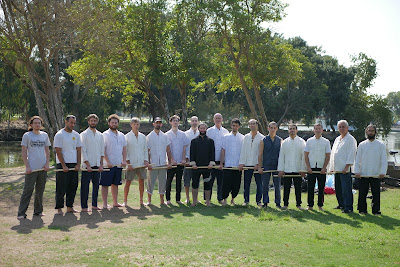


Tong Bu Dao is a systematic and coherent curriculum for teaching martial arts, of my own creation. The curriculum of Tong Bu Dao includes materials from the following martial arts:  Xing Yi Quan, Pigua Zhang, Jook Lum Southern Mantis and Bagua Zhang. Of these four martial arts, Xing Yi Quan makes for the greater bulk of the curriculum. The system is not one of ‘mixed martial arts’. The styles are not taught together, but in succession based on the student’s progress. Their methods and techniques and unified and streamlined in a way, which is meant for the practitioner to recognize and assimilate them as a single body of knowledge, rather than as separate entities. Some would consider Tong Bu Dao to be “a new martial art”. While I do not object that idea, I also do not feel that we offer a lot which is “new”. Nearly all of the ideas, methods and skills taught in Tong Bu Dao were already conceived and taught prior. I have merely arranged these in a format which I personally feel is more efficient for our goals and purposes.

The core motivation behind the creation of Tong Bu Dao was to create a curriculum for the instruction of an internal martial arts, which would be more approachable to the average Western practitioner. The original framework of traditional Xing Yi Quan had several challenges and difficulties to it, which were addressed by the creation of Tong Bu Dao. 


Footwork
Traditional Xing Yi Quan is noted for lacking in complex footwork dynamics, for the most part. Tong Bu Dao solves this problem with several additions to the system. Many types of stepping methods and patterns are used, most of which are either absent from Xing Yi Quan or not commonly utilized originally in that martial art. Among these are:   Sìjiǎo Bù (Four-Corner Step), Gōng Bù (Bow Step), Mǎ Bù (Horse Step), Sān Tǐ Shì (Three Bodies Momentum), Bàn bù (half-step), Fúhǔ Bù (Tiger-Taming Step), Māo Bù (Cat Step), Xiè Bù (Crab Step), Hóu Bù (Monkey Step), Qīxīng Bù (7-Star Step), Sì Bù Pán Gēn (Four-Step Coiling Root), and several more variations and combinations of these and others. 


The four-corner step was borrowed from Southern Mantis, the four-step coiling root from Bagua Zhang, the 7-star stepping is from Pigua Zhang, etc. Though the steps are different, they all use the same structure. All the while, Bagua Zhang, Pigua Zhang and Southern Mantis were missing the essential stepping method of San Ti Shi, which was already emphasized in Xing Yi Quan. There are even evasive stepping patterns borrowed from Western Boxing.
All seasoned practitioners of the martial arts tend to agree, that the footwork makes for the biggest difference in combative efficacy, which is why this element has been expanded in Tong Bu Dao, and is the first aspect of the curriculum beginners are expected to study and practice well.

Structure and Power      
Jook Lum Southern Mantis, an art which I studied, specializes in the generation of formidable explosive powers (fa jin). These are manifested by using a body structure which can coil internally in a similar way to complex Asanas in Indian Yoga, then releasing such tensions with combative utility. These ideas exist in Xing Yi, Pi Gua and Ba Gua, but were not heavily emphasized in these martial arts. In Tong Bu Dao, these ideas pervade throughout the system. A related concept is that principle of releasing three short explosive powers in quick succession – a skill which was adapted into a few Tong Bu Dao techniques.

Movements and Forms 

Xing Yi Quan and Bagua Zhang emphasize the practice of single movements or single combinations. Jook Lum Southern Mantis and Pigua Zhang emphasize the practice of medium and long movement forms (and Taiji Quan, even more so!). Both modes of practice have much merit. In Tong Bu Dao, they are combined.                

The system is comprised of 18 levels. The first 8 of 18 levels are the beginner levels, dedicated mostly to the practice of single movements and single combinations (with the sole exception of a partner form which teaches joint-locking skills and counters to them). During the first 8 of 18 levels, the practitioner engages with the qualitative study of basics (Jiben Gong), understanding different steps, strikes, circles and spirals. That is, alongside standing practices (Zhang Zhuang) and additional internal cultivation methods. Emphasis during levels 1-8 then, is on free-form study of personal expression via a limited amount of a few dozen ‘options’.                       

During levels 9-12, the practitioner then studies a long form called ‘Hun Yuan Quan’ – The Fist of Smooth Roundness’. It is Tong Bu Dao’s equivalent of the Taiji Quan long forms. This form, which takes about 20 minutes to complete at a walking pace, summarizes the entire curriculum and principles of Xing Yi Quan as I understand it. Xing Yi Quan makes for about 80% of the movements and methods in the Hun Yuan Quan form. The rest, intertwined, is composed of materials borrowed from Bagua, Southern Mantis and Pigua. Emphasis during levels 9-12 then, is on condensing one’s understanding through rules and boundaries.                 

The next levels, 13-18, are dedicated to the study of orthodox Bagua Zhang and weaponry. It is also expected that people of advanced levels who be well-read on martial arts literature. During these levels, personal expression and rules for expression find a balance.


Philosophy and Morality    
      
In the world of martial arts, we see a lot of people abuse the power they had gotten from their teachers. As the idiom goes: “When one has a hammer, everything looks like a nail”. But one can be taught how to use a hammer for countless constructive purposes as well. So why is it, that in the traditional Chinese martial arts, we see so much aggression, anger, deceit and political bickering?...           

My thoughts are, that this has to do with education, first and foremost. The majority of martial arts teachers see themselves as instructors of a craft. They leave the educational, cultural and philosophical aspects of life, to be dealt with by parents and school-teachers. 

This is not the approach we take at Blue Jade Martial Arts schools. The study of traditional Chinese philosophy, culture and morals are inherent to our Tong Bu Dao system, and these systematically taught, especially to those who wish to become instructors.

Moreover, that it should be noted, that traditional Chinese martial arts cannot be fully comprehended, without the study of Chinese culture, philosophy and morals. To understand such martial arts, it is essential to deeply resonate with our ancestors who created them. 

Who were these people? How did their lives look? How did they think and why did they think in such ways?... Today, many could not care less. People erroneously believe that living ‘in the future’ provides us with a license to neglect the past, and reject thousands of years of Oriental wisdom. At Blue Jade International, we hold the opposite point of view.

______________

These are just some of the many ways, in which I endeavored to make our organization and martial arts better. The Tong Bu Dao system is thus a body of knowledge for the service of our students in class, and of humanity at large. To learn more, you can visit our official website, which includes ridiculous amounts of mostly free information about the traditional Chinese martial arts, in the form of short essays, articles, books, videos.


________________

You may also subscribe to Shifu Bluestein's youtube channel, which is regularly updated with rare and fascinating martial arts videos:


https://www.youtube.com/channel/UCR0VUbThdexbXJb9BBSKMbw

All rights of this article are and the pictures within it are reserved to Jonathan Bluestein ©. No part of this article may be reproduced or transmitted in any form or by any means, electronic or mechanical, including photocopying, recording, or by any information storage and retrieval system, without permission, in writing, from Jonathan Bluestein.