Here at the frontier, the leaves fall like rain. Although my neighbors are all barbarians, and you, you are a thousand miles away, there are still two cups at my table.


Ten thousand flowers in spring, the moon in autumn, a cool breeze in summer, snow in winter. If your mind isn't clouded by unnecessary things, this is the best season of your life.

~ Wu-men ~


Tuesday, January 31, 2006

Calligraphy


I've always heard that calligraphy is a high art. I've never really understood it, but I've accepted it. I've sort of filed "calligraphy as art" in the category of things I don't know enough about to have an opinion.

Now I'm learning to read and write kanji. Now I'm starting to get it.

It's quite a task to write a character well; one that is well proportioned and balanced. You really have to slow down and think about what you're doing.

If you've ever golfed you might know the feeling of hitting a ball really well. It feels a special way as your hands grip the club, and the sound of the striking the ball has a certain tone. I'm more familiar with what it feels like to hit a ball not so well (it feels like hitting a rock), and that sound is also distinctive. Writing Kanji is like this.

Calligraphy as art is something I am just now beginning to appreciate.

Zhuge Liang, Strategist and Daoist Wizard


On the Jan 25th entry at The Pragmatic View, is a short article about the brilliant Chinese strategist from the Three kingdoms period, Zhuge Liang.

When Zhuge Liang joined the faction he supported during the Three Kingdoms period, it was little more than a small band of warriors trying to not get wiped out. Under his direction, at the time of his premature death, his faction controlled the Kingdom of Shu, one of the three kingdoms which strived to rule all of China.

Here is one story about him: Zhuge Liang was known for his painstaking planning and preparation. He was once inspecting a city with a small band of guards, when a large enemy army was seen approaching. He didn't have enough troops to fight, and he didn't want to run away and leave the city for the invaders.

What he did was hide his troops, throw open the city gates, and made himself conspicuous on the city ramparts apparantly relaxing and playing his lute.

The enemy general stopped in his tracks. Knowing Zhuge Liang's reputation, he expected a trap; turned around, and marched off.

You can get to The Pragmatic View by clicking on the link at the right, or on the title of this post.

Monday, January 30, 2006

The Father of Japanese Karate


At 24FightingChickens.com, Rob Redmond has written a very good article about the facts and myths that surround the life of Gichin Funakoshi, who is widely knows as the Father of Japanese Karate. It's a fascinating article for anyone who is interested in the history of martial arts.

If you click on the title of this post, you'll be directed to the article. You can also click on the link at the right, and be directed to the 24FightingChickens homepage.

Saturday, January 28, 2006

How to make a Japanese wooden training sword


If you click on the title of this post, you'l be directed to an article on how to make a Japanese wooden sword, a bokken, which is used in the practice of Japanese swordsmanship.

Thursday, January 26, 2006

Dao De Jing: Chapter 10


The Dao De Ching (aka Tao De Ching) is not only one of the world's classics, it's the foundation of philosophic daoism. If you click on the title of this post, you'll be directed to a complete online version.

10. Harmony
Embracing the Way, you become embraced;
Breathing gently, you become newborn;
Clearing your mind, you become clear;
Nurturing your children, you become impartial;
Opening your heart, you become accepted;
Accepting the world, you embrace the Way.
Bearing and nurturing,
Creating but not owning,
Giving without demanding,
This is harmony.

Tuesday, January 24, 2006

Better to stay inside


Dark sky
cold winter snow
better to stay inside
another log on the fire
warms us

-The Snow Shovelling Daoist

Sunday, January 22, 2006

The 36 Strategies: #12 Take the sheep in hand as you go along


Next to the Art of War, by Sun Tzu (or SunZi), probably the next best known Chinese book on strategy is the 36 Strategies. Here is #12.

12 Take the sheep in hand as you go along

You take advatange of any opportunity, however small, and avail yourself to any profit, however slight. This comes from the story of a destitute traveler walking on a road. As he went along, he came across a flock of sheep; making his way through them, when he emerged from their midst he had a sheep with him. He behaved so calmly and naturally, as if he had been leading his own sheep to market all along, that the shepherd never noticed him.

Thursday, January 19, 2006

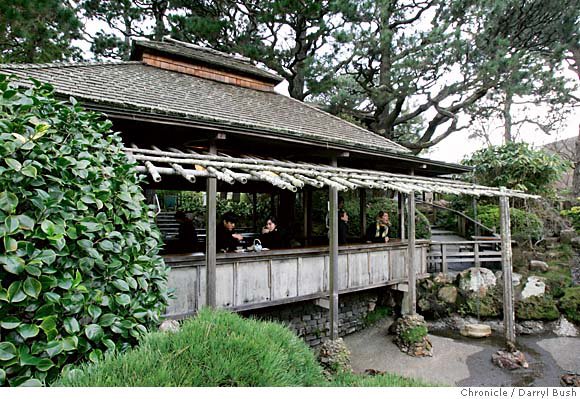
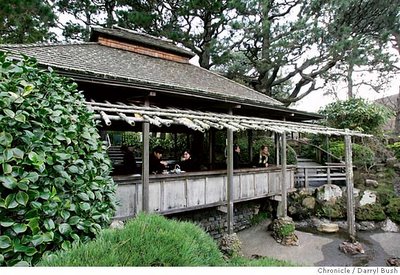
San Francisco Japanese Tea Garden


If you click on the title of this post, you'll be directed to original on line news article, where you'll find more pictures.

Thursday, January 19, 2006
(SF Chronicle)
SAN FRANCISCO/Tempest in Japanese Tea Garden/Move to restore fidelity to design, oust the schlock
Charles Burress,
Chronicle Staff Writer

A conflict over cultural sensitivity is brewing at a Bay Area landmarkfamous for its image of tranquility -- the Japanese Tea Garden in GoldenGate Park. The generic souvenirs and junk food sold in the 5-acre garden's tea houseand its gift shop are a glaring intrusion of tourist schlock, someJapanese American community leaders contend. The 112-year-old oasis, the oldest public Japanese garden in the UnitedStates, should more accurately reflect Japanese culture for hundreds ofthousands of visitors annually, the community leaders say.

"We're very uncomfortable with the products being sold at the tea garden,"said Rich Hashimoto, president of the Japantown Merchants Association."They reflect more a Chinese culture than a Japanese culture. And thequality of the products doesn't meet our standards."

Hashimoto and leaders of other Japantown organizations are backing a bid from a Japanese American cafe owner to take over the concession from the current operator, a Chinatown business owner, and bring in more Japanese-themed food and items.

The concession battle includes the open-air tea house, where tea is served with a fortune cookie and other cookies for $3.20. Critics point to the racks of American candy bars and chips and to the casually-fitted robes the waitresses wear, which are meant to resemble normally snug kimonos.

Another irritant is that the tea menu is topped by jasmine tea, more of a Chinese staple. The fortune cookie in the tea service is no problem, however. The tea garden is the reputed birthplace of what has become known as the "Chinese fortune cookie," an American invention ubiquitous in Chinese restaurants in the United States but not commonly found in China.

In anotherJapanese-Chinese admixture, a scene for the recent film "Memoirs of a Geisha," which drew criticism for casting Chinese actresses in Japanese roles, was filmed in the garden.

The gift shop contains some Japanese items such geisha dolls, as well as some Chinese items like tomb-warrior figurines, but the lion's share ofthe merchandise could be found at a typical tourist shop in San Francisco-- cable-car mugs, giant lollipops, Alcatraz caps, little license plates bearing common American first names.

Carol Murata, who sits on the Japantown Merchants Association board and owns Murata's Cafe Hana, a cafe and flower shop in the Japan Center mall, submitted a proposal to the city's Recreation and Park Department to takeover the concession from Fred Lo, whose Chinatown Fashion House Inc. has held the contract for 14 years.

Murata's supporters stress fidelity to the heritage of a garden established by wealthy landscape designer Makoto Hagiwara for the Japanese Village exhibit at the California Midwestern International Exposition of1894. The Hagiwara family ran the garden until the World War II Japanese internment in 1942. Lo, who also has the Coit Tower concession, wants to keep the contract.

City staff members gave a higher bid score to Murata and recommended giving her the concession. The Recreation and Park Commission will consider the issue today.

"I don't know why they gave higher scores to her with no experience," said Lo.

He called Murata's projected 100 percent increase in revenue impossible. He also criticized her plan to offer higher-quality, more expensive goods, saying tourists don't want to spend much.

The city cares about the tea garden's finances because the Recreation and Park Department budget included $200,000 in rent from the concessionaire in fiscal 2004-05. The city received $1.1 million from visitors paying the$3.50-admission fee.

Lo's concession grossed $648,299 this past fiscal year, according to city records. He has hired two attorneys to represent him on the bid and what he called "a specialist ... to create a whole series of Japanese items."

Murata declined to comment, saying city staff members advised her not to. Her plan would add upgraded Japanese-themed gifts and menu items such assushi, miso soup and Japanese desserts, as well as Japanese cultural programs developed in cooperation with Japantown organizations.

"Japanese Americans operated it for many, many years," said businessman Allen Okamoto, co-organizer of the Japantown centennial commemorations this year.

"There was a little consternation in the community about a Chinese American taking over the Japanese Tea Garden." Lo said ethnicity, like gender, shouldn't matter: "You don't need a woman to design the latest dress."

When he took over from the former Japanese American operator, some workers were wearing Raiders' jackets and he helped restore authenticity, he said. Douglas Dawkins, a great-great grandson of Hagiwara, agreed that race is not the issue but said Murata's Japanese American background and ties to Japantown do matter.

"From the Hagiwara family perspective, it's not a racial issue," he said."It's an affinity for Japanese culture issue."

E-mail Charles Burress at http://us.f524.mail.yahoo.com/ym/Compose?To=cburress@sfchronicle.com&YY=33309&order=up&sort=date&pos=0&view=a&head=b.

Tuesday, January 17, 2006

Who needs fiction: Parrot squawks on woman's affair


If you click on the title of this post, you'll be directed to the new article on the BBC page.

A parrot owner was alerted to his girlfriend's infidelity when his talkative pet let the cat out of the bag by squawking "I love you Gary".

Suzy Collins had been meeting ex-work colleague "Gary" for four months in the Leeds flat she shared with her partner Chris Taylor, according to reports.

Mr Taylor apparently became suspicious after Ziggy croaked "Hiya Gary" when Ms Collins answered her mobile phone.

The parrot also made smooching sounds whenever the name Gary was said on TV.

New home

Mr Taylor, 30, a computer programmer, confronted the woman he had lived with for a year who admitted the affair and moved out, several newspapers reported.

He also gave up his eight-year-old African Grey parrot after the bird continued to call out Gary's name and refused to stop squawking the phrases in his ex-girlfriend's voice.

"I wasn't sorry to see the back of Suzy after what she did, but it really broke my heart to let Ziggy go," he said.

"I love him to bits and I really miss having him around, but it was torture hearing him repeat that name over and over again."

Ms Collins, 25, said: "I'm not proud of what I did but I'm sure Chris would be the first to admit we were having problems."

Ziggy - named after David Bowie's former alter ego Ziggy Stardust - has now found a new home through the offices of a local parrot dealer.