Here at the frontier, the leaves fall like rain. Although my neighbors are all barbarians, and you, you are a thousand miles away, there are still two cups at my table.


Ten thousand flowers in spring, the moon in autumn, a cool breeze in summer, snow in winter. If your mind isn't clouded by unnecessary things, this is the best season of your life.

~ Wu-men ~


Friday, December 30, 2005

Two Dragons


This news story is from Yahoo. If you click on the title of this post, you'll be directed there.

Nationalism drives China, Japan apart

By Robert Marquand,
Staff writer of The Christian Science Monitor
Thu Dec 29, 3:00 AM ET

The growing trade between Japan and China in 2005 has been matched by rising symbolic and verbal provocations and a steady decline in public opinion and diplomatic ties - marking a new nadir in relations between the most important competitors for Asia's future.

And the year is ending on a sour note. Last week, China formally declared a policy of "peaceful development" as it rises economically in Asia. But within 24 hours, Japan's new foreign minister, Taro Aso, warned that China's nuclear program and secretive military development "pose a considerable threat," the first time a Japanese foreign minister has made such a bald statement of concern.

"This could possibly be the worst period of Sino-Japanese relations since World War II," says James Mulvenon, Asia specialist at the Center for Intelligence Research and Analysis in Washington.

Few analysts predict violent conflict between Japan and China. Both nations are regarded as practical and pragmatic. Yet the negative dynamics of rising nationalism, fear, historical animosity - and China's rapid economic expansion in Asia - are at work with no mediating structures or nations. Diplomats and even some Chinese and Japanese officials say privately that Washington has yet to show it is paying much attention, apparently preoccupied with other priorities such as Iraq.

Relations between the historic Pacific rivals immediately plummeted at the start of this calendar year. Japan surprised China in February, on the first day of its biggest national holiday, Spring Festival, by saying it claimed formal control of the disputed Senkaku (or Diaoyu) islands in the oil-rich East China Sea. The year has now ended with rhetorical salvos, with Beijing describing the Japanese foreign minister's comments about China's military last week as "highly irresponsible."

Two days after Mr. Aso's warning, Tokyo announced it would jointly develop a naval SM-3 missile interceptor with the US, part of a "nuclear missile shield," for use on Japan's advanced Aegis-system destroyers that are expected to be launched in 2008. The US and Japan have been developing closer formal military ties since early this year.

In between the 2005 bookends has been a quiet, intense game of diplomatic snubs, protests, and cat-and-mouse maneuvers in the East China Sea over drilling rights and borders. China has systematically worked to keep Japan off the UN Security Council in proposed reforms of that body. This spring, carefully controlled Chinese "mobs" threw bottles and rocks at the Japanese Embassy here, and smashed up some Japanese businesses in brief rampages in Shanghai, frightening Japanese expatriates.

Japan's UN bid
After a Dec. 26 meeting with Japan on UN reform, China stated it would support greater participation by African countries in the UN rather than an expansion of the Security Council, and reiterated its concern that until Japan is properly repentant for its war-time past, China will block Japan's effort.

No plans now exist for leaders or even foreign ministers of the two most powerful states in Asia to meet. At the first "East Asian summit" this month in Kuala Lumpur, designed to enhance intra-Asian ties (and exclude the US), no "sideline" talks took place. Summit host Malaysian Prime Minister Abdullah Badawi publicly stated, "We are concerned about the developing dichotomy in Japan-China relations ... one of the main pillars of East Asia cooperation."

Meanwhile, the general public opinion in both China and Japan about each other continues to slide, despite many instances of good business and professional working relationships. In fact, China is now Japan's No. 1 trade and export partner, replacing the US. But only 32 percent of Japanese have a friendly feeling toward China, a new government-sponsored poll shows. The figure has been dropping since 1995, when nearly 50 percent of Japanese said they felt positively toward their huge neighbor.

"Such a major drop in friendly feelings, or ... a rise in feelings of dislike, is not good for both countries," said former foreign minister Nobutaka Machimura in Tokyo Friday, after the poll was released.

Since visiting the Yasukuni shrine in October, Prime Minister Junichiro Koizumi has come under pressure from the Japanese business community to curb his provocations with such an important business partner. On Tuesday Aso the foreign minister stated that Japan should not view China as an "economic threat" but that "competition is a good thing in nature."

Both China and Japan have strong domestic reasons for allowing, and even carefully feeding and managing, the chill between the two.

Cohesion through a new nationalism
China is a communist state whose ideology no longer inspires most of its people, experts point out, but whose communist structures of control still are relied on for authority and legitimacy.

Within that system, hatred for the Japanese occupation in World War II is one substitute for ideology, and building a proud China capable of becoming the No. 1 power in Asia is one way of creating national cohesion. When Japanese Prime Minister Koizumi visits the Yasukuni Shrine, a place where more than a dozen top Japanese war criminals were secretly placed for burial in the early 1970s, it gives China plenty of fuel to stoke the flames of nationalism.

"Try to imagine [German] Chancellor Angela Merkel going repeatedly to pay her public respects at a cemetery where a dozen high ranking Nazis and members of Hitler's inner circle were buried," Mr. Mulvenon points out. "Do you think that might be upsetting?"

In Japan, China's rise has become a major political topic. Japanese politicians, even the head of the liberal Democratic Party of Japan, now are shifting to the right, looking for votes in a prouder "stand tall" rhetoric. Japan has sought to become a "normal nation" not so reliant on the US. Japanese used to point to dictator Kim Jong Il in North Korea as an example of dangers in their neighborhood.

But today the talk is of the enormity of the Chinese threat, a country of 1.3 billion people that Japanese say is controlled by a government whose workings are secret and is less than forthcoming about the size and intentions of its military, and could one day shut down Japan's oil supply.

Just $25.6 billion for defense?After Aso's comment about China's hefty military spending increases, Beijing vehemently and publicly repeated the official Chinese annual defense spending figure of $25.6 billion. Yet few China experts believe that figure. The London-based International Institute for Strategic Studies this fall argued that China now spends nearly $25 billion purchasing Russian armaments alone.

"If you are sitting in Japan, an island nation, and you are watching a huge neighboring country many times larger than you, start to develop a modern military, you are going to get worried," notes one European scholar in Beijing. "It is a fairly basic thing."

What many analysts worry about in the developing chill between China and Japan is the potential for a miscalculation. Japan's inability to offer a convincing apology for its wartime past, and the use of the Yasukuni shrine to score subtle ethnic put-downs in Asia (and get domestic applause) is one possible miscalculation.

Another is Beijing's apparent inability to apprehend how its growing muscularity looks in Asia, and its apparent inability to believably reassure other nations about its peaceful intentions. As Mulvenon points out, "When my Chinese friends ask me why Japan is so worried, I tell them the Chinese have no one to blame but themselves. They created this schism with their military modernization program.... [and] lack of transparency in their strategic intentions."

So far, the US has not actively engaged in trying to reduce the chill. "The US is better positioned than any of the regional powers to take the lead in changing the geopolitical context in Northeast Asia," notes James Goodby, a former US ambassador, speaking of a range of animosities and schisms in the Pacific.

"Until very recently the Bush administration has not seen fit to exercise this unique role...," he says. But Mr. Goodby adds that in recent weeks the White House may have gained a greater "awareness" of its potential for helping with stability.

Thursday, December 29, 2005

The Lotus


If you click on the title of this post, you'll be directed to www.chinesepaintings.com, where you'll not only find a huge collection of beautiful paintings, but also a lot of information on the meaning of symbols, history, different styles of painting, etc.

Lotus

Thanks to the Buddhist influence, the lotus (or sea-rose) is of unique importance in Chinese folklore and symbolism. It is the symbol of purity. The lotus comes out of the mire but is not itself soiled. It is inwardly empty yet outwardly upright. It has no branches but yet smells sweet. The words for lotus in Chinese have the same meanings as: to bind, connect (in marriage), one after the other, uninterrupted, to love, and modesty. It is one of the Eight Auspicious Symbols of Buddhism.

Saturday, December 24, 2005

Karate


If you've ever trained in karate, or are now, or ever plan to; if you have any interest in martial arts, you have to read 24FightingChickens.

The host is Rob Redmond, who trained in traditional Shotokan Karate. He trained in Japan for several years. His teacher told him that he have taught him his art, and he should do with it what he saw fit.

Redmond has. He's taken a critical look at dogma and tradition, to see what really makes sense for American students of karate.

While personally I may not agree 100% with everything he has to say, he's given a lot of thought to every aspect of martial arts practice and teaching.

If you click on the title of this post, or if you find the 24FightingChickens link over at the right, please pay him a visit.

Friday, December 23, 2005

Empty Chairs


Empty Chairs

A table full of empty chairs,
Reminders of Christmas past.

The children were too young to know
That's where Grandpa used to sit.

The brother who couldn't make the flight.
Close cousins becoming strangers.
The daughter with her friends,
the son at his in-laws house.

The party becoming smaller, quieter.

The children grown,
their table put away.
They have lives of their own,
each has a full house...and not enough chairs.

300 Tang Dynasty Poems: #11 Seeing Li Bai in a Dream I


The Tang Dynasty was a Golden Age of culture in China. Poetry was particularly esteemed. The two giants of Tang Dynasty poetry were Da Fu and Li Po (also read as Li Bai). They were great friends as well as opposites.

LiPo could dash off a complete masterpiece in a single draft while drunk, while Da Fu had to grind his work out.

If you click on the title of this post, you'll be directed to an online version of the classic anthology, the 300 Tang Dynasty Poems.

Below is #11, written by Da Fu.

Five-character-ancient-verse
Du Fu
SEEING Li Bai IN A DREAM I
There are sobs when death is the cause of parting;
But life has its partings again and again. ...
From the poisonous damps of the southern river
You had sent me not one sign from your exile --
Till you came to me last night in a dream,
Because I am always thinking of you.
I wondered if it were really you,
Venturing so long a journey.
You came to me through the green of a forest,
You disappeared by a shadowy fortress....
Yet out of the midmost mesh of your snare,
How could you lift your wings and use them?
...I woke, and the low moon's glimmer on a rafter
Seemed to be your face, still floating in the air.
...There were waters to cross, they were wild and tossing;
If you fell, there were dragons and rivermonsters.

Thursday, December 22, 2005

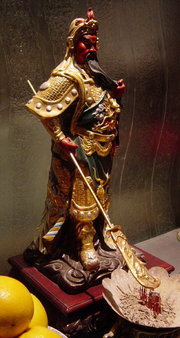
Guan Yu


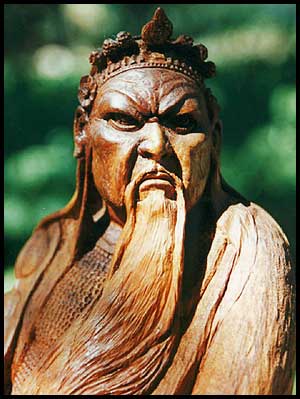
You might notice that whenever I post one of the 36 Strategies, I tend to use a variation of the image of the guy I'm using for this post. Who is he?

He is Guan Yu, the Chinese God of War. If you click on the title of this post, you'll be directed to the entry from Answers.com about Guan Yu. Below, I've also copied an entry from www.pantheon.org.

Guan Yu was a real person who was one of the main figures in during the Three Kingdoms Period. While his actual historic deeds are forever entwined with those attributed to him, we can safely say that he was regarded as a paragon of martial virtue, and eventually became regarded as a god.

The last time I was in San Francisco, in Chinatown, I passed by a temple dedicated to Guan Yu.

The following is copied from http://www.pantheon.org/articles/g/guan-di.html
Guan-di
by Micha F. Lindemans

"Emperor Guan", the Taoist god of war. He opposes all disturbers of the peace. He is charged with the task of guarding the realm against all external enemies, as well as internal rebels. He was also called upon during spiritualist seances to provide information about people who had died, prophecies concerning the future, and knowledge about divine recompense or retaliation for good and evil deeds. Guan-di was also revered as a god of literature since he supposedly memorized one of the classics of Confucianism, and as patron of bean-curd sellers. His immense popularity rests particularly on his supposed power over demons and evil spirits, and his ability to prevent war.

The war-god is a historical personality, the bean-curd seller Zhang (162-220 CE). He changed his name into Guan and became a renowned adventurer and general. As general Guan Yu he served under the founder of one of the three realms. In 220 CE he was executed on the orders of a hostile ruler. His cult is of relatively recent origin and was strongly influenced by Buddhist ideas. His veneration began somewhere around the 7th century CE, and even spread to Korea. In 1594 he was canonized by a Ming Dynasty emperor as god of war and protector of China and its people, and was accorded the title of Great Just Emperor Who Assists Heaven and Protects the State in the 16th century and was admitted to the Taoist pantheon. The title of Military Emperor was bestowed upon him in the 19th century by the then emperor of China who elevated him to the level of Confucius.

Guan-di was also worshipped as the protector of state officials who accorded him special veneration. The government sponsored the building of thousands of temples throughout the realm. In those temples the swords of public executioners were housed. Imperial official made offerings to him on the thirteenth day of the first and fifth month of each year; a practice that continued until the end of the Chinese empire in 1911.

Guan-di is portrayed as a nine-foot tall giant with a two-foot-long beard, a scarlet face, the eyes of a phoenix and eyebrows of silkworms. He is frequently shown standing beside his horse, wearing full armor and carrying a halberd. Alternatively he is portrayed as a military mandarin, sitting unarmed and stroking his beard with one hand and holding the Chun-qiu (the Spring and the Autumn Annals, one of the classic Confucianist works) in his other hand.

In popular belief he is known primarily for casting out demons and people call him Fu-mo da-di, the Great Ruler Who Banishes Demons. His festival is May 13.

The36 Strategies: #11 One Tree Falls For Another


In our review of the 36 Strategies, we now come to #11: One tree falls for another.

This means that an individual sacrifice may be required for the greater goal.

During the Three Kingdoms period, the leader Cao Cao found that his army was unexpectedly running out of food. If the troops came to blame Cao Cao, they'd lose confidence in his leadership, and the campaign would probably not be successful.

He asked the Chief Cook to take the blame for the shortfall, promising him that his wife and family would be well taken care of after he was executed. The cook agreed, and the campaign continued as planned.

Wednesday, December 21, 2005

The Pragmatic View


The Cardinal has been posting all sorts of interesting stuff over at The Pragmatic View. Either click on the title of this post to be directed there, or find the link over at the right.

More on current training


My practice,such as it is - a hodge podge of YiQuan, Xing Yi Quan, and CMC's Taiji form. That's fine. I don't have the dedicated time to practice a complete system. Maybe in early retirement, I can make a real run at that kind of practice. In the meantime, here I am.

Mostly my practice is stance. I do the other things - shi li the next most often, stepping, and combat stances/mojin after that, but mostly my practice is centered on stance. When I am practicing stance I'm mostly just relaxing, or following my thoughts as one would in zazen practice; but sometimes I work on the YiQuan visualizations as well. Whatever strikes me that day.

While my intention is to stand everyday, I rarely manage to come close to that goal. There's always a lot going on.

When I was younger I used to get up much earlier to work out in the morning. The last few attempts at doing that hasn't worked out so well. I have such a difficult time getting motivated. My next strategy had been working out in the evenings when the family is settling in. I've had more success wtih that, but sometimes we go out, or have people over, or what have you.

I've organized my training material into things I really need some dedicated time for, such as stance; and other items that I can just do on the spur of the moment, such as some repetitions of PiQuan. I've become more and more aware of opportunites to get something done, and am getting better at selecting something for right NOW!

So while I may not stand everyday, I'm doing something everyday. I can really feel it when my standing practice is lacking however. I can just feel myself getting all balled up. I will continue the standing practice (or some variation of it; when I'm older I might have to sit) as long as I live.

The CMC form has become an interesting exercise for me. I hadn't practiced it in years. I wanted to see what it would be like to do it again, after some years of standing practice; and I was also curious if I could even remember the steps.

I don't practice it the way I was taught.I use it as a structure of sorts around which to practice shi li. When I work on it, it's REALLY unlike what I had been taught. I haven't been very respectful of the choreography either. I'm likely to do a movement on the opposite side, repeat sequences, do them forwards, backward, then forwards again. It's a tool.

As for Xing YiQuan, I've only scratched the surface of that. I've developed an interest in it for quite some time, as it was the foundation Wang Xiang Zhai drew from in creating YiQuan. I'm only doing a most basic variation of PiQuan, but it's enough for now.

If I were to practice the full curriculum for YiQuan as laid out by Yao Cheng Guang, I'd be practicing a lot of fighting drills. I intend to use XYQ to fill that niche. I find XYQ interesting in it's historical role and for it's aethetics.

Well, that's what I'm working on.